
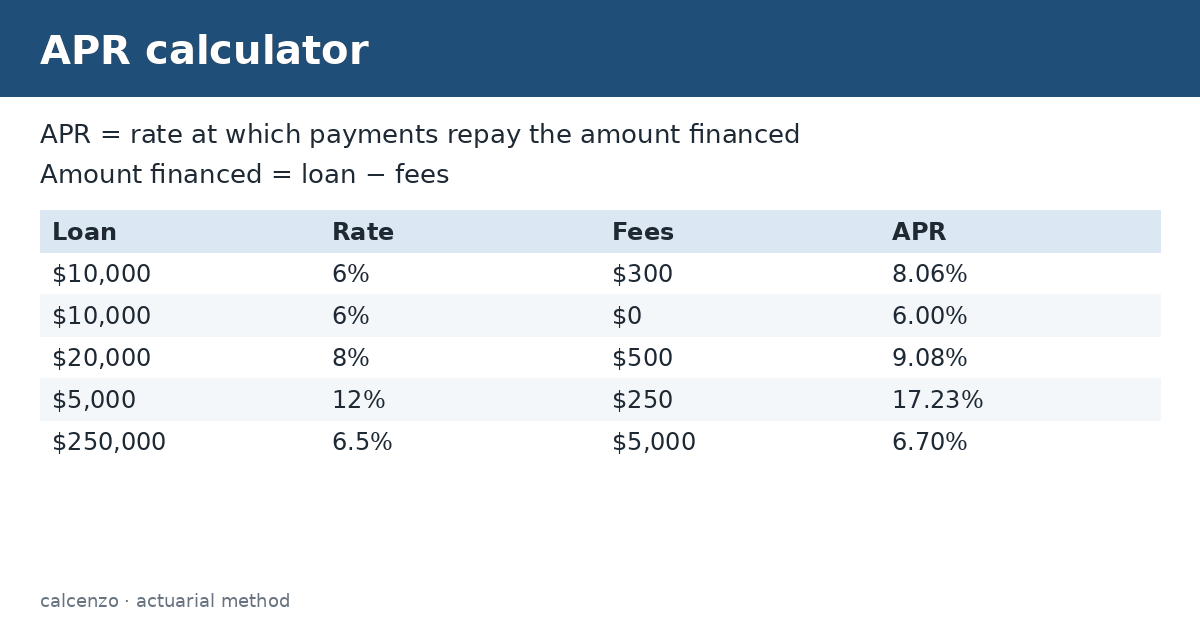
An APR calculator finds the annual percentage rate of a loan, the yearly cost of borrowing including upfront fees, so you can compare offers fairly. A $10,000 loan at 6% for 36 months with $300 of fees has an APR of about 8.06%.
On this page
How to use the APR calculator
- Enter the loan amount.
- Enter the stated interest rate.
- Enter the term in months.
- Enter fees paid to get the loan, such as origination fees.
What formula does the APR calculator use?
- Monthly payment = loan amount × r ÷ (1 − (1 + r)−n), using the stated interest rate
- Amount financed = loan amount − prepaid finance charges (fees you pay to get the loan)
- APR = 12 × the monthly rate at which the payments repay exactly the amount financed
That is the actuarial method set out in Regulation Z. Because you pay the same payment but receive less money, the APR is higher than the stated rate whenever there are finance charges.
APR calculator worked example
| Loan | Rate | Months | Fees | Payment | APR |
|---|---|---|---|---|---|
| $10,000 | 6% | 36 | $300 | $304.22 | 8.06% |
| $10,000 | 6% | 36 | $0 | $304.22 | 6.00% |
| $20,000 | 8% | 60 | $500 | $405.53 | 9.08% |
| $5,000 | 12% | 24 | $250 | $235.37 | 17.23% |
| $250,000 | 6.5% | 360 | $5,000 | $1,580.17 | 6.70% |
A $10,000 loan at 6% for 36 months has a payment of $304.22. If $300 of fees is taken from the loan, you receive $9,700 but still repay $304.22 a month, so the APR is about 8.06%. Without fees, the APR equals the 6% rate.
What APR includes
APR reflects the interest rate plus finance charges such as origination fees, discount points and some mortgage insurance. It does not include every cost: on mortgages, items like appraisal and title fees are often left out. Lenders must disclose the APR under the Truth in Lending Act, and Regulation Z treats a disclosed APR as accurate for a regular loan if it is within 1/8 of a percentage point of the exact figure.
Comparing loans with APR
APR lets you compare loans with different rate and fee combinations on one scale. A loan with a lower rate but large fees can cost more than one with a higher rate and no fees, especially if you will repay early. Fees are spread over the full term in the APR, so if you expect to sell, refinance or pay off the loan sooner, the effective cost of the fees is higher than the APR suggests. Run the APR calculator for each offer using the same loan amount and term.
APR vs APY
APR is a yearly rate that does not add the effect of compounding within the year; it is 12 times the monthly rate for a monthly loan. APY, used for savings, includes compounding. A 6% APR charged monthly is equal to about 6.17% a year once compounding is counted. Credit cards also quote APR; their interest is usually charged daily on the balance.
Estimates for education only, not financial advice. Your lender’s figures are final.
Reading a loan disclosure
For most consumer loans, the lender’s Truth in Lending disclosure shows four key figures together: the annual percentage rate, the finance charge, the amount financed and the total of payments. These are linked. The amount financed is what you actually receive after prepaid fees, the total of payments is every payment added up, and the finance charge is the difference between the two. If you enter the same loan amount, rate, term and fees into the APR calculator, its result should be close to the disclosed APR. A large gap is worth a question: it may mean a fee was added that you did not expect, the term is different or optional products such as credit insurance were included in the loan.
Keep in mind that a variable-rate loan’s APR is based on the starting rate, so the cost can change later if the index rate moves up or down over the life of the loan.
Related converters and calculators
Related calculators:
- Loan calculator: payments
- Interest rate calculator: rates
- Amortization calculator: schedules
- Merchant cash advance APR calculator: MCAs
Sources
CFPB: Regulation Z § 1026.22, determination of APR; CFPB: Loan Estimate explainer.
Questions about this calculator
What is APR?
The yearly cost of a loan including interest and certain fees, as a rate.
Why is APR higher than the interest rate?
Fees reduce the money you receive while payments stay the same.
What is the APR on $10,000 at 6% with $300 fees over 36 months?
About 8.06%.
How accurate must a lender’s APR be?
Within 1/8 of a percentage point for a regular loan under Regulation Z.
Is APR the same as APY?
No. APY includes compounding; APR does not.
Check the assumptions and units before relying on a result. Financial, tax and health estimates do not replace advice for your individual circumstances.
Report a calculation issue