
A BTU calculator estimates how much cooling capacity, in BTU per hour, a room needs from its floor area, using the ENERGY STAR sizing chart and adjustments for sun, occupants and kitchens. A 400 sq ft room with an 8 ft ceiling needs about 10,000 BTU/h.
On this page
How to use the BTU calculator
- Enter the room area in square feet (length × width).
- Enter the ceiling height.
- Choose heavily shaded, normal or very sunny.
- Enter how many people regularly use the room, and whether it is a kitchen.
- Read the adjusted BTU estimate.
What is the BTU formula?
- Base capacity = ENERGY STAR chart size for the room area (chart assumes an 8 ft ceiling)
- × (ceiling height ÷ 8) for other ceiling heights (an estimate; ENERGY STAR does not adjust for height)
- × 0.9 if heavily shaded, × 1.1 if very sunny
- + 600 BTU/h for each person beyond two who regularly uses the room
- + 4,000 BTU/h for a kitchen
A BTU (British thermal unit) is the heat needed to raise one pound of water by one degree Fahrenheit. Air conditioner capacity is rated in BTU per hour; 12,000 BTU/h equals one “ton” of cooling. The BTU calculator looks up the ENERGY STAR size for your room, then applies the adjustments ENERGY STAR recommends.
BTU calculator worked example
A 400 sq ft room with an 8 ft ceiling falls in the 400–450 sq ft row, so the base is 10,000 BTU/h. If the room is very sunny, add 10% for 11,000. If four people regularly use it, add 2 × 600 = 1,200 for 12,200. If it is also a kitchen, add 4,000 for 16,200 BTU/h. With a 10 ft ceiling and no other adjustments, the estimate rises by a quarter to 12,500.
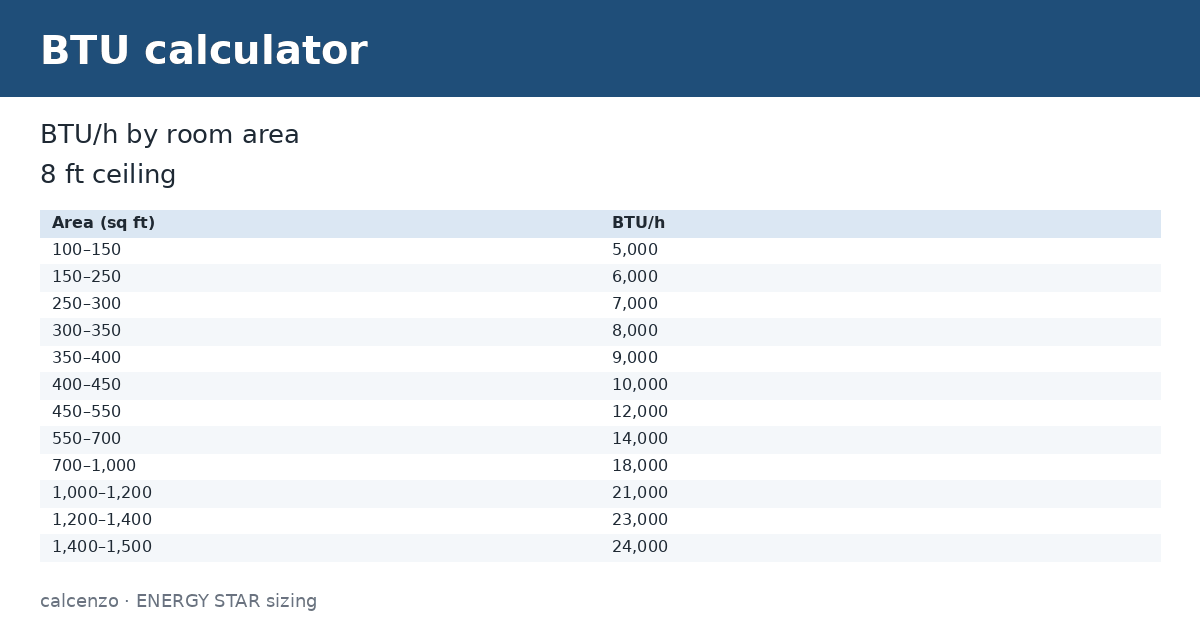
ENERGY STAR room air conditioner chart
| Area (sq ft) | Capacity (BTU/h) |
|---|---|
| 100–150 | 5,000 |
| 150–250 | 6,000 |
| 250–300 | 7,000 |
| 300–350 | 8,000 |
| 350–400 | 9,000 |
| 400–450 | 10,000 |
| 450–550 | 12,000 |
| 550–700 | 14,000 |
| 700–1,000 | 18,000 |
| 1,000–1,200 | 21,000 |
| 1,200–1,400 | 23,000 |
| 1,400–1,500 | 24,000 |
| 1,500–2,000 | 30,000 |
| 2,000–2,500 | 34,000 |
ENERGY STAR’s sizing chart, which assumes an 8 ft ceiling, gives 10,000 BTU/h for 400–450 sq ft, the base used in the example. ENERGY STAR then recommends these adjustments, which the BTU calculator applies from your answers:
- Heavily shaded room: reduce capacity by 10%.
- Very sunny room: increase capacity by 10%.
- More than two people regularly use the room: add 600 BTU/h per extra person.
- Kitchen: add 4,000 BTU/h.
Pick the unit whose rated capacity is closest to the adjusted result. Rooms of 2,500 sq ft or more are beyond the chart, and the BTU calculator asks you to use a professional load calculation instead.
Why the right size matters
An undersized unit runs constantly and still cannot reach the set temperature on hot days. An oversized unit cools the room quickly and shuts off before it removes enough moisture, leaving the air cold and clammy, and its frequent short cycles waste energy. ENERGY STAR notes that a properly sized unit is more efficient and better at dehumidifying, so choose the size closest to your adjusted estimate rather than simply buying the biggest model.
Using the result for heating
Heaters are rated in BTU per hour too, and the same room-size logic gives a rough starting point. A 1,500-watt electric heater produces about 5,118 BTU/h (1 watt = 3.412 BTU/h). For whole-home furnaces, heat pumps and central air, contractors use a Manual J load calculation, which accounts for insulation, windows, air leakage and local design temperatures; a BTU calculator is not a substitute for that.
Running cost and efficiency
Once you know the size, efficiency decides the running cost. Room air conditioners are rated by their Combined Energy Efficiency Ratio (CEER): the cooling output in BTU per hour divided by the power the unit uses, in watts, averaged over operating and standby modes. A higher CEER means lower bills for the same cooling. A 10,000 BTU/h unit with a CEER of 12 draws roughly 830 watts while running. Over 8 hours a day for 90 summer days that is about 600 kWh; at 17 cents per kWh it costs roughly $102 a season. Plugging your local rate into an electricity calculator gives a closer figure.
Simple steps cut the load the unit has to handle: close blinds on sunny windows, seal gaps around the window kit, and run fans to spread cool air. If you are between two sizes on the BTU calculator, these steps can let the smaller, cheaper and more efficient unit do the job. Place the unit away from lamps and televisions, whose heat can make the thermostat run it longer than needed, and clean the filter every two weeks during heavy use.
Related converters and calculators
Related calculators:
- Square footage calculator: room area
- Area calculator: area
- Electricity calculator: running cost
- Unit converter: units
Sources
ENERGY STAR: Room air conditioner sizing.
Questions about this calculator
How many BTU do I need for 400 sq ft?
About 10,000 BTU/h for an 8 ft ceiling, per ENERGY STAR.
How many BTU is one ton?
12,000 BTU per hour.
Is a bigger air conditioner better?
No. Oversized units short-cycle and remove less humidity.
How much should I add for a kitchen?
4,000 BTU/h, per ENERGY STAR.
How many BTU is 1,500 watts?
About 5,118 BTU per hour.
Check the assumptions and units before relying on a result. Financial, tax and health estimates do not replace advice for your individual circumstances.
Report a calculation issue