
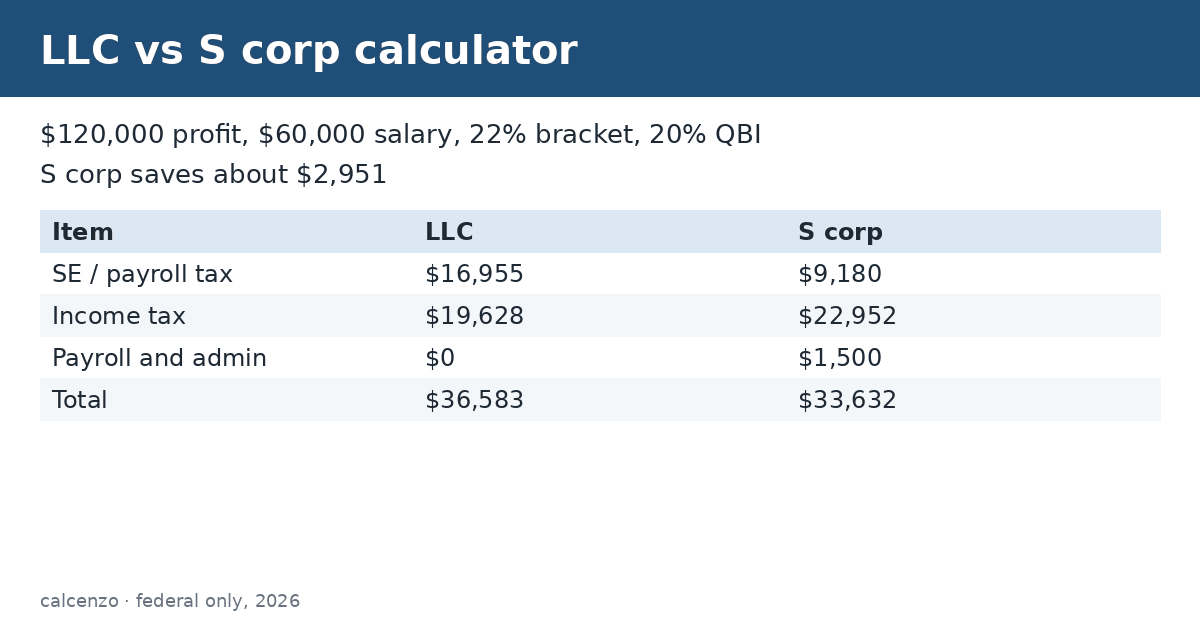
An LLC vs S corp calculator compares the tax on business profit as a sole proprietorship LLC with the tax after electing S corporation status. The LLC vs S corp calculator uses this formula: Headline = LLC total tax sketch − S-Corp total tax sketch (including admin). Uses SE tax on 92.35% of profit vs FICA on salary, simplified 20% QBI, flat marginal rate. With $120,000 profit, a $60,000 salary and a 22% bracket, the S corporation saves about $2,951 a year after $1,500 of extra admin costs.
On this page
How to use the LLC vs S corp calculator
- Enter expected net profit.
- Enter a reasonable salary you would pay yourself.
- Choose your marginal federal tax bracket.
- Choose whether the QBI deduction applies.
- Enter extra S corp costs such as payroll service and tax return fees.
What formula does the LLC vs S corp calculator use?
LLC taxed as a sole proprietorship:
- Self-employment tax = 92.35% of profit × 15.3% (12.4% Social Security up to $184,500 for 2026, plus 2.9% Medicare)
- Half of SE tax is deducted; a 20% qualified business income (QBI) deduction is applied to the rest
- Income tax = remaining profit × your marginal bracket
LLC taxed as an S corporation:
- Payroll tax = 15.3% of your salary (employer and employee halves)
- Distribution = profit − salary − the employer half of payroll tax, which is a business expense
- Income tax = (salary + distribution − 20% QBI on the distribution) × bracket
- Plus the cost of payroll, a separate return and bookkeeping
LLC vs S corp calculator worked example
| Item | LLC (sole prop) | S corp |
|---|---|---|
| Self-employment / payroll tax | $16,955 | $9,180 |
| Income tax (22%, after 20% QBI) | $19,628 | $22,952 |
| Payroll and admin | $0 | $1,500 |
| Total | $36,583 | $33,632 |
With $120,000 profit, a $60,000 salary, a 22% bracket and $1,500 of extra admin, the S corporation saves about $2,951 a year. The saving comes from paying FICA only on the salary instead of SE tax on almost all the profit.
S corp savings by profit level
| Profit | Salary | Estimated saving |
|---|---|---|
| $60,000 | $40,000 | $-1,110 |
| $80,000 | $45,000 | $550 |
| $120,000 | $60,000 | $2,951 |
| $150,000 | $70,000 | $4,982 |
| $200,000 | $90,000 | $7,731 |
At low profits the admin cost and the salary needed can wipe out the saving, which is why S corp status usually only pays off once profit is comfortably above a reasonable salary.
Reasonable salary rules
The IRS requires S corporation shareholders who work in the business to be paid reasonable compensation as wages before taking distributions. Paying yourself an unrealistically low salary to avoid payroll tax can be challenged, with the distributions reclassified as wages. A reasonable figure reflects what you would pay someone else to do the job; the IRS lists factors such as training, duties and time spent.
How to elect S corp status
An eligible LLC or corporation files Form 2553 with the IRS. The business then files Form 1120-S each year and gives each owner a Schedule K-1, and it must run payroll for owner wages. Check your state too: some states tax S corporations or charge extra fees. Run the LLC vs S corp calculator again each year, as profit and the wage base change.
What this estimate leaves out
- State income and franchise taxes
- QBI limits for higher incomes and specified service businesses; QBI is simplified at 20%
- Retirement contributions, which depend on salary in an S corp
- Health insurance rules for more-than-2% shareholders
Estimates for education only, not legal, tax or financial advice. Rules vary by state and change over time; check with the official agency or a licensed professional.
When to review your choice
The best tax treatment can change as your business grows. Revisit the comparison when profit changes a lot, when you add owners or employees, or when tax rules change. Some owners start as a sole proprietorship LLC and elect S corp status once profit is high enough to cover the extra costs. If you elect, run payroll from the start of the year and keep salary records that support your figure as reasonable. Re-run the LLC vs S corp calculator with each year’s figures, since the LLC vs S corp calculator result can change from year to year, and ask a tax professional to check the result before you file Form 2553.
Related converters and calculators
Related calculators:
- Quarterly estimated tax calculator: estimated tax
- Income tax calculator: income tax
- Employee cost calculator: payroll cost
Sources
IRS: S corporation compensation; IRS: Self-employment tax; IRS: About Form 2553; IRS: Qualified business income deduction; SSA: Contribution and benefit base.
Questions about this calculator
When does an S corp save tax?
When profit is well above a reasonable salary, so FICA is avoided on the distributions.
What is the SE tax rate?
15.3% on 92.35% of profit, with Social Security capped at $184,500 for 2026.
Do I have to pay myself a salary?
Yes. The IRS requires reasonable compensation for shareholder-employees.
How do I elect S corp status?
File Form 2553 with the IRS.
Are state taxes included?
No. Some states tax S corporations separately.
Check the assumptions and units before relying on a result. Financial, tax and health estimates do not replace advice for your individual circumstances.
Report a calculation issue