
A refinance calculator compares your current loan payment with a new loan and shows how many months the saving takes to cover closing costs. Moving $280,000 from 7% to 5.5% saves about $366 a month in the default example.
On this page
How to use the refinance calculator
- Enter the remaining balance, current rate and months left.
- Enter the new rate and new term in months.
- Enter closing costs.
- Read the new payment, saving, breakeven and lifetime result.
How the refinance calculator works
The refinance calculator compares the monthly payment on your current loan with the payment on a new one. You enter the remaining balance, the current rate and remaining months, the new rate and new term, and closing costs. Closing costs are treated as paid at closing and counted once. The tool then shows:
- current payment and new payment, using the standard amortization formula on the same balance;
- monthly saving = current payment − new payment;
- breakeven months = closing costs ÷ monthly saving, rounded up;
- lifetime result = (current payment × months left) − (new payment × new term + closing costs).
Refinance calculator worked example
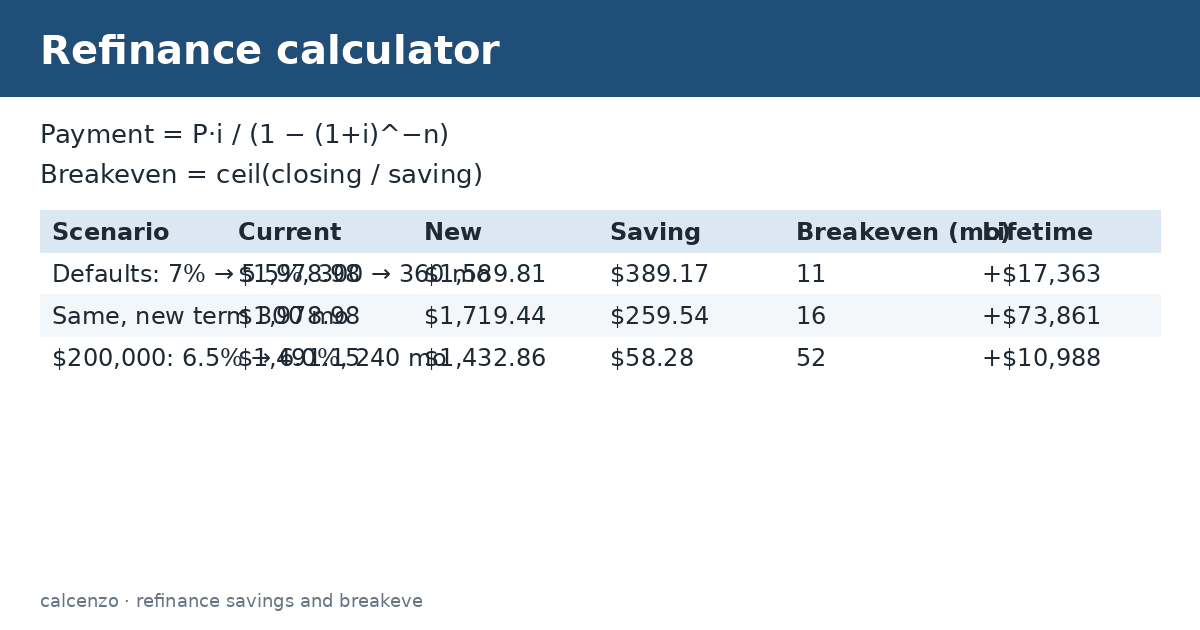
You owe $280,000 at 7% with 300 months left, a payment of $1,978.98. A new 30-year loan at 5.5% with $4,000 of closing costs comes to $1,589.81 a month. The refinance calculator shows a saving of $389.17 a month and a breakeven of 11 months. Over the full life of both loans it still saves about $17,363, but the new loan runs 60 months longer. If you keep the new term at 300 months, the payment is $1,719.44, the saving is $259.54, breakeven is 16 months and the lifetime saving rises to about $73,861.
| Scenario | Current | New | Saving | Breakeven (mo) | Lifetime |
|---|---|---|---|---|---|
| Defaults: 7% → 5.5%, 300 → 360 mo | $1,978.98 | $1,589.81 | $389.17 | 11 | +$17,363 |
| Same, new term 300 mo | $1,978.98 | $1,719.44 | $259.54 | 16 | +$73,861 |
| $200,000: 6.5% → 6.0%, 240 mo | $1,491.15 | $1,432.86 | $58.28 | 52 | +$10,988 |
How to read the results
A longer new term lowers the payment partly by stretching the loan, not by saving money. That is why the tool shows the interest left on the current loan, the interest on the new loan and a lifetime result that adds closing costs to the new side. In the default case the monthly saving is $389.17, but the lifetime saving is only about $17,363 because of the 60 extra months; matching the old term raises it to about $73,861. If the lifetime line says the refinance costs more, the lower payment comes only from the longer term. If you roll closing costs into the loan instead of paying them, add them to the balance and enter 0 for closing costs.
When refinancing can make sense
The Federal Reserve’s consumer guide suggests weighing how long you plan to stay in the home against the time it takes to recover the costs. If you expect to move before the breakeven month, refinancing usually costs more than it saves. Other reasons to refinance include switching from an adjustable rate to a fixed rate, shortening the term to pay off sooner, or removing mortgage insurance.
Closing costs
Refinance costs often include an application fee, appraisal, title search and insurance, origination charges and points. They commonly total a few percent of the loan. Ask lenders for a Loan Estimate, a standard form that makes offers easy to compare. A “no-closing-cost” loan usually builds the cost into a higher rate.
Cash-out and other cases
The refinance calculator models a rate-and-term refinance. For a cash-out refinance, add the cash you take to the balance, but remember you are borrowing more. It does not include taxes, insurance or mortgage insurance in the payment.
When the saving is small
A $200,000 balance at 6.5% over 240 months costs $1,491.15 a month. Moving to 6.0% for the same 240 months with $3,000 of closing costs gives $1,432.86, a saving of $58.28. Breakeven is 52 months, more than four years, and the lifetime saving is about $10,988. Unless you plan to stay that long, a small rate drop like this rarely pays. A common rule of thumb looks for a drop of at least about one percentage point, but your costs and plans matter more than any rule.
Tips
- Use the remaining balance and months from your latest statement.
- Run the refinance calculator with the same term as your current loan for a fair comparison.
- Compare at least three lender quotes.
- Check for prepayment penalties on the current loan.
Estimates for education only, not financial advice. Your lender’s figures are final.
Related converters and calculators
Related calculators:
- Mortgage calculator: payments
- Amortization calculator: schedule
- Mortgage payoff calculator: pay off early
- HELOC calculator: home equity line
Sources
Federal Reserve: A consumer’s guide to mortgage refinancings; CFPB: Buying a house.
Formula and method
Pays closing in cash. New pay = PMT(principal, new_rate, new_months). Savings = old - new. Breakeven = ceil(closing/savings). Lifetime = old pay*old months - (new pay*new months + closing).
Standard amortizing refinance sketch with closing rolled into the new balance.
Questions about this calculator
How is breakeven calculated?
Closing costs divided by the monthly saving, rounded up.
Are closing costs added to the loan?
No. They are treated as paid at closing and counted once in breakeven and lifetime cost.
Does a lower payment mean I save money?
Not always; check the lifetime result, which covers each loan’s full term.
Does it include taxes and insurance?
No, principal and interest only.
When is refinancing worth it?
Usually when you stay past the breakeven month.
Check the assumptions and units before relying on a result. Financial, tax and health estimates do not replace advice for your individual circumstances.
Report a calculation issue