
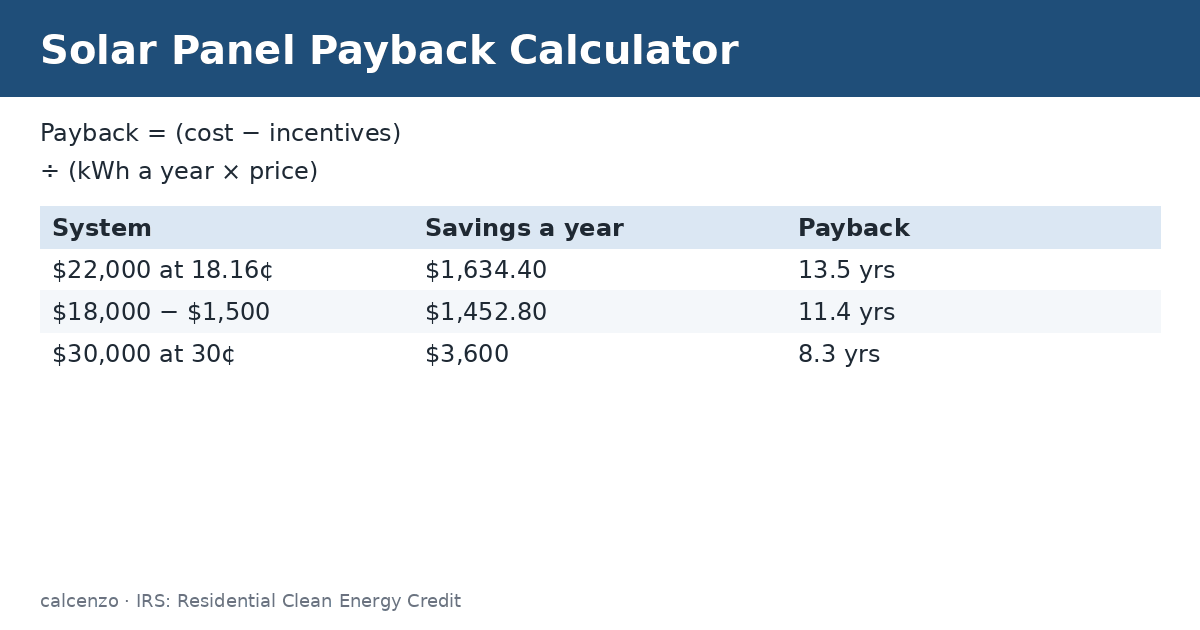
A solar panel payback calculator divides the net cost of a solar system by the money it saves each year to estimate the years to break even. Formula: Payback years = (system cost − incentives) ÷ (yearly kWh × electricity price). A $22,000 system making 9,000 kWh a year at the August 2026 U.S. average residential price of 18.16 cents saves $1,634.40 a year and pays back in about 13.5 years.
On this page
How to use the solar panel payback calculator
- Enter the full installed price from your quote.
- Enter state, utility or local incentives you are sure to receive.
- Enter the yearly production the installer estimates, in kWh.
- Enter your electricity price per kWh. Divide your bill total by the kWh used, so fees are included.
The solar panel payback calculator shows the net cost, the yearly savings and the simple payback.
What formula does the solar panel payback calculator use?
Net cost is the price minus incentives. Yearly savings is production times your price. Simple payback is net cost divided by yearly savings. It assumes you use or are fully credited for every kWh, and that prices and output stay flat.
In practice panels lose a little output each year, prices tend to change, and exported power may be credited at less than retail.
Solar panel payback calculator worked example
Results from the solar panel payback calculator:
| System | Incentives | kWh a year | Price | Yearly savings | Payback |
|---|---|---|---|---|---|
| $22,000 | $0 | 9,000 | $0.1816 | $1,634.40 | 13.5 years |
| $18,000 | $1,500 | 8,000 | $0.1816 | $1,452.80 | 11.4 years |
| $30,000 | $0 | 12,000 | $0.30 | $3,600.00 | 8.3 years |
| $22,000 | $0 | 9,000 | $0.16 | $1,440.00 | 15.3 years |
Price per kWh is the biggest lever. The same $22,000 system pays back in 15.3 years at 16 cents and 13.5 years at 18.16 cents. In high-price states, payback is shorter.
The federal tax credit ended after 2025
The IRS says the Residential Clean Energy Credit was 30% of the cost of qualified property installed from 2022 through December 31, 2025, and is not available for property placed in service after that date. For a system installed in 2026, enter $0 for the federal credit, and only count state, utility or local incentives you can confirm. Older articles that subtract 30% will show a shorter payback than you will get.
Finding your electricity price
The EIA publishes average residential prices each month. In August 2026 the U.S. average was 18.16 cents per kWh, up from 17.57 cents a year earlier, and state averages vary widely. Your own bill is the best number. Our electricity calculator helps you check your use.
The Department of Energy’s homeowner guide explains that net metering depends on your state and utility, so ask your utility how exported power is credited.
Getting a better estimate
Ask each installer for the full price, the system size in kW, the expected first-year production in kWh, and how that estimate was made. Check whether the quote includes permits, an electrical panel upgrade, and monitoring. Then run the solar panel payback calculator for every quote with the same electricity price. The quote with the lowest price is not always the fastest payback, because a larger or better-placed system can make more power.
If you are comparing a cash purchase with a loan, lease or power purchase agreement, remember that a lease or agreement means the solar company owns the system, so payback works differently.
Common mistakes to avoid
A common mistake is using an expired federal credit. Another is using a production estimate for a roof facing the wrong way or shaded by trees. A third is ignoring loan interest; if you finance, add the interest to the cost before you run the solar panel payback calculator.
Estimates for planning only. Prices, codes and site conditions vary; get a written quote and check local building rules before you buy materials.
Related converters and calculators
Related calculators:
- Electricity calculator: your power use
- ROI calculator: return on the system
- Home equity loan calculator: finance the panels
Sources
IRS: Residential Clean Energy Credit; EIA: Average price of electricity by state (Electric Power Monthly Table 5.6.A); U.S. Department of Energy: Homeowner’s Guide to Solar.
Questions about this calculator
How long does it take solar panels to pay for themselves?
Divide net cost by yearly savings. A $22,000 system saving $1,634.40 a year pays back in about 13.5 years.
Is there a federal solar tax credit in 2026?
The IRS says the Residential Clean Energy Credit does not apply to property placed in service after December 31, 2025.
What electricity price should I use?
Your own bill total divided by kWh. The U.S. residential average was 18.16 cents in August 2026, per EIA.
Does the calculator include panel degradation?
No. It is a simple payback with flat output and prices.
Does net metering change payback?
Yes. If exported power earns less than retail, savings fall and payback gets longer.
Check the assumptions and units before relying on a result. Financial, tax and health estimates do not replace advice for your individual circumstances.
Report a calculation issue