
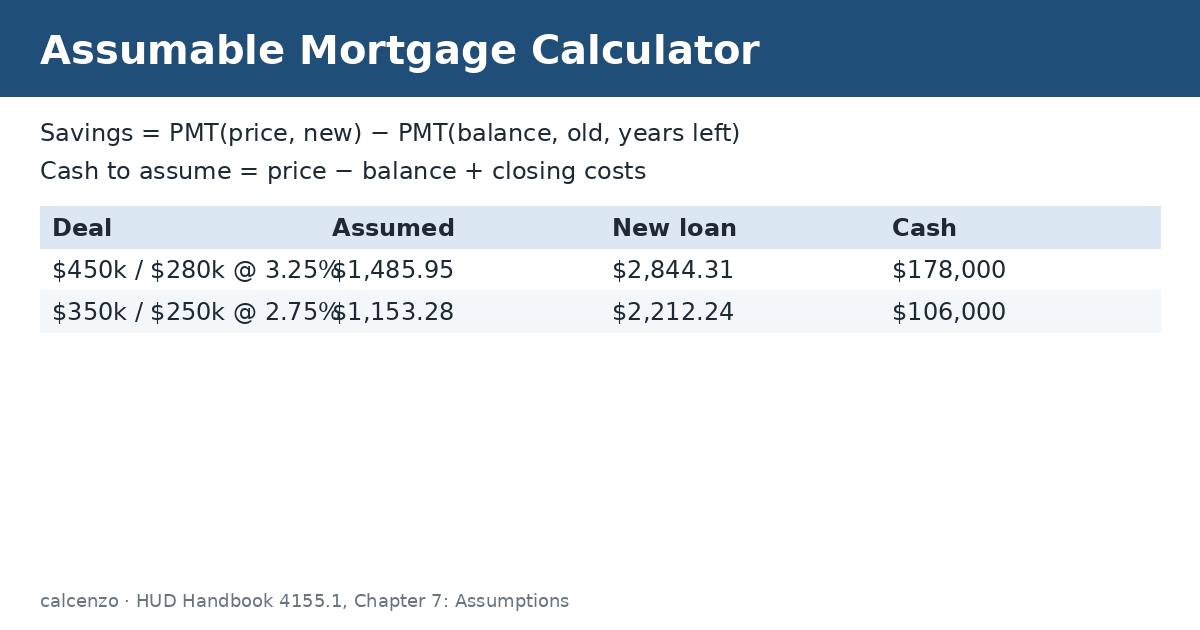
An assumable mortgage calculator compares taking over a seller’s existing low-rate loan with getting a new mortgage for the whole price. Formula: Monthly savings = PMT(price, new rate, new term) − PMT(balance, old rate, years left); cash to assume = price − balance + closing costs. Buying a $450,000 home and assuming $280,000 at 3.25% with 22 years left costs $1,485.95 a month, versus $2,844.31 on a new 30-year loan at 6.5%; you would need $178,000 in cash.
On this page
How to use the assumable mortgage calculator
- Enter the purchase price and the seller’s current loan balance.
- Enter the rate on that loan and the years left on it.
- Enter the rate and term you could get on a new loan today.
- Add the cash closing costs you expect for the assumption.
The assumable mortgage calculator shows both payments, the monthly difference and the cash you need at closing.
What formula does the assumable mortgage calculator use?
- Assumed payment: the standard amortizing payment on the current balance, at the old rate, over the years left.
- New payment: the same formula on the full price, at the new rate and term.
- Cash to assume: price minus balance (the equity gap), plus the closing costs you enter.
The new-loan side assumes no down payment so the comparison is simple. If you would put money down on a new loan, the real gap in monthly payments is smaller.
Assumable mortgage calculator worked example
Results from the assumable mortgage calculator, both compared with a new 30-year loan at 6.5%:
| Deal | Assumed payment | New loan payment | Monthly savings | Cash to assume |
|---|---|---|---|---|
| $450,000 price, $280,000 at 3.25%, 22 years left, $8,000 costs | $1,485.95 | $2,844.31 | $1,358.35 | $178,000 |
| $350,000 price, $250,000 at 2.75%, 25 years left, $6,000 costs | $1,153.28 | $2,212.24 | $1,058.96 | $106,000 |
The savings look large, but the equity gap is the catch. Few buyers have $170,000 in cash, and a second loan to cover the gap brings its own payment, usually at a higher rate.
Which loans can be assumed?
Government-backed loans are the main source of assumable mortgages. HUD says all FHA-insured mortgages are assumable, and loans closed on or after December 15, 1989 require a credit review of the person assuming. VA rules require that the loan is current, that the buyer takes on full liability and that the buyer is creditworthy under VA standards. USDA guaranteed loans need Rural Development approval, and the buyer must meet program eligibility. Most conventional loans have a due-on-sale clause and cannot be assumed by a buyer.
Ways to cover the equity gap
Buyers usually close the gap in one of three ways. The first is cash from savings or the sale of another home. The second is a second mortgage or home equity loan taken at the same time, which must be allowed by the servicer and the program. The third is negotiating the price so the gap shrinks. Whatever you choose, add the second loan’s payment to the assumed payment before comparing it with a brand-new mortgage, because that combined number is what you will actually pay each month.
Also check that the remaining term suits you. A loan with 22 years left has a higher payment per dollar than a fresh 30-year loan, but it builds equity faster and ends sooner.
Release of liability and VA entitlement
A seller should ask for a release of liability so they are not on the hook if the buyer stops paying. With a VA loan, the seller’s entitlement stays tied up unless an eligible veteran buyer substitutes their own entitlement, which matters if the seller wants another VA loan soon. USDA rules state the transferor remains personally liable after an assumption.
Timeline and costs to expect
VA asks servicers with automatic authority to decide a complete assumption package within 45 calendar days. In practice, assumptions can take longer than a normal purchase loan, so build that into the contract. Enter realistic fees in the assumable mortgage calculator, including any assumption fee, title costs and the cost of a second loan if you need one.
Estimates for education only, not tax, legal or financial advice. Check current rules with the tax authority or a qualified adviser.
Related converters and calculators
Related calculators:
- Mortgage calculator: new loan payment
- FHA loan calculator: FHA payment
- VA mortgage calculator: VA payment
Sources
HUD Handbook 4155.1, Chapter 7: Assumptions; VA Circular 26-23-10: VA assumption updates; eCFR: 7 CFR 3555.256, Transfer and assumptions.
Questions about this calculator
Can any mortgage be assumed?
No. FHA, VA and USDA loans can usually be assumed with approval; most conventional loans have a due-on-sale clause.
What is the equity gap?
The difference between the price and the loan balance you take over. You pay it in cash or with a second loan.
Do I need to qualify to assume an FHA loan?
Yes, for FHA loans closed on or after December 15, 1989, the person assuming must pass a credit review.
Does the seller stay liable?
Unless the lender or agency grants a release of liability, the seller can remain liable. USDA rules keep the seller personally liable.
How long does a VA assumption take?
VA asks servicers with automatic authority to decide a complete package within 45 calendar days.
Check the assumptions and units before relying on a result. Financial, tax and health estimates do not replace advice for your individual circumstances.
Report a calculation issue