
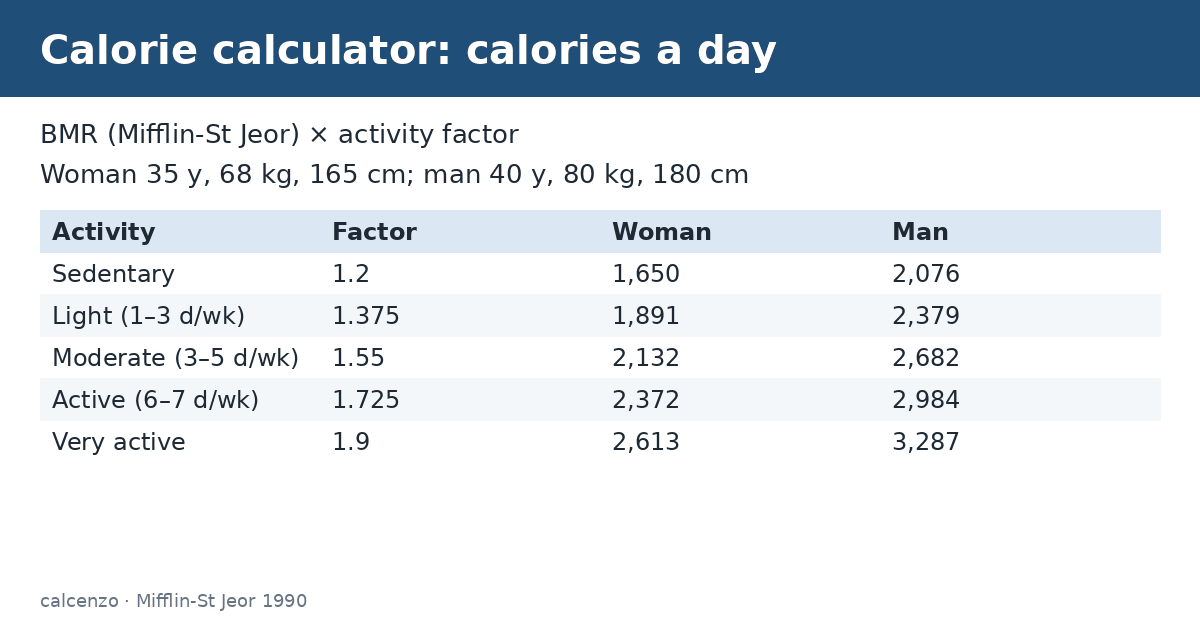
This calorie calculator estimates how many calories you need a day to keep your current weight: resting needs from the Mifflin-St Jeor equation, multiplied by an activity factor from 1.2 to 1.9. Example: a 35-year-old woman who is 165 cm tall, weighs 68 kg and is moderately active needs about 2,132 calories a day.
It answers “how many calories should I eat?” for planning; it is not a medical prescription.
On this page
How to use the calorie calculator
- Choose your sex and enter your age.
- Enter your weight in kilograms and height in centimeters (1 lb = 0.4536 kg; 1 in = 2.54 cm).
- Pick the activity level that matches a typical week.
- Read your maintenance calories. Eat less to lose weight or more to gain.
The equation was developed for adults, so the calorie calculator is less reliable for teenagers.
Formula: Mifflin-St Jeor times activity
Step 1: basal metabolic rate (BMR)
- Men: BMR = 10 × weight (kg) + 6.25 × height (cm) − 5 × age + 5
- Women: BMR = 10 × weight (kg) + 6.25 × height (cm) − 5 × age − 161
Step 2: multiply by your activity level
| Activity level | Description | Factor |
|---|---|---|
| Sedentary | Little or no exercise | 1.2 |
| Light | Exercise 1 to 3 days a week | 1.375 |
| Moderate | Exercise 3 to 5 days a week | 1.55 |
| Active | Exercise 6 to 7 days a week | 1.725 |
| Very active | Intense exercise daily or a physical job | 1.9 |
The result is often called total daily energy expenditure (TDEE). The Mifflin-St Jeor equation was published in 1990 and is widely used by dietitians because it predicts resting needs more accurately than older equations for most adults.
Calorie calculator worked example
Woman, 35 years, 68 kg (150 lb), 165 cm (5 ft 5 in):
- BMR = 10 × 68 + 6.25 × 165 − 5 × 35 − 161 = 680 + 1,031.25 − 175 − 161 = 1,375 calories
- Daily needs at each activity level:
| Activity | Maintenance calories |
|---|---|
| Sedentary (1.2) | 1,650 |
| Light (1.375) | 1,891 |
| Moderate (1.55) | 2,132 |
| Active (1.725) | 2,372 |
| Very active (1.9) | 2,613 |
A 40-year-old man at 80 kg and 180 cm has a BMR of 1,730 calories and needs about 2,682 calories a day at a moderate activity level.
Calories to lose or gain weight
A deficit of about 500 calories a day is a common starting point for gradual weight loss of roughly 0.5 kg (1 lb) a week, although real results vary because the body adapts. For gain, a smaller surplus of a few hundred calories a day limits fat gain.
| Goal | Daily target (example woman, moderate) |
|---|---|
| Maintain | 2,132 |
| Lose gradually (−500) | 1,632 |
| Gain gradually (+300) | 2,432 |
Avoid very low intakes without medical supervision. The Dietary Guidelines for Americans estimate that most adult women need about 1,600 to 2,400 calories a day and most adult men about 2,000 to 3,000, depending on age and activity.
Harvard Health advises that, unless a health professional is supervising you, daily intake should not fall below about 1,200 calories for women or 1,500 for men. To lose about 2 pounds a week you would need a deficit near 1,000 calories a day, which is only realistic for people with a high maintenance number.
Accuracy and limits
- Any equation is an estimate. Individual needs can differ by 10% or more.
- Very muscular people may need more than predicted; people with obesity may need less.
- The equation is not designed for pregnancy, breastfeeding, children or medical conditions that change metabolism.
- Track your weight for two to four weeks and adjust the target based on what actually happens.
Checking the estimate against real results
Any calorie calculator gives a starting point, not a measured value, and the best calorie calculator result is one you have checked against your scale. Equations like Mifflin-St Jeor are accurate to within about 10% for most adults, and activity factors add more uncertainty. The practical fix is to test the number. Eat close to the target for two or three weeks, weigh yourself several times a week under the same conditions, and look at the trend rather than single days. If your weight is steady, the estimate is about right for maintenance, and the calorie calculator has done its job. If you are losing about half a kilogram a week while eating at the estimate, your true maintenance is roughly 500 kcal higher. Adjust the calorie calculator target by 100 to 200 kcal at a time and retest.
Related converters and calculators
Related tools and guides:
- BMR calculator: resting calories
- TDEE calculator: total daily energy
- Macro calculator: protein, fat, carbs
- BMI calculator: weight category
- Calories burned calculator: exercise
Sources
Mifflin MD, St Jeor ST, et al. Am J Clin Nutr 1990;51(2):241–247 (PubMed, NIH); Dietary Guidelines for Americans, estimated calorie needs; NIH NIDDK: Body Weight Planner.
Questions about this calculator
How many calories should I eat a day?
Roughly your BMR times your activity factor. The Dietary Guidelines estimate most adult women need about 1,600 to 2,400 and most adult men about 2,000 to 3,000.
How many calories should I eat to lose weight?
A deficit of about 500 calories below maintenance is a common starting point for losing roughly 1 lb a week. Adjust based on results.
What equation does this calorie calculator use?
The Mifflin-St Jeor equation for resting needs, multiplied by an activity factor from 1.2 to 1.9.
How accurate are calorie calculators?
They are estimates. Track your weight for a few weeks and adjust.
Is the calorie calculator suitable during pregnancy?
No. Pregnancy and breastfeeding change calorie needs; ask your doctor or a registered dietitian.
Check the assumptions and units before relying on a result. Financial, tax and health estimates do not replace advice for your individual circumstances.
Report a calculation issue