
A TDEE calculator estimates your total daily energy expenditure, the calories you burn in a day including activity. Formula: Male BMR = 10w + 6.25h – 5a + 5. Female BMR = 10w + 6.25h – 5a – 161. TDEE = BMR x activity. A 30-year-old man at 70 kg and 175 cm who exercises moderately burns about 2,556 kcal a day.
On this page
How to use the tdee calculator
- Enter weight in kg, height in cm and age.
- Choose your sex and activity level.
- Read your BMR and TDEE in kcal per day.
How the TDEE calculator works
The TDEE calculator estimates total daily energy expenditure in two steps. First it finds your basal metabolic rate (BMR) with the Mifflin-St Jeor equation, then it multiplies BMR by an activity factor. For men, BMR = 10 × weight in kg + 6.25 × height in cm − 5 × age + 5. For women the last term is −161 instead of +5. The result is rounded to whole kilocalories.
Activity factors used
- Sedentary, desk work and little exercise: 1.2
- Light, exercise one to three days a week: 1.375
- Moderate, exercise three to five days a week: 1.55 (the default)
- Active, hard exercise six or seven days a week: 1.725
- Very active, physical job plus training: 1.9
Most people overrate their activity. If you are unsure between two levels, pick the lower one and adjust after two or three weeks of tracking your weight.
TDEE calculator worked example
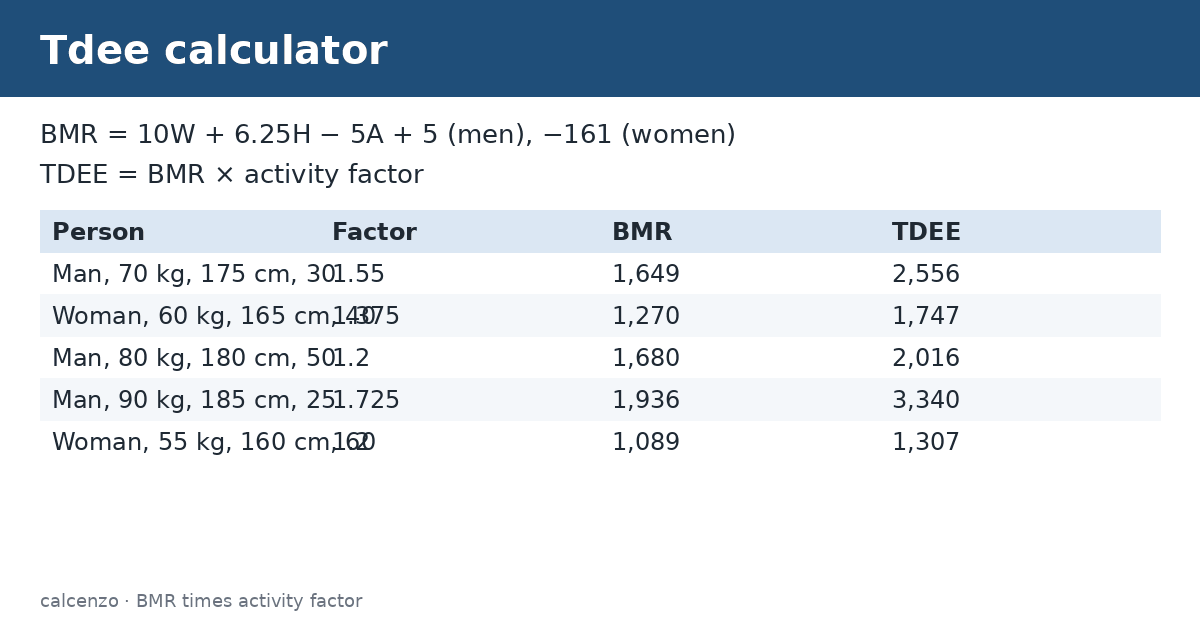
A 30-year-old man who weighs 70 kg and is 175 cm tall has a BMR of 700 + 1,093.75 − 150 + 5 = 1,649 kcal. At the moderate factor of 1.55, the TDEE calculator gives about 2,556 kcal a day. The table shows other examples.
| Person | Factor | BMR | TDEE |
|---|---|---|---|
| Man, 70 kg, 175 cm, 30 | 1.55 | 1,649 | 2,556 |
| Woman, 60 kg, 165 cm, 40 | 1.375 | 1,270 | 1,747 |
| Man, 80 kg, 180 cm, 50 | 1.2 | 1,680 | 2,016 |
| Man, 90 kg, 185 cm, 25 | 1.725 | 1,936 | 3,340 |
| Woman, 55 kg, 160 cm, 60 | 1.2 | 1,089 | 1,307 |
Using your TDEE
TDEE is an estimate of the calories that keep your weight steady. Eating a little less leads to slow weight loss, and eating a little more supports weight gain. A deficit of about 500 kcal a day is a common starting point for gradual loss, but the right amount depends on your size, health and goals. Very low intakes are hard to sustain and can leave you short of protein, vitamins and minerals.
How accurate is it?
Mifflin-St Jeor was developed from measured resting energy expenditure in healthy adults and is one of the more accurate prediction equations, but individual results can still differ by 10% or more. Muscle mass, genetics, medicines, illness, pregnancy and hormonal changes all shift energy needs. The TDEE calculator is a starting point, not a measurement. Track your weight for a few weeks and adjust intake by 100 to 200 kcal if the trend does not match your plan.
Entering your details
Enter weight in kilograms and height in centimeters. To convert, 1 lb is 0.4536 kg and 1 inch is 2.54 cm. Weight and height must be greater than zero. The equation was built for adults, so results for children and teenagers are not reliable; growing children need far more energy per kilogram than the formula suggests.
BMR versus TDEE
BMR is the energy your body uses at complete rest to keep organs working, breathe and maintain temperature. It is usually the largest part of daily needs, often 60% to 70%. The rest comes from digesting food and from movement, both planned exercise and everyday activity such as walking, standing and fidgeting. The TDEE calculator folds all of that movement into one activity factor, which is why choosing the factor honestly matters more than small changes in weight or height.
Everyday movement varies a lot between people with similar jobs and workouts. Someone who walks 10,000 steps a day can burn several hundred more kilocalories than a colleague who drives everywhere, even if both train three times a week. If your step count is high, the next factor up may fit better.
Tips
- Weigh yourself at the same time each morning and look at weekly averages.
- Recalculate after every 5 kg change in weight.
- Count exercise through the activity factor, not by adding it again.
- Pair the result with enough protein and fiber.
For general information only, not medical advice. Your midwife, doctor or other clinician should confirm dates and care decisions.
Related converters and calculators
Related calculators:
- BMR calculator: resting needs
- Calorie calculator: goals
- Macro calculator: protein, carbs, fat
- Protein calculator: protein
Sources
Formula and method
TDEE = BMR × activity factor. Men: BMR = 10w + 6.25h − 5a + 5. Women: BMR = 10w + 6.25h − 5a − 161. Factors: 1.2, 1.375, 1.55, 1.725, 1.9.
Mifflin-St Jeor resting estimate times selected activity multiplier. Not medical advice.
Questions about this calculator
What is TDEE?
Total daily energy expenditure: BMR times an activity factor.
Which BMR formula is used?
Mifflin-St Jeor.
What activity factor should I pick?
The lowest that honestly fits; 1.2 for desk work with little exercise.
How accurate is it?
Within about 10% for many adults; track and adjust.
Is it for children?
No, it is designed for adults.
Check the assumptions and units before relying on a result. Financial, tax and health estimates do not replace advice for your individual circumstances.
Report a calculation issue