
A protein calculator estimates how many grams of protein to eat each day from your body weight and a grams-per-kilogram target. Formula: daily protein (g) = weight kg x g per kg; headline rounds to a whole gram. A 70 kg adult at 1.6 g/kg needs about 112 g a day.
On this page
How to use the protein calculator
- Enter your weight in kilograms.
- Enter a target in grams per kilogram, such as 0.8 or 1.6.
- Read your daily protein in grams.
How the protein calculator works
The protein calculator multiplies body weight in kilograms by a target in grams of protein per kilogram:
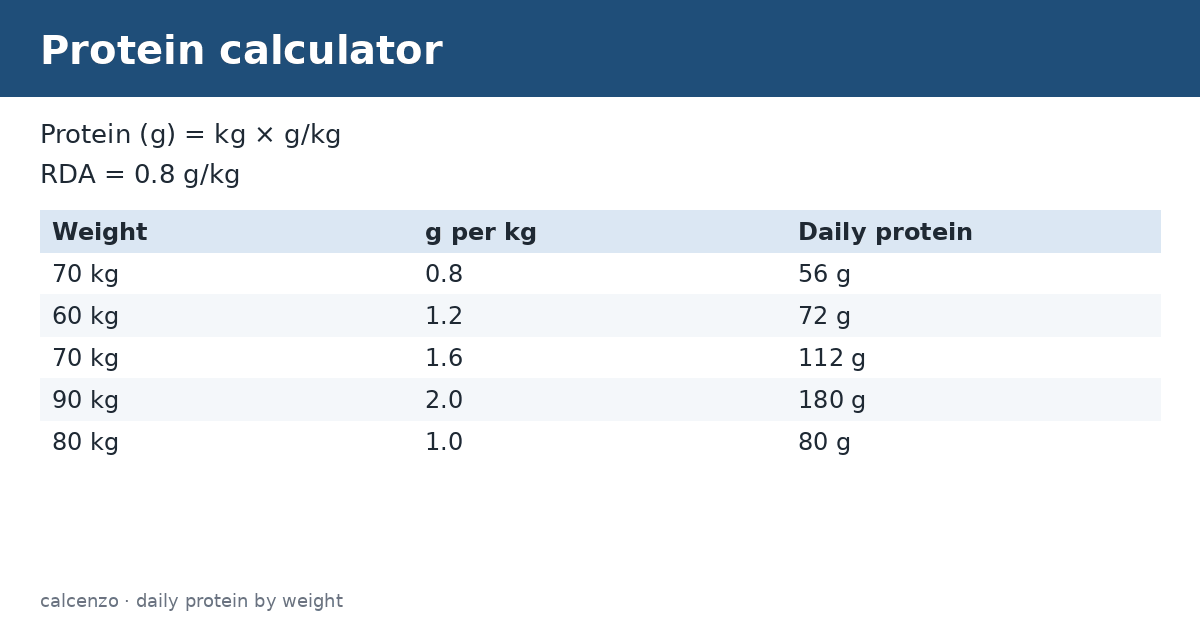
- Daily protein (g) = weight (kg) × g per kg
The default is 70 kg at 1.6 g/kg, which gives 112 g a day. You choose the g/kg figure. If you know your weight in pounds, divide by 2.2046 first; 154 lb is about 70 kg. The result is rounded to the nearest gram. The g/kg target must be more than 0 and at most 4; values outside that range are rejected, because they are outside any published guidance.
Choosing a g/kg target
For healthy adults, the Recommended Dietary Allowance (RDA) is 0.8 g per kg of body weight per day, set in the Dietary Reference Intakes. That is a minimum to meet needs for most people, not an ideal for everyone. Sports nutrition groups often suggest about 1.2 to 2.0 g/kg for people who train hard, with the higher end used during intense strength training or while losing weight. Older adults are sometimes advised to aim near 1.0 to 1.2 g/kg to help keep muscle.
Protein calculator worked example
A 70 kg adult who lifts weights four times a week chooses 1.6 g/kg. The protein calculator gives 70 × 1.6 = 112 g a day. Split across four meals, that is 28 g per meal, roughly a palm-sized portion of chicken or fish plus some dairy or beans. At the RDA of 0.8 g/kg, the same person would need 56 g.
| Weight | g per kg | Daily protein |
|---|---|---|
| 70 kg | 0.8 | 56 g |
| 60 kg | 1.2 | 72 g |
| 70 kg | 1.6 | 112 g |
| 90 kg | 2.0 | 180 g |
| 80 kg | 1.0 | 80 g |
Protein as a share of calories
MedlinePlus notes that protein supplies 4 calories per gram and that 10% to 35% of daily calories should come from protein. On 2,200 calories a day, 112 g supplies 448 calories, about 20%, well within that range. A very high target on a low calorie budget can crowd out carbohydrate and fat, so compare the two numbers.
Good protein sources
Meat, poultry, fish, eggs and dairy provide complete protein. Beans, lentils, tofu, tempeh, nuts and seeds count too, and a mix of plant foods over the day supplies all essential amino acids. Choose lean cuts and low-fat dairy to limit saturated fat. Most people can meet their protein calculator result from food; supplements are a convenience, not a requirement.
Who should be careful
People with kidney disease may need to limit protein, and should follow their clinician or dietitian rather than a general target. Pregnancy, breastfeeding, recovery from surgery and some illnesses raise needs. If you have obesity, a clinician may base the target on a reference weight instead of current weight. Drink enough water when eating more protein.
Timing and portions
Research on muscle building suggests that about 0.3 to 0.4 g/kg per meal, spread over three or four meals, helps the body use protein well. For a 70 kg adult, that is roughly 20 to 30 g per meal. Many people eat little protein at breakfast and a lot at dinner, so moving some to the morning is an easy change.
Tips
- Spread protein across meals rather than one large serving.
- Re-run the protein calculator when your weight or training changes.
- Track food for a few days to compare intake with the target.
- Start near 1.2 g/kg if you are new to training and adjust.
For general information only, not medical or nutrition advice. A doctor or registered dietitian can give advice for your health and goals.
Related converters and calculators
Related calculators:
- Calorie calculator: daily calories
- Macro calculator: macronutrients
- TDEE calculator: energy use
- Fat intake calculator: fat grams
Sources
MedlinePlus (NIH): Protein in diet; National Academies: Dietary Reference Intakes for Energy, Carbohydrate, Fiber, Fat, Fatty Acids, Cholesterol, Protein, and Amino Acids.
Formula and method
daily protein (g) = weight_kg x g_per_kg; headline rounds to a whole gram.
Linear scaling only. It does not choose the g/kg factor for you or adjust for kidney disease, age bands, or meal timing.
Questions about this calculator
How much protein do I need?
The RDA is 0.8 g per kg; active people often use 1.2 to 2.0 g/kg.
How much is 70 kg at 1.6 g/kg?
112 g a day.
Can I use pounds?
Divide pounds by 2.2046 to get kg first.
How many calories are in protein?
4 per gram.
Is a high-protein diet safe?
For most healthy adults, yes within 10–35% of calories; ask a clinician if you have kidney disease.
Check the assumptions and units before relying on a result. Financial, tax and health estimates do not replace advice for your individual circumstances.
Report a calculation issue