
A fat intake calculator converts your daily calories and a chosen percentage of calories from fat into grams of fat per day. Formula: Fat grams = (calories × fat percent / 100) / 9. Headline rounds to whole grams. At 2,200 calories and 25% from fat, that is about 61 grams a day.
On this page
How to use the fat intake calculator
- Enter your daily calories.
- Enter the percentage of calories from fat (20% to 35% for most adults).
- Read your daily fat target in grams.
What is the fat intake formula?
Each gram of fat supplies 9 calories, more than twice the 4 calories in a gram of protein or carbohydrate. The fat intake calculator turns a share of your daily calories into grams:
- Calories from fat = daily calories × fat percentage
- Grams of fat = calories from fat ÷ 9
Fat intake calculator worked example
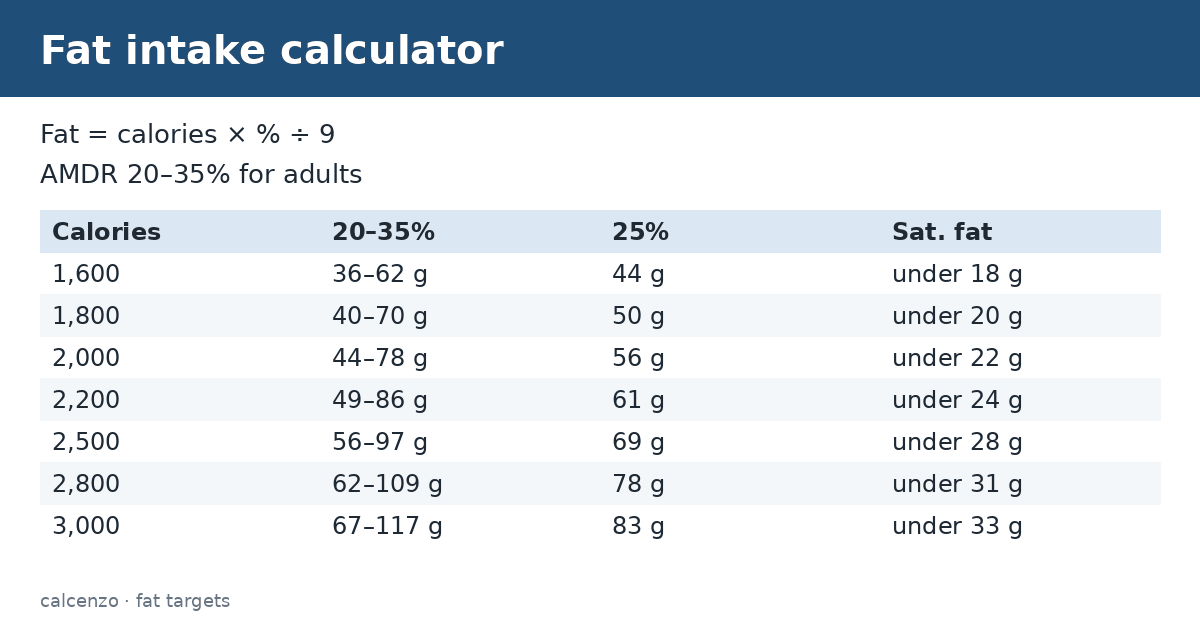
On a 2,200-calorie diet with 25% of calories from fat: 2,200 × 0.25 = 550 calories, and 550 ÷ 9 ≈ 61 grams of fat a day. The National Academies’ Acceptable Macronutrient Distribution Range for adults is 20% to 35% of calories from fat, which at 2,200 calories is about 49 to 86 grams.
| Daily calories | Total fat (20–35%) | Total fat at 25% | Saturated fat (<10%) |
|---|---|---|---|
| 1,600 | 36–62 g | 44 g | under 18 g |
| 1,800 | 40–70 g | 50 g | under 20 g |
| 2,000 | 44–78 g | 56 g | under 22 g |
| 2,200 | 49–86 g | 61 g | under 24 g |
| 2,500 | 56–97 g | 69 g | under 28 g |
| 2,800 | 62–109 g | 78 g | under 31 g |
| 3,000 | 67–117 g | 83 g | under 33 g |
Official guidance on fat
- Total fat: 20% to 35% of calories for adults (National Academies Dietary Reference Intakes).
- Saturated fat: the Dietary Guidelines for Americans, 2025–2030, say saturated fat should not exceed 10% of daily calories.
- Daily Value: the FDA uses 78 grams of total fat and 20 grams of saturated fat as the Daily Values on Nutrition Facts labels, based on a 2,000-calorie diet.
Children have higher ranges than adults, so these adult figures do not apply to them.
Types of fat
- Unsaturated fats (monounsaturated and polyunsaturated) are found in olive and canola oil, nuts, seeds, avocados and fatty fish. Omega-3 fats are a type of polyunsaturated fat.
- Saturated fats are found mostly in meat, butter, cheese, cream and coconut and palm oils.
- Trans fats from partially hydrogenated oils have been largely removed from the U.S. food supply; small amounts occur naturally in meat and dairy.
Using Nutrition Facts labels
The label lists total fat, saturated fat and trans fat per serving, plus %DV. A food with 5% DV or less of a nutrient is considered low in it, and 20% DV or more is high, according to the FDA. If your calorie needs differ from 2,000, compare the grams on the label with your own target from the fat intake calculator instead of the %DV.
Choosing a percentage
Many people land around 25% to 30% of calories from fat. Lower-fat eating patterns sit near 20%, while some higher-fat patterns approach 35%. Within whatever range you choose, focus on the type of fat: swapping saturated fat for unsaturated fat matters more for heart health than the total alone. A useful check is that saturated fat stays under one-tenth of your calories; at 2,000 calories that is under 22 grams, or about 20 grams to match the label Daily Value.
Finding your calorie needs
The fat intake calculator needs a daily calorie figure. Estimate it from your age, size and activity, or track your current intake for a week. Then set a fat percentage, and use the remaining calories for protein and carbohydrates.
Estimates for education only, not financial advice. Your lender’s figures are final.
Turning grams into meals
Spread your daily fat across meals rather than counting every gram. On a 61-gram target, three meals of about 15 grams plus two snacks of about 8 grams fits well. For reference, a tablespoon of olive oil has about 14 grams of fat, a one-ounce handful of almonds about 14 grams, and a large egg about 5 grams. Recalculate with the fat intake calculator whenever your calorie target changes, such as during weight loss or training.
Related converters and calculators
Related calculators:
- Macro calculator: macros
- Calorie calculator: calories
- Protein calculator: protein
- TDEE calculator: energy needs
Sources
National Academies: Dietary Reference Intakes for Energy, Carbohydrate, Fiber, Fat, Fatty Acids, Cholesterol, Protein, and Amino Acids; Dietary Guidelines for Americans, 2025–2030; FDA: Daily Value on the Nutrition and Supplement Facts labels.
Questions about this calculator
How many grams of fat should I eat?
20% to 35% of calories; about 44 to 78 g on 2,000 calories.
How many calories are in a gram of fat?
9.
What is the saturated fat limit?
Under 10% of daily calories, per the Dietary Guidelines.
What is the Daily Value for fat?
78 g total fat and 20 g saturated fat.
Do these ranges apply to children?
No, children have higher ranges.
Check the assumptions and units before relying on a result. Financial, tax and health estimates do not replace advice for your individual circumstances.
Report a calculation issue