
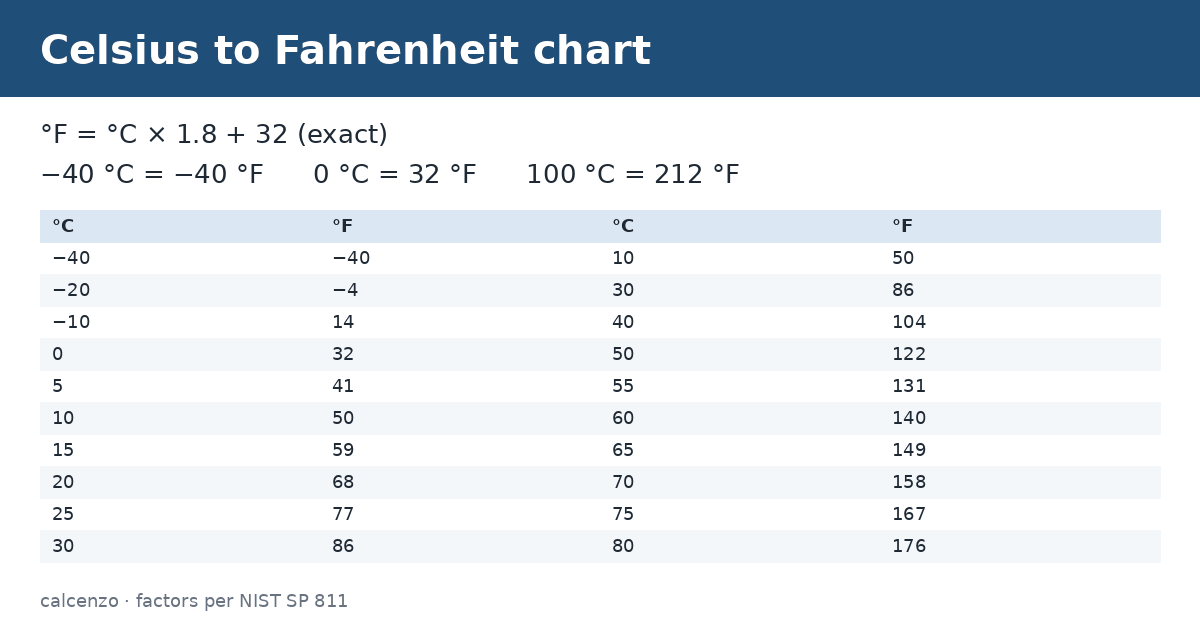
To convert celsius to fahrenheit, multiply by 1.8 (9/5) and add 32. The relation is exact: water freezes at 0 °C = 32 °F and boils at 100 °C = 212 °F at standard pressure, so 25 °C = 77 °F.
On this page
How to use the celsius to fahrenheit converter
- Enter the temperature in °C, for example 30.
- Read the celsius to fahrenheit converter result: 30 × 1.8 + 32 = 86 °F.
- For negative values keep the sign: −10 × 1.8 + 32 = 14 °F.
What is the Celsius to Fahrenheit formula?
°F = °C × 9/5 + 32 (or °C × 1.8 + 32)
The Celsius–Fahrenheit relationship is exact: a Fahrenheit degree is 5/9 of a Celsius degree and water freezes at 0 °C = 32 °F.
What are Celsius and Fahrenheit?
Temperature measures how hot or cold something is. Celsius and Fahrenheit are everyday scales, kelvin is the SI base unit used in science (0 K is absolute zero), and Rankine is an absolute scale using Fahrenheit-sized degrees.
Celsius to fahrenheit worked examples
- Normal body temperature: 37 × 1.8 + 32 = 98.6 °F
- A mild room temperature: 20 × 1.8 + 32 = 68 °F
- A moderate oven setting: 180 × 1.8 + 32 = 356 °F
Conversion chart
| °C | °F | °C | °F |
|---|---|---|---|
| −40 | −40 | 15 | 59 |
| −30 | −22 | 20 | 68 |
| −20 | −4 | 25 | 77 |
| −10 | 14 | 30 | 86 |
| −5 | 23 | 35 | 95 |
| 0 | 32 | 37 | 98.6 |
| 5 | 41 | 40 | 104 |
| 10 | 50 | 100 | 212 |
Values are rounded to one decimal place.
Quick mental conversion
Double the Celsius and add 30 for a rough estimate: 20 °C → 70 °F (exact 68 °F). It drifts at high temperatures.
Common temperatures
| Description | °C | °F |
|---|---|---|
| Celsius and Fahrenheit are equal | −40 | −40 |
| Water freezes (at sea level) | 0 | 32 |
| Cool room | 18 | 64.4 |
| Comfortable room | 21 | 69.8 |
| Normal body temperature (typical) | 37 | 98.6 |
| Fever threshold often used | 38 | 100.4 |
| Water boils (at sea level) | 100 | 212 |
Oven temperatures
| Gas mark | °C (conventional) | °F |
|---|---|---|
| 2 | 150 | 302 (often written 300) |
| 4 | 180 | 356 (often written 350) |
| 5 | 190 | 374 (often written 375) |
| 6 | 200 | 392 (often written 400) |
| 7 | 220 | 428 (often written 425) |
Recipes round oven temperatures, so 180 °C and 350 °F are treated as equivalent. For a fan oven, recipes often reduce the Celsius setting by about 20 °C.
Body temperature in Celsius and Fahrenheit
Clinical thermometers in most countries read °C:
| °C | °F | Note |
|---|---|---|
| 36.1 | 97 | |
| 37 | 98.6 | traditional normal |
| 37.5 | 99.5 | |
| 38 | 100.4 | common fever threshold |
| 39 | 102.2 | |
| 40 | 104 |
Normal body temperature varies by person, time of day and measuring site; 37 °C (98.6 °F) is the traditional reference.
The reverse formula and −40
To go back, subtract 32 and divide by 1.8: °C = (°F − 32) ÷ 1.8. The two scales meet at −40, where −40 °C = −40 °F. A temperature change converts without the 32: a rise of 10 °C is a rise of 18 °F. For differences, use the temperature interval converter; for the reverse, the fahrenheit to celsius converter.
Fridge, freezer and kitchen settings
Food safety guidance often comes in both scales. A fridge at 4 °C is 39.2 °F, just under the US FDA advice to keep it at or below 40 °F. A freezer at −18 °C is −0.4 °F, the metric match for the familiar 0 °F target.
Cooking temperatures show the same pattern. Sous-vide steak at 57 °C is 134.6 °F. Candy at the soft-ball stage, 112 to 116 °C, is about 234 to 241 °F. A thermometer that only reads one scale is fine as long as you convert the recipe first.
Differences are not temperatures
A change of 10 °C is a change of 18 °F, not 50 °F. When converting a temperature rise or a tolerance, multiply by 1.8 and skip the +32. A celsius to fahrenheit converter for single readings always adds the offset, so use it for temperatures, not for differences. A weather report saying it will be 5 °C warmer tomorrow means 9 °F warmer.
Wine storage is another everyday case. Cellars are kept around 12 to 13 °C, which is about 54 to 55 °F. Serving temperatures for white wine, around 8 to 10 °C, work out to 46 to 50 °F. A celsius to fahrenheit conversion for these small ranges is easy to do in your head with the double-and-add-30 shortcut, which is close enough for a cellar but not for candy making, where a few degrees change the result.
Related converters and calculators
Related conversions:
- Fahrenheit to celsius: °F to °C
- Temperature converter: °C, °F, K
- Temperature difference converter: ΔC and ΔF
- kg to lbs: kg to lb
- cm to inches: cm to in
Sources
NIST Special Publication 811, Appendix B; NIST: SI units – temperature.
Questions about this calculator
What is the celsius to fahrenheit formula?
°F = °C × 1.8 + 32.
What is 20 °C in °F?
68 °F.
What is 37 °C in °F?
98.6 °F.
What is the quick trick?
Double the °C and add 30; exact at 10 °C (50 °F) and within a few degrees nearby.
Where are Celsius and Fahrenheit equal?
At −40 degrees.
Check the assumptions and units before relying on a result. Financial, tax and health estimates do not replace advice for your individual circumstances.
Report a calculation issue