
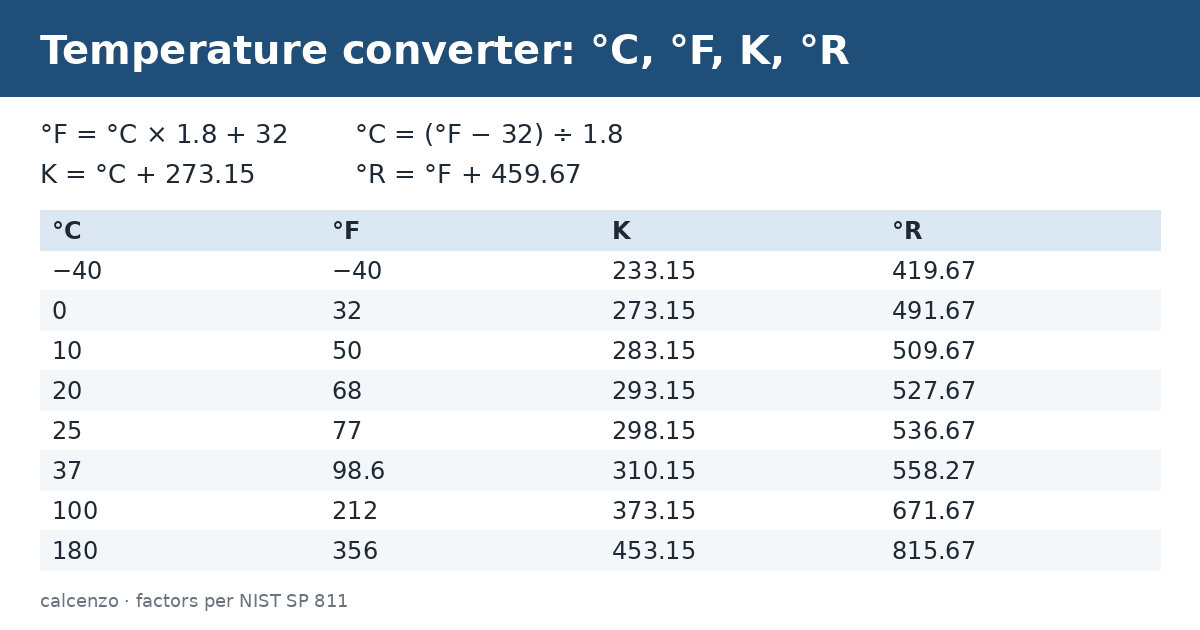
This temperature converter changes a reading between Celsius (°C), Fahrenheit (°F), kelvin (K) and Rankine (°R) with the exact formulas published by NIST. Temperature scales start from different zero points, so conversion needs an offset as well as a scale factor: °F = °C × 1.8 + 32, K = °C + 273.15 and °R = °F + 459.67. For example, 25 °C = 77 °F = 298.15 K.
On this page
How to use the temperature converter
- In the temperature converter, type the temperature you have into the value box. Negative numbers are fine, for example −18 for a freezer.
- Pick the scale you are converting from and the scale you want.
- Read the result. The temperature converter keeps full precision internally and rounds only the number it shows.
Kelvin and Rankine are absolute scales, so values below 0 K or 0 °R are not physical temperatures. Single-pair pages with their own charts are listed under related converters below.
Temperature conversion formulas
| From → To | Formula |
|---|---|
| Celsius → Fahrenheit | °F = °C × 9/5 + 32 |
| Fahrenheit → Celsius | °C = (°F − 32) × 5/9 |
| Celsius → Kelvin | K = °C + 273.15 |
| Kelvin → Celsius | °C = K − 273.15 |
| Fahrenheit → Kelvin | K = (°F − 32) × 5/9 + 273.15 |
| Kelvin → Fahrenheit | °F = (K − 273.15) × 9/5 + 32 |
| Fahrenheit → Rankine | °R = °F + 459.67 |
| Kelvin → Rankine | °R = K × 9/5 |
Two everyday cases: Celsius to Fahrenheit is multiply by 1.8 and add 32, and kelvin to Celsius is just subtract 273.15. A Celsius degree is the same size as a kelvin, and a Fahrenheit degree is the same size as a Rankine degree (5/9 of a kelvin). These relationships are exact by definition (NIST SP 811, section B.9). Since the 2019 revision of the SI, the kelvin itself is defined by fixing the Boltzmann constant at exactly 1.380649 × 10⁻²³ J/K.
Why temperature is different from other conversions
Most units differ only by a multiplier: 1 inch is always 2.54 cm. Temperature scales also start from different zero points. Zero Celsius is the freezing point of water, zero Fahrenheit is 32 °F below it, and zero kelvin is absolute zero. That is why 20 °C is not “twice as hot” as 10 °C, and why you cannot convert a temperature difference with the same formula. A rise of 10 °C is a rise of 18 °F (no +32), because only the scale factor applies to differences. Use the temperature interval converter for changes in temperature.
Temperature conversion chart
Common Celsius readings with their Fahrenheit and kelvin equivalents, rounded to two decimals:
| °C | °F | K |
|---|---|---|
| −40 | −40 | 233.15 |
| −20 | −4 | 253.15 |
| −10 | 14 | 263.15 |
| 0 | 32 | 273.15 |
| 10 | 50 | 283.15 |
| 15 | 59 | 288.15 |
| 20 | 68 | 293.15 |
| 25 | 77 | 298.15 |
| 30 | 86 | 303.15 |
| 37 | 98.6 | 310.15 |
| 40 | 104 | 313.15 |
| 50 | 122 | 323.15 |
| 100 | 212 | 373.15 |
| 180 | 356 | 453.15 |
| 200 | 392 | 473.15 |
| 220 | 428 | 493.15 |
Key temperatures on every scale
Reference points worth knowing:
| Reference point | °C | °F | K | °R |
|---|---|---|---|---|
| Absolute zero | −273.15 | −459.67 | 0 | 0 |
| Celsius equals Fahrenheit | −40 | −40 | 233.15 | 419.67 |
| Water freezes (sea level) | 0 | 32 | 273.15 | 491.67 |
| Room temperature (typical) | 20 | 68 | 293.15 | 527.67 |
| Normal body temperature (typical) | 37 | 98.6 | 310.15 | 558.27 |
| Water boils (sea level) | 100 | 212 | 373.15 | 671.67 |
Worked example: 350 °F to °C and K
Convert 350 °F, a common oven setting, to Celsius and kelvin by hand. The temperature converter gives the same result:
- Subtract 32: 350 − 32 = 318
- Multiply by 5/9: 318 × 5/9 = 176.67 °C
- Add 273.15: 176.67 + 273.15 = 449.82 K
Recipes written in Celsius usually round this to 175 or 180 °C, which is close enough for baking.
Quick mental conversion
Without a temperature converter at hand, a rough Celsius to Fahrenheit estimate is: double the Celsius value and add 30. The shortcut is exact at 10 °C and drifts by 2 °F for every 10 °C away from it:
| °C | Exact °F | Double + 30 | Error (°F) |
|---|---|---|---|
| 0 | 32 | 30 | −2 |
| 10 | 50 | 50 | 0 |
| 20 | 68 | 70 | 2 |
| 30 | 86 | 90 | 4 |
| 40 | 104 | 110 | 6 |
Going the other way, subtract 30 from Fahrenheit and halve it. Use the exact formula for anything where 2 or 3 degrees matter, such as a fever reading or candy making.
Which scale is used where
Four scales are still in everyday or technical use:
- Celsius: everyday temperatures in almost every country, and most science outside thermodynamics.
- Fahrenheit: everyday weather, cooking and body temperature in the United States.
- Kelvin: the SI base unit of thermodynamic temperature, used in physics, chemistry and the color temperature of lighting (for example, 2,700 K warm white). It takes no degree sign.
- Rankine: some US engineering thermodynamics work, as an absolute scale with Fahrenheit-sized degrees.
Related converters and calculators
These tools cover nearby questions:
- Celsius to Fahrenheit and Fahrenheit to Celsius: single-pair converters with charts
- Temperature interval converter: for changes in temperature
- Heat index calculator, wind chill calculator and dew point calculator: weather readings that build on temperature
- Thermal expansion coefficient converter and unit converter for other quantities
Sources
The temperature converter is based on these sources: NIST Special Publication 811, Appendix B; NIST: SI units – temperature; BIPM: The International System of Units (SI Brochure).
Questions about this calculator
How do I convert Celsius to Fahrenheit?
To convert Celsius to Fahrenheit, multiply by 9/5 (1.8) and add 32. For example, 25 °C × 1.8 + 32 = 77 °F.
How do I convert Fahrenheit to Celsius?
To convert Fahrenheit to Celsius, subtract 32 and multiply by 5/9. For example, (98.6 °F − 32) × 5/9 = 37 °C.
How do I convert Celsius to Kelvin?
To convert Celsius to kelvin, add 273.15. For example, 25 °C = 298.15 K. For kelvin to Celsius, subtract 273.15. Kelvin is written without a degree sign.
How can I convert Celsius to Fahrenheit in my head?
Double the Celsius value and add 30. It gives 50 °F for 10 °C, which is exact, but drifts by about 2 °F for every 10 °C you move away from 10 °C, so use the exact formula for cooking or medicine.
At what temperature are Celsius and Fahrenheit equal?
Celsius and Fahrenheit are equal at −40. Solving °C × 1.8 + 32 = °C gives −40, so −40 °C = −40 °F.
What is absolute zero in Celsius and Fahrenheit?
Absolute zero is 0 K, which is −273.15 °C, −459.67 °F and 0 °R.
Does the temperature converter accept negative values?
Yes. It accepts negative Celsius and Fahrenheit readings, such as −18 °C for a freezer. Kelvin and Rankine values below zero are not physical, because nothing can be colder than absolute zero.
Can I use these formulas for a change in temperature?
No. For a temperature difference, use only the scale factor: a change of 1 °C equals a change of 1.8 °F and 1 K. Drop the +32 and +273.15 offsets.
Check the assumptions and units before relying on a result. Financial, tax and health estimates do not replace advice for your individual circumstances.
Report a calculation issue