
A wind chill calculator estimates how cold it feels on exposed skin when wind combines with low temperatures. Formula: WC = 35.74 + 0.6215T – 35.75V^0.16 + 0.4275T V^0.16 (°F, mph). Outside T>50 or V<3, returns air temperature with a note. At 20°F with a 15 mph wind, it feels like about 6°F.
On this page
How to use the wind chill calculator
- Enter the air temperature in °F.
- Enter the sustained wind speed in mph.
- Read the wind chill, or the note if conditions are outside the formula range.
How the wind chill calculator works
The wind chill calculator uses the formula adopted by the US National Weather Service in 2001: wind chill (°F) = 35.74 + 0.6215T − 35.75V^0.16 + 0.4275TV^0.16, where T is the air temperature in degrees Fahrenheit and V is the wind speed in miles per hour. The formula is defined for temperatures at or below 50°F and wind speeds of at least 3 mph. Outside that range the tool shows the air temperature with a note instead.
Wind chill calculator worked example
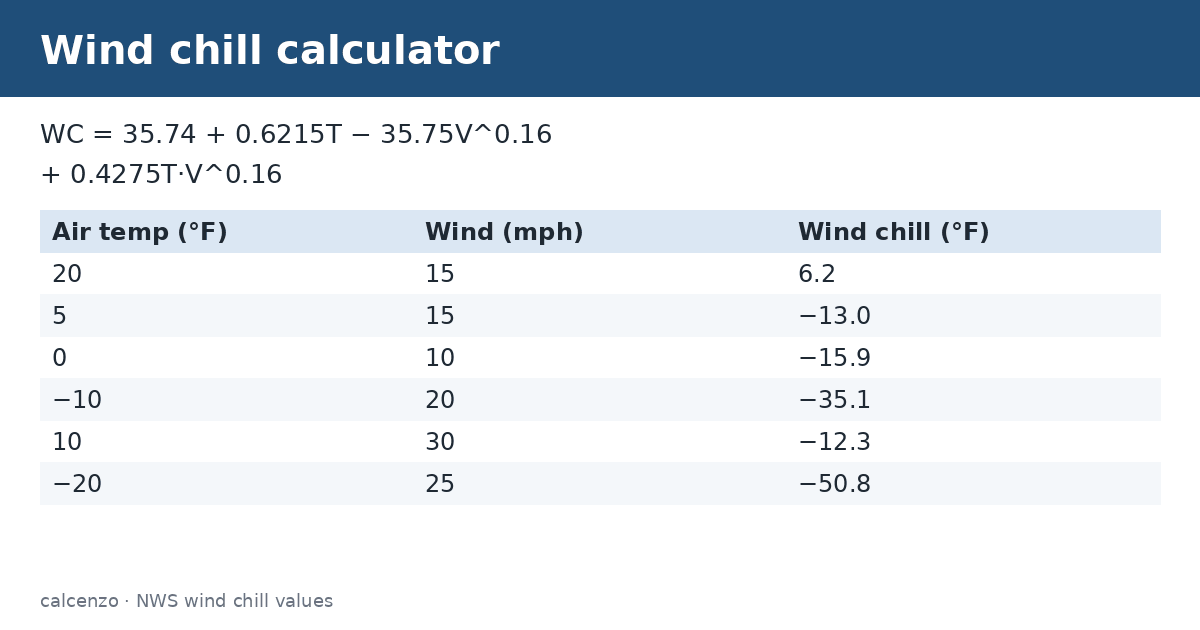
At 20°F with a 15 mph wind, V^0.16 is about 1.543. The wind chill calculator gives 35.74 + 12.43 − 55.17 + 13.19 ≈ 6.2°F. At 0°F with a 10 mph wind, it feels like about −15.9°F, and at −10°F with 20 mph it feels like about −35.1°F.
| Air temp (°F) | Wind (mph) | Wind chill (°F) |
|---|---|---|
| 20 | 15 | 6.2 |
| 5 | 15 | −13.0 |
| 0 | 10 | −15.9 |
| −10 | 20 | −35.1 |
| 10 | 30 | −12.3 |
| −20 | 25 | −50.8 |
What wind chill means
Wind chill describes how cold it feels on exposed skin because wind carries heat away faster than still air. It does not lower the temperature of objects below the air temperature: a car radiator or water pipe will not freeze if the air is above 32°F, whatever the wind. The index was built from models of heat loss from the human face, assuming a person walking at about 3 mph.
Frostbite risk
The National Weather Service wind chill chart shades combinations of temperature and wind by how quickly frostbite can develop on exposed skin, with bands for 30, 10 and 5 minutes. As wind chill falls well below zero, the time to frostbite shortens sharply. Cover the face, ears, fingers and toes, dress in layers, and watch for numbness or white, waxy skin. Hypothermia can develop even at milder wind chills if you are wet or outside for a long time.
Using Celsius and km/h
The wind chill calculator expects °F and mph. To convert, °F = °C × 9 ÷ 5 + 32, and mph = km/h ÷ 1.609. For example, −10°C is 14°F and 30 km/h is about 18.6 mph. Convert the answer back with °C = (°F − 32) × 5 ÷ 9. Canada and the US use the same underlying index, reported in their own units.
Measuring wind speed
Official wind speeds are measured at 10 meters, about 33 feet, above the ground, and the 2001 formula adjusts for the lower wind at face height. Use the sustained wind from a forecast or nearby station rather than gusts. Wind on a ridge, a frozen lake or a moving snowmobile can be much stronger than the reported value, so the real chill may be worse.
Children, older adults and pets
Young children and older adults lose heat faster and may not notice the cold, so check a wind chill calculator or forecast before outdoor play or walks. Pets with short coats are vulnerable too. Limit time outside when the wind chill is well below freezing, and make sure everyone has dry gloves, a hat and a scarf or face covering. Change out of wet clothes promptly after snow play.
Tips
- Check the forecast wind chill before outdoor activity.
- Cover exposed skin when wind chill is below about 0°F.
- Stay dry; wet clothing speeds heat loss.
- Bring pets indoors in severe cold.
For study and planning only. Check lab, engineering and safety work against your course, instrument or a qualified professional.
Related converters and calculators
Related calculators:
- Heat index calculator: hot weather
- Dew point calculator: humidity
- Temperature converter: °C and °F
- Speed converter: km/h and mph
Sources
National Weather Service: Wind chill chart.
Formula and method
WC = 35.74 + 0.6215T - 35.75V^0.16 + 0.4275T V^0.16 (°F, mph). Outside T>50 or V<3, returns air temperature with a note.
Matches the U.S. NWS wind chill temperature index coefficients used in the live calculator.
Questions about this calculator
What formula is used?
The NWS 2001 wind chill formula.
When does it apply?
At 50°F or below with wind of at least 3 mph.
Can wind chill freeze pipes above 32°F?
No, it affects exposed skin, not objects.
What wind speed should I use?
Sustained wind, not gusts.
How do I use Celsius?
Convert to °F and mph first.
Check the assumptions and units before relying on a result. Financial, tax and health estimates do not replace advice for your individual circumstances.
Report a calculation issue