
A closing costs calculator estimates the fees and taxes due when you buy or sell a home, based on the price and your state. Formula: Buyer estimate = price × state.buyerPct/100. Transfer/doc tax = price × state.transferPct/100. Seller estimate = price × commission%/100 + transfer. Headline uses role (buyer or seller). For a $400,000 home in Texas, the calculator’s buyer estimate is $10,000 (2.5%); a seller paying 5% commission would budget about $20,000.
On this page
How to use the closing costs calculator
- Choose your state.
- Enter the purchase price and loan amount.
- Choose buyer or seller; sellers also enter the agent commission percentage.
- Read the estimate, the transfer tax line and your loan-to-value ratio.
What formula does the closing costs calculator use?
- Buyer: estimated closing costs = price × the state’s typical buyer closing-cost percentage
- Seller: estimated costs = price × agent commission % + price × the state’s approximate transfer or documentary tax rate
The buyer estimate bundles lender fees, title insurance, recording fees and prepaid items such as initial escrow into one statewide average. It is a planning figure, not a quote.
Closing costs calculator worked example
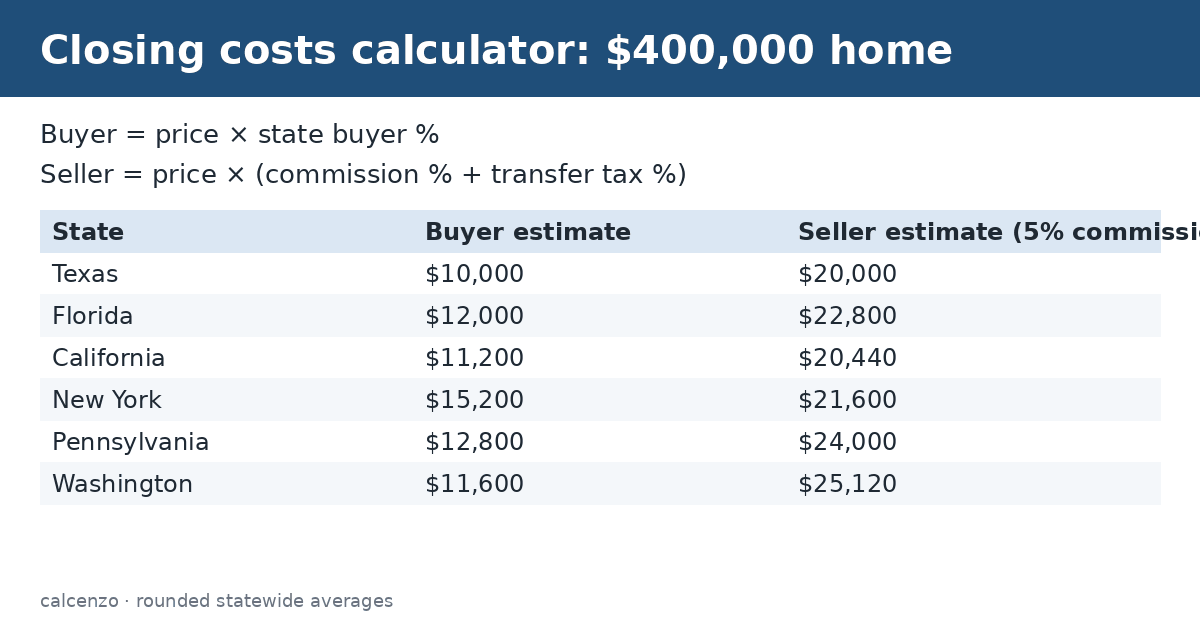
For a $400,000 home, with 5% commission in the seller view:
| State | Buyer estimate | Transfer tax rate used | Seller estimate |
|---|---|---|---|
| Texas | $10,000 | 0.00% | $20,000 |
| Florida | $12,000 | 0.70% | $22,800 |
| California | $11,200 | 0.11% | $20,440 |
| New York | $15,200 | 0.40% | $21,600 |
| Pennsylvania | $12,800 | 1.00% | $24,000 |
| Washington | $11,600 | 1.28% | $25,120 |
The rates in the closing costs calculator are rounded statewide approximations. Many states charge transfer tax at graduated or local rates, and who pays it is set by local custom and your contract, so treat these as starting points.
What closing costs include
- Loan costs: origination charges, discount points, appraisal, credit report and underwriting fees.
- Title and settlement: title search, lender’s and owner’s title insurance, settlement or attorney fees.
- Government fees: recording fees and transfer taxes.
- Prepaids and escrow: homeowners insurance, prepaid interest and the initial deposit into your escrow account for property taxes and insurance.
Loan Estimate and Closing Disclosure
Under federal rules, your lender must send a Loan Estimate within three business days of receiving your application, and a Closing Disclosure at least three business days before closing. The CFPB recommends comparing the two line by line; some fees cannot increase at all, and others can rise only within limits. Use the closing costs calculator to set a budget, then rely on these forms for the real numbers.
Seller costs beyond commission and transfer tax
Sellers often pay more than the two items in the seller view. Depending on the deal, that can include the owner’s title policy, settlement or attorney fees, any repair credits agreed after inspection, a prorated share of property taxes and HOA dues, and payoff of the existing mortgage. Agent commissions are negotiable, so check your listing and purchase agreements for what you have agreed to pay. Your net proceeds are the price minus all of these and minus the loan payoff.
Ways to lower closing costs
- Compare Loan Estimates from several lenders.
- Shop for services the Loan Estimate says you can shop for, such as title and settlement.
- Ask about seller credits, or state and local down payment and closing cost assistance.
- Weigh lender credits against a higher rate over the time you expect to keep the loan.
Estimates for education only, not financial advice. Your lender’s figures are final.
From closing costs to cash to close
Closing costs are only part of what you bring to the table. The Closing Disclosure shows a separate line, cash to close, that also counts the down payment and subtracts money already paid or credited. Take a $350,000 purchase with 10% down. The loan is $315,000, and if closing costs come to 3% of the loan, that is $9,450. With a $5,000 earnest money deposit and a $3,000 seller credit, cash to close is $35,000 + $9,450 − $5,000 − $3,000 = $36,450.
Use the closing costs calculator for the cost estimate, then build the cash-to-close figure yourself so you know how much to have ready. Wire the funds only after confirming the instructions by phone with your title or escrow company, using a number you found independently, because closing wire fraud is common. The closing costs calculator cannot protect you from that; a phone call can.
Related converters and calculators
Related calculators:
- Mortgage calculator: monthly payment
- House affordability calculator: price range
- Escrow shortage calculator: escrow changes
- Capital gains on home sale calculator: seller tax
Sources
CFPB: Closing on your home; CFPB: Loan Estimate explainer; CFPB: Closing Disclosure explainer.
Questions about this calculator
How much are closing costs for a buyer?
The calculator’s statewide averages range from 2.5% to 3.8% of the price; your Loan Estimate gives the real figure.
Who pays transfer tax?
It depends on the state, local custom and your contract; it is often paid by the seller.
When do I get my Loan Estimate?
Within three business days of applying for a mortgage.
When do I get the Closing Disclosure?
At least three business days before closing.
Can closing costs be negotiated?
Some can. Shop lenders and title services, and ask about seller or lender credits.
Check the assumptions and units before relying on a result. Financial, tax and health estimates do not replace advice for your individual circumstances.
Report a calculation issue