
A credit card interest calculator shows how many months it takes to pay off a card balance with a fixed monthly payment and how much interest you pay along the way. The credit card interest calculator uses this formula: Months = ceil( ln(payment / (payment – balance × r)) / ln(1+r) ) with r = APR/100/12 when payment covers interest. Total interest ≈ payment × months – balance. If payment ≤ monthly interest, payoff is impossible. $5,000 at 19.99% APR with $200 a month takes 33 months and costs about $1,521.02 in interest.
On this page
How to use the credit card interest calculator
- Enter your current balance.
- Enter the card’s APR.
- Enter the fixed amount you will pay each month.
- Read the months to payoff, total interest and total paid.
How the credit card interest calculator works
Card issuers state interest as an annual percentage rate (APR), but they charge it each billing cycle on the balance you carry. The credit card interest calculator divides the APR by 12 to get a monthly rate, adds that month’s interest to the balance, subtracts your payment, and repeats until the balance reaches zero. The last payment is only what is left, so the totals are not simply payment × months.
- Monthly rate = APR ÷ 12
- Interest this month = balance × monthly rate
- New balance = balance + interest − payment
- If the payment is not larger than the first month’s interest, the balance never falls and the tool shows a warning
Credit card interest calculator worked example
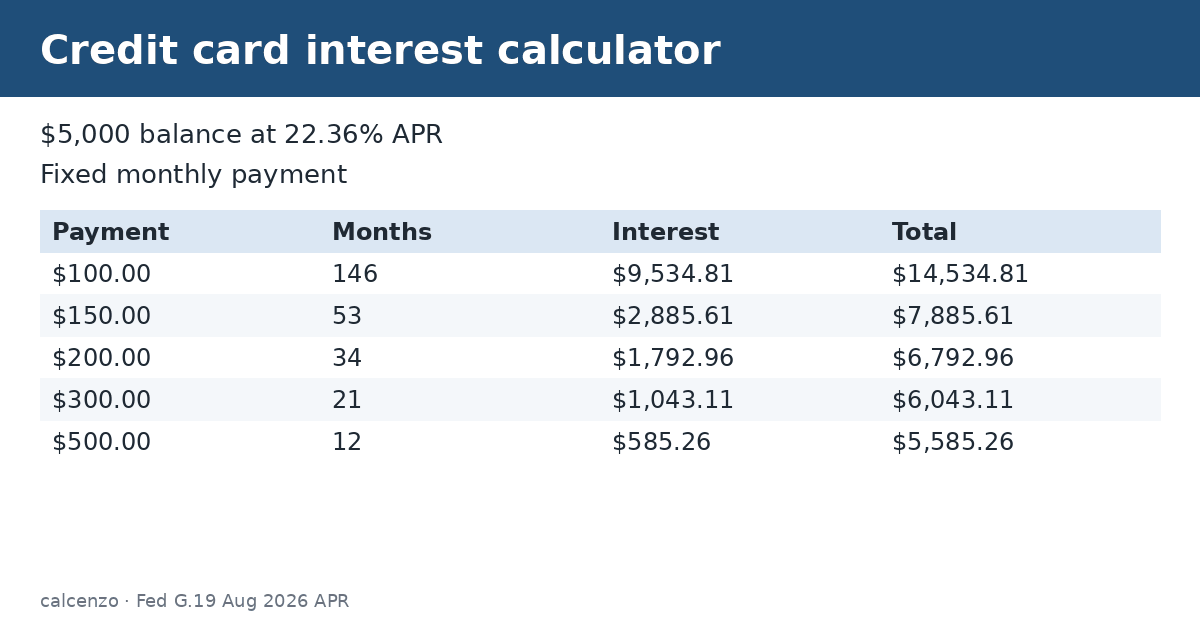
A $5,000 balance at 19.99% APR with a fixed $200 payment takes 33 months to clear. The first month’s interest is about $83.29, so only about $117 of the first payment reduces the balance. Over the whole payoff you pay about $1,521.02 in interest. The Federal Reserve’s G.19 release put the average APR on credit card accounts that were charged interest at 22.36% in August 2026. At that rate, the same $5,000 costs:
| Monthly payment | Months | Total interest | Total paid |
|---|---|---|---|
| $100.00 | 146 | $9,534.81 | $14,534.81 |
| $150.00 | 53 | $2,885.61 | $7,885.61 |
| $200.00 | 34 | $1,792.96 | $6,792.96 |
| $300.00 | 21 | $1,043.11 | $6,043.11 |
| $500.00 | 12 | $585.26 | $5,585.26 |
Doubling the payment from $150 to $300 cuts the interest by roughly two thirds. Small increases have the biggest effect when the payment is close to the monthly interest charge, so try a few amounts in the credit card interest calculator.
Why minimum payments cost so much
Minimum payments are usually a small percentage of the balance plus interest, with a dollar floor; the formula varies by issuer. Because the payment shrinks as the balance falls, payoff can stretch for many years. For example, with a minimum of 1% of the balance plus that month’s interest and a $25 floor, $5,000 at 22.36% would take about 231 months, more than 19 years, and cost about $8,241 in interest. Federal rules under Regulation Z require card statements to show a “Minimum Payment Warning”, how long minimum payments would take, and, in most cases, the monthly payment that would clear the balance in 3 years. On $5,000 at 22.36% that 36-month payment is about $191.88.
Ways to pay less interest
- Pay in full each month: most cards have a grace period, so new purchases are interest-free if the previous statement balance was paid in full by the due date.
- Pay more than the minimum: any amount above the interest charge goes straight to principal.
- Pay earlier in the cycle: issuers usually charge interest on the average daily balance, so a mid-cycle payment lowers it.
- Ask for a lower APR: issuers sometimes agree, especially for long-standing accounts with on-time payments.
- Consider a balance transfer: a promotional rate can help if you can clear the balance before it ends; check the transfer fee.
Daily versus monthly interest
Most issuers actually use a daily periodic rate, the APR divided by 365 (or 360), applied to each day’s balance. The credit card interest calculator uses a monthly rate instead, which gives very close results for a fixed payment and no new purchases. Your statement will differ slightly because of billing-cycle length, new charges, fees and penalty rates. A penalty APR after a late payment can raise the cost sharply, so set up autopay for at least the minimum.
Estimates for education only, not financial advice. Your lender’s figures are final.
Related converters and calculators
Related calculators:
- Credit card payoff calculator: payoff plans
- Debt payoff calculator: debts
- Debt consolidation calculator: consolidation
- APR calculator: APR
Sources
Federal Reserve G.19 Consumer Credit (released Oct 7, 2026); CFPB: Regulation Z § 1026.7, periodic statement repayment disclosures.
Formula and method
Months = ceil( ln(payment / (payment - balance * r)) / ln(1+r) ) with r = APR/100/12 when payment covers interest. Total interest ≈ payment*months - balance. If payment ≤ monthly interest, payoff is impossible.
Fixed-payment revolving payoff model. Same engine as the credit card payoff and debt payoff calculators; this page emphasizes card APR cost framing.
Questions about this calculator
How is credit card interest calculated?
The APR divided into a periodic rate is charged on the balance each cycle, usually daily on the average daily balance.
What is the average credit card APR?
22.36% for accounts assessed interest in August 2026, per the Federal Reserve G.19.
How long does $5,000 take at $200 a month?
About 33 months at 19.99% APR.
Do I pay interest if I pay in full?
Usually not on purchases, thanks to the grace period.
Why does the tool say my payment is too low?
The payment does not cover the monthly interest, so the balance would never fall.
Check the assumptions and units before relying on a result. Financial, tax and health estimates do not replace advice for your individual circumstances.
Report a calculation issue