
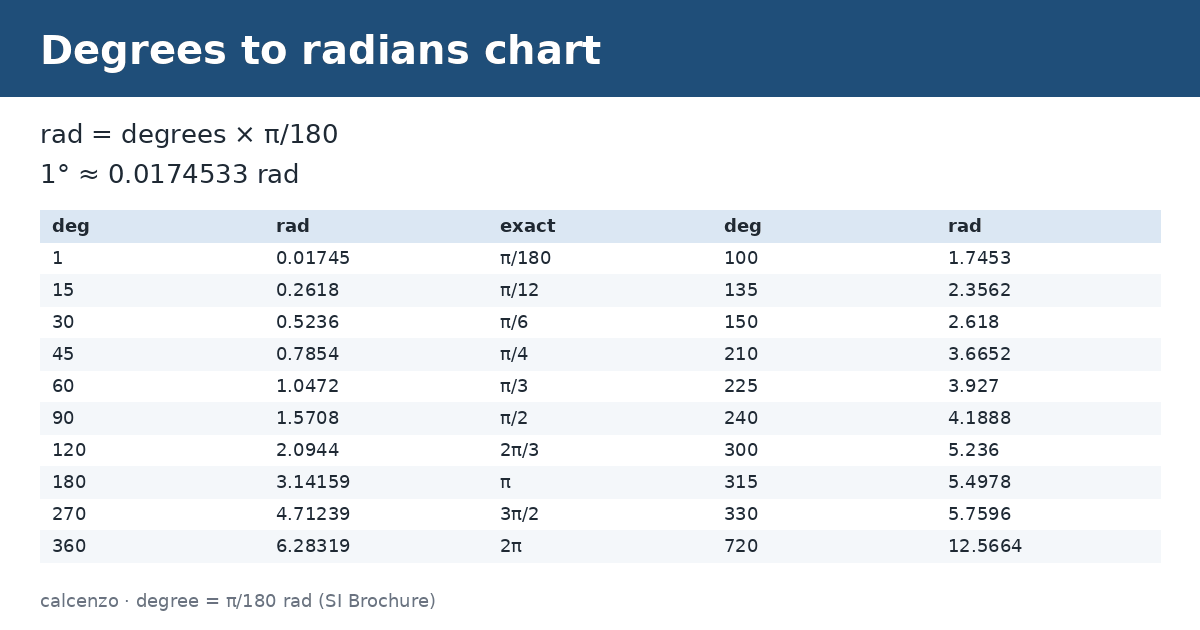
To convert degrees to radians, multiply by π/180, because a full turn is 360° or 2π radians. For example, 90° = π/2 ≈ 1.5708 rad, and 45° = π/4 ≈ 0.7854 rad.
On this page
How to use the degrees to radians converter
- Enter the angle in degrees, for example 135.
- Read the decimal result: 135 × π/180 ≈ 2.3562 rad.
- For an answer in terms of pi, simplify the fraction 135/180 = 3/4, giving 3π/4.
What is the degrees to radians formula?
radians = degrees × 0.0174533
The reverse is degrees = radians × 57.29578 (approximately).
A full turn is 360° or 2π radians, so 1 radian = 180/π degrees exactly. The multiplier 0.0174533 is rounded to six significant digits; the degrees to radians calculator uses the full-precision value.
What are degrees and radians?
An angle measures rotation between two lines. The SI-derived unit is the radian; a full turn is 2π radians or 360 degrees. Degrees, arcminutes and arcseconds dominate navigation and astronomy, gradians appear in surveying, and milliradians are used in optics and ballistics.
- Degree (°): 1 ° = 0.01745329252 rad (Common unit).
- Radian (rad): the base unit used here for angles.
Degrees to radians worked examples
- A right angle: 90 × 0.0174533 = 1.5708 rad
- Half a right angle: 45 × 0.0174533 = 0.785398 rad
- A full turn: 360 × 0.0174533 = 6.28319 rad
Conversion chart
| ° | rad | ° | rad |
|---|---|---|---|
| 1 | 0.0175 | 120 | 2.0944 |
| 5 | 0.0873 | 135 | 2.3562 |
| 10 | 0.1745 | 150 | 2.618 |
| 15 | 0.2618 | 180 | 3.1416 |
| 30 | 0.5236 | 225 | 3.927 |
| 45 | 0.7854 | 270 | 4.7124 |
| 60 | 1.0472 | 315 | 5.4978 |
| 90 | 1.5708 | 360 | 6.2832 |
Values are rounded to four decimal places, or two for results of 100 or more.
Quick mental conversion
Multiply by π/180 ≈ 0.017453.
Why radians?
A radian is the angle that cuts an arc equal to the radius. Calculus, physics and most programming math functions (Math.sin, Python’s math.sin) expect radians, so convert degrees first.
Degrees from radians: reverse chart
Going the other way, degrees = radians × 57.29578. Common values:
| radians | degrees |
|---|---|
| 1 | 57.29578 |
| 2 | 114.5916 |
| 5 | 286.4789 |
| 10 | 572.9578 |
| 20 | 1,145.916 |
| 50 | 2,864.789 |
| 100 | 5,729.578 |
| 500 | 28,647.89 |
| 1,000 | 57,295.78 |
Common angles in terms of pi
Divide the angle by 180 and reduce the fraction:
| Degrees | Radians (exact) | Radians (decimal) |
|---|---|---|
| 30° | π/6 | 0.5236 |
| 45° | π/4 | 0.7854 |
| 60° | π/3 | 1.0472 |
| 90° | π/2 | 1.5708 |
| 120° | 2π/3 | 2.0944 |
| 180° | π | 3.1416 |
| 270° | 3π/2 | 4.7124 |
| 360° | 2π | 6.2832 |
Angle conversion in Excel and code
Spreadsheet and programming trig functions expect radians. In Excel and Google Sheets use =RADIANS(A1) or =A1*PI()/180. Python has math.radians(x), and JavaScript uses x * Math.PI / 180. Forgetting the conversion is a common bug: Math.sin(90) returns about 0.894, not 1. Calculators have the same trap: in DEG mode sin 90 = 1, but in RAD mode it is about 0.894, so check the mode indicator before trusting a result. Going the other way, Excel has =DEGREES(A1) and Python has math.degrees(x). Engineering drawings and navigation use degrees, often split into minutes and seconds, so convert 30° 15′ to 30.25° before multiplying by π/180. Use the radians to degrees converter for the reverse and the right triangle calculator for trigonometry.
Robots, games and roofs
Robot arms, CNC software and game engines often expect angles in radians. A joint limit of 90° is π/2, or 1.5708 rad, and a turn rate of 360° per second is 6.283 rad/s. Entering degrees where radians are expected is a classic bug: the arm swings about 57 times further than intended. A degrees to radians conversion at the input stage avoids it.
Roof pitch gives another example. A 6/12 roof rises 6 inches per 12 inches of run. Its angle is arctan(0.5), about 26.57°, or 0.4636 rad. Spreadsheet functions such as TAN need the radian value, so use RADIANS() first if you start with degrees.
Physics formulas such as arc length s = rθ and angular speed ω = θ/t only work as written with radians. A wheel of radius 0.35 m turning through 45° rolls 0.35 × 0.7854 ≈ 0.275 m. With degrees, you would need to multiply by π/180 inside the formula. A degrees to radians step before the calculation keeps the formulas simple and makes unit errors easier to spot.
Related converters and calculators
Related conversions:
- Radians to degrees: rad to °
- Right triangle calculator: sides and angles
- Triangle calculator: any triangle
- Angle converter: deg, rad, grad
Sources
BIPM: The International System of Units (SI Brochure); Microsoft: RADIANS function; Python documentation: math module.
Questions about this calculator
What is the formula for degrees to radians?
radians = degrees × π/180.
What is 1 degree in radians?
π/180 ≈ 0.0174533 rad.
What is 60 degrees in radians?
π/3 ≈ 1.0472 rad.
How do I convert degrees to radians in Excel?
Use =RADIANS(A1).
Why use radians?
In radians, arc length is radius × angle and calculus formulas such as d/dx sin x = cos x hold without extra factors.
Check the assumptions and units before relying on a result. Financial, tax and health estimates do not replace advice for your individual circumstances.
Report a calculation issue