
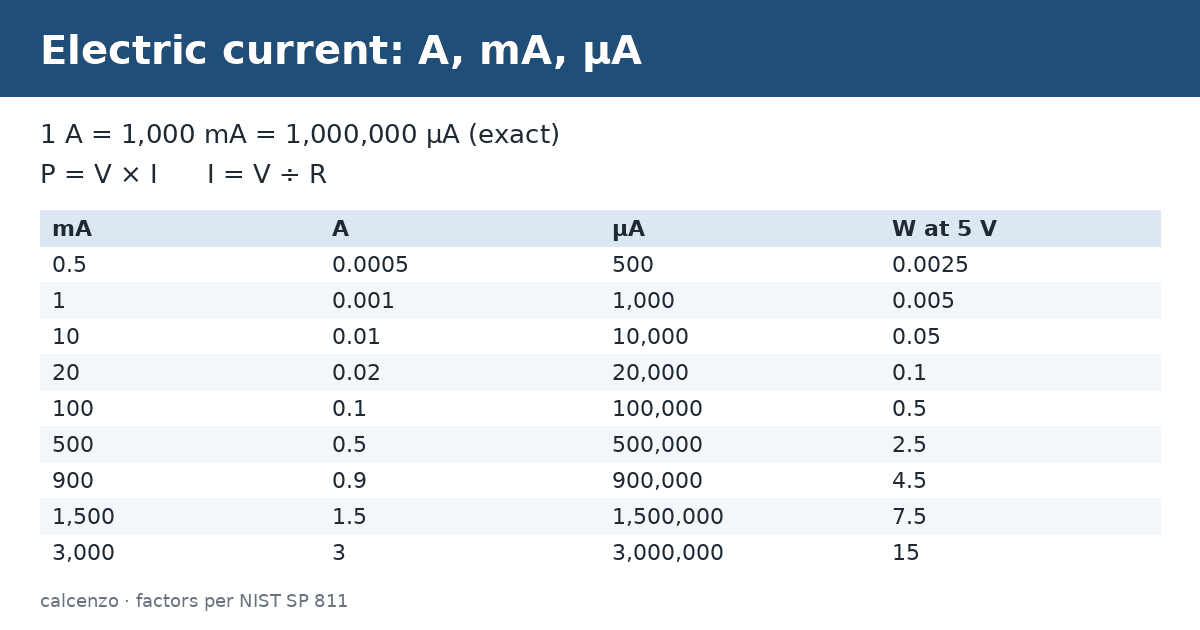
This electric current unit converter changes current between amperes, kiloamperes, milliamperes, microamperes, nanoamperes, biots (abamperes) and statamperes. The ampere is an SI base unit, so the metric units convert by powers of ten: 1 A = 1,000 mA, and 1 mA = 1,000 µA.
On this page
How to use the electric current unit converter
- Enter the current, for example 250 mA from a device label.
- In the electric current unit converter, choose its unit and the target unit, such as mA to amps.
- Read the electric current unit converter result: 250 mA = 0.25 A.
For mA to amps, divide by 1,000; for amps to mA, multiply by 1,000. For µA to mA, divide by 1,000.
What is electric current?
Electric current is the rate of flow of electric charge. Its SI unit, the ampere (A), is one of the seven SI base units. Electronics typically use milliamperes and microamperes, while power systems use amperes and kiloamperes.
Conversion formula
The electric current unit converter stores every unit as a multiple of the base unit, the ampere (A). To convert:
value in target unit = value × (factor of source unit ÷ factor of target unit)
where each factor is the size of the unit in amperes.
Common electric current conversions
| From | To | 1 unit equals |
|---|---|---|
| ampere (A) | milliampere (mA) | 1,000 mA |
| milliampere (mA) | ampere (A) | 0.001 A |
| ampere (A) | kiloampere (kA) | 0.001 kA |
| microampere (µA) | milliampere (mA) | 0.001 mA |
Electric current unit converter worked example
Convert 25 microamperes to milliamperes:
- Factor of µA = 1 × 10⁻⁶ A
- Factor of mA = 0.001 A
- 25 × 1 × 10−6 ÷ 0.001 = 0.025 mA
Electric current unit reference
| Unit | Symbol | Group | Equals (A) |
|---|---|---|---|
| Ampere | A | SI | 1 |
| Kiloampere | kA | SI | 1,000 |
| Milliampere | mA | SI | 0.001 |
| Microampere | µA | SI | 1 × 10⁻⁶ |
| Nanoampere | nA | SI | 1 × 10⁻⁹ |
| Biot | Bi | CGS-EMU | 10 |
| Statampere | statA | CGS-ESU | 3.33564 × 10⁻¹⁰ |
Reverse factors for each electric current unit
The reference table gives each unit in amperes. To go the other way, divide by that factor; the list below does the division for you.
- Kiloampere (kA), SI: 1 kA = 1,000 A, so 1 A = 0.001 kA.
- Milliampere (mA), SI: 1 mA = 0.001 A, so 1 A = 1,000 mA.
- Microampere (µA), SI: 1 µA = 1 × 10⁻⁶ A, so 1 A = 1,000,000 µA.
- Nanoampere (nA), SI: 1 nA = 1 × 10⁻⁹ A, so 1 A = 1 × 10⁹ nA.
- Biot (Bi), CGS-EMU: 1 Bi = 10 A, so 1 A = 0.1 Bi.
- Statampere (statA), CGS-ESU: 1 statA = 3.33564 × 10⁻¹⁰ A, so 1 A = 2.99793 × 10⁹ statA.
USB and circuit current ratings
Device and supply ratings mix mA and A. Common values in both units:
| Device or rating | Current | In amps |
|---|---|---|
| USB 2.0 port, default maximum | 500 mA | 0.5 A |
| USB 3.x port, default maximum | 900 mA | 0.9 A |
| USB Power Delivery, standard cable | 3 A | 3 A |
| Typical US 15 A branch circuit | 15 A | 15 A |
| Typical US 20 A branch circuit | 20 A | 20 A |
USB defaults come from the USB 2.0 and 3.x specifications; USB Power Delivery allows up to 5 A with an electronically marked cable. Branch circuit ratings refer to common breaker sizes.
Current, voltage and power
Ohm’s law links current to voltage and resistance: I = V ÷ R. A 5 V supply across 220 Ω drives about 22.7 mA. Power is P = V × I, so 2 A at 5 V is 10 W. Battery life is roughly capacity ÷ current: a 2,000 mAh battery at 100 mA lasts about 20 hours, less under real conditions. Since 2019 the ampere is defined by fixing the elementary charge, so 1 A is about 6.241509 × 10¹⁸ electrons per second. Use the Ohm’s law calculator and the electric charge converter for mAh.
kA ratings on breakers
Breakers and fuses carry two current ratings. The trip rating, say 20 A, is the load current it protects. The interrupting rating, such as 10 kA, is the fault current it can safely break. In the electric current unit converter, 10 kA is 10,000 A, five hundred times the trip rating. Sensors work at the other end of the scale, with signals of 4 to 20 mA, or 0.004 to 0.020 A.
Related converters and calculators
Related electrical tools:
- Ohm’s law calculator: V, I, R
- Voltage converter: V and mV
- Electric charge converter: C and mAh
- Current density converter: A/m²
- Power unit converter: W and BTU/h
Sources
BIPM: SI Brochure; NIST Special Publication 811, Appendix B; USB-IF: USB specifications.
Questions about this calculator
How many mA are in an amp?
1,000 mA = 1 A exactly.
How do I convert mA to amps?
Divide by 1,000. For example, 750 mA = 0.75 A.
How do I convert amps to mA?
Multiply by 1,000. For example, 2.4 A = 2,400 mA.
How do I convert µA to mA?
Divide by 1,000. For example, 50 µA = 0.05 mA.
What is a biot?
The CGS electromagnetic unit of current, also called the abampere, equal to 10 A.
How much current can a USB 2.0 port supply?
500 mA by default under the USB 2.0 specification.
Check the assumptions and units before relying on a result. Financial, tax and health estimates do not replace advice for your individual circumstances.
Report a calculation issue