
An exponent calculator raises a base number to a power, multiplying the base by itself as many times as the exponent says. 2 to the power 10 is 1,024.
On this page
How to use the exponent calculator
- Enter the base.
- Enter the exponent, which can be negative or a decimal.
- Read the result.
What an exponent means
An exponent tells you how many times to multiply a base by itself. In bn, b is the base and n is the exponent or power. 210 = 2 × 2 × 2 × 2 × 2 × 2 × 2 × 2 × 2 × 2 = 1,024. The exponent calculator raises any base to any power, including negative and fractional exponents.
Exponent calculator worked examples
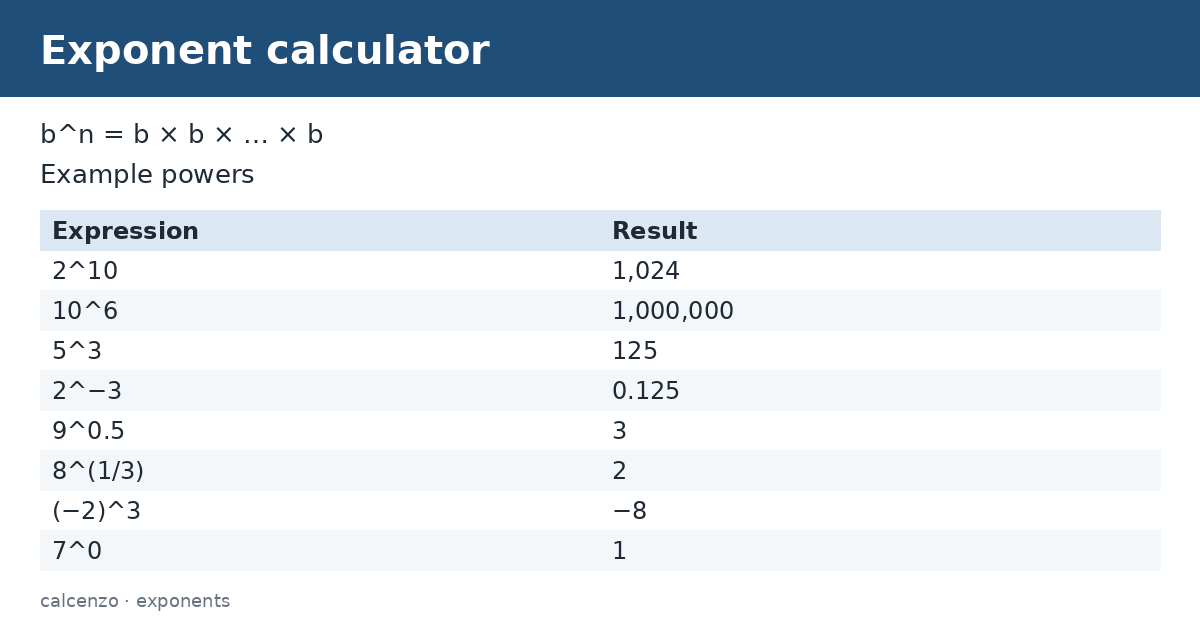
| Expression | Result |
|---|---|
| 2^10 | 1,024 |
| 10^6 | 1,000,000 |
| 5^3 | 125 |
| 2^−3 | 0.125 |
| 9^0.5 | 3 |
| 8^(1/3) | 2 |
| (−2)^3 | −8 |
| 7^0 | 1 |
A negative exponent means a reciprocal: 2−3 = 1 ÷ 23 = 1/8 = 0.125. A fractional exponent means a root: 91/2 is the square root of 9, and 81/3 is the cube root of 8. Any nonzero number to the power 0 equals 1.
Exponent rules
- Product: bm × bn = bm+n (23 × 24 = 27 = 128)
- Quotient: bm ÷ bn = bm−n
- Power of a power: (bm)n = bmn
- Power of a product: (ab)n = anbn
- Negative exponent: b−n = 1 ÷ bn
- Fractional exponent: bm/n = the nth root of bm
Negative bases
A negative base raised to a whole number is fine: (−2)3 = −8 and (−2)4 = 16, because an odd number of negative factors gives a negative result. Be careful with notation: −24 usually means −(24) = −16. A negative base with a fractional exponent, such as (−8)0.5, has no real-number answer, so the exponent calculator reports it as undefined. Mathematically, (−8)1/3 has a real cube root of −2, but computers compute fractional powers of negative numbers in a way that does not return it; enter the cube root as a separate step if you need it.
Exponential growth
Exponents grow quickly. Doubling 10 times multiplies by 1,024, and doubling 20 times multiplies by more than a million. That is why compound interest, population growth and computer memory sizes are described with exponents. Money growing at 7% a year multiplies by 1.0710 ≈ 1.967 in 10 years, almost doubling.
Scientific notation
Very large and small numbers are written as a number between 1 and 10 times a power of 10. The speed of light, about 299,792,458 m/s, is 2.998 × 10⁸. A micrometer is 10−6 m. Results too large or small to show in full are displayed this way, for example 1e+21 for 1021.
Limits
The exponent calculator uses standard double-precision numbers. They are exact for integers up to 253, about 9 × 10¹⁵, and overflow above roughly 1.8 × 10308, which is reported as an overflow. For huge exact integers, such as 2100, use a big number calculator.
Exponents in everyday life
Exponents appear in many places outside math class. Computer storage uses powers of two: a kibibyte is 210 = 1,024 bytes. Area and volume units carry exponents, so a room 4 meters square covers 42 = 16 square meters, and a 3-meter cube holds 33 = 27 cubic meters. The decibel and Richter scales are based on powers of ten, so each step represents a large multiplication of intensity. Half-lives in chemistry and medicine use powers of one half: after three half-lives, (1/2)3 = 1/8 of a substance remains.
To check a result, estimate first. 38 is 81 squared, a bit over 6,400, and the exponent calculator confirms 6,561. If your answer is far from the estimate, recheck whether you entered the base and exponent in the right order, since 25 = 32 but 52 = 25.
Related converters and calculators
Related calculators:
- Root calculator: roots
- Log calculator: logarithms
- Scientific calculator: math
- Compound interest calculator: growth
Sources
OpenStax Prealgebra 2e, 10.2: Multiplication properties of exponents.
Formula and method
result = base ^ exp (IEEE floating Math.pow). Invalid if the result is non-finite.
Direct power evaluation. Fractional exponents and negative bases follow JavaScript floating-point rules; overflow returns an invalid message.
Questions about this calculator
What is 2 to the 10th power?
1,024.
What does a negative exponent mean?
The reciprocal: b^−n = 1 ÷ b^n.
What is anything to the power 0?
1, for any nonzero base.
What does a fractional exponent mean?
A root; b^(1/2) is the square root.
Why is (−8)^0.5 undefined?
It has no real-number answer.
Check the assumptions and units before relying on a result. Financial, tax and health estimates do not replace advice for your individual circumstances.
Report a calculation issue