
A root calculator finds the nth root of a number, such as a square root or a cube root. Formula: root = sign(value) × abs(value)^(1/degree), for degree != 0. Even degree requires value >= 0. The square root of 81 is 9, and the cube root of −27 is −3.
On this page
How to use the root calculator
- Enter the value.
- Enter the degree (2 for square root, 3 for cube root).
- Read the root.
How the root calculator works
The root calculator finds the nth root of a number: the value that, multiplied by itself n times, gives the number back. You enter the value and the degree. A degree of 2 is the square root, 3 is the cube root, and any other degree works the same way. It computes:
- ⁿ√x = x^(1/n)
For a negative value, it takes the root of the absolute value and keeps the minus sign. That is correct for odd whole-number degrees, such as the cube root of −27, which is −3. An even root of a negative number is not a real number, so the tool shows an error. Results show up to 8 decimal places.
Root calculator worked example
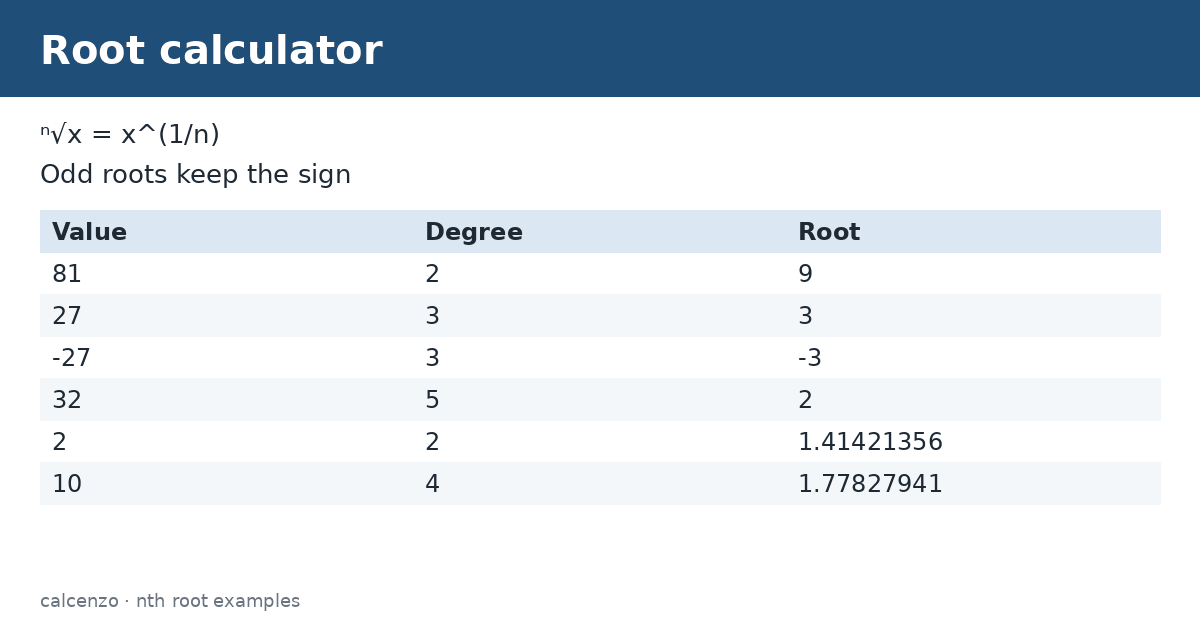
Enter 81 and degree 2. The root calculator returns 9, because 9 × 9 = 81. Enter 27 and degree 3 to get 3, since 3 × 3 × 3 = 27. Enter 32 with degree 5 to get 2. A number that is not a perfect power gives an irrational answer, so √2 is shown as 1.41421356.
| Value | Degree | Root |
|---|---|---|
| 81 | 2 | 9 |
| 27 | 3 | 3 |
| -27 | 3 | -3 |
| 32 | 5 | 2 |
| 2 | 2 | 1.41421356 |
| 10 | 4 | 1.77827941 |
Roots as exponents
Every root can be written as a fractional exponent: ⁿ√x = x^(1/n). This makes rules easy to apply. For example, x^(2/3) is the cube root of x, squared. 8^(2/3) is (∛8)² = 2² = 4. You can find the root part here and then square the result, or use the exponent calculator for the whole power.
Simplifying radicals by hand
To simplify √72, look for the largest perfect-square factor: 72 = 36 × 2, so √72 = 6√2 ≈ 8.48528137. For cube roots, look for perfect cubes; ∛54 = ∛27 × ∛2 = 3∛2. The root calculator gives the decimal, which you can use to check a simplified form.
Negative numbers and fractional degrees
Odd roots of negative numbers are real; even roots are not. Use whole-number degrees with negative values. A degree such as 1.5 or 2.5 with a negative value does not have a real answer, and the root calculator now shows an error for that combination instead of a number. For positive values, any non-zero degree is fine; a degree of 0.5 squares the number.
Where roots are used
Square roots give the side of a square from its area, distances in the Pythagorean theorem and the standard deviation in statistics. Cube roots give the side of a cube from its volume. Higher roots appear in growth rates: the yearly rate that doubles money in 10 years is the tenth root of 2 minus 1, about 7.18%.
Checking a result
Raise the answer to the degree and you should get the original value back, apart from tiny rounding. 1.77827941⁴ ≈ 10.0000. Small differences in the last digit come from rounding the display, not from an error in the root calculator.
Perfect squares and cubes to know
Knowing a few perfect powers makes estimates quick. The perfect squares up to 144 are 1, 4, 9, 16, 25, 36, 49, 64, 81, 100, 121 and 144. The first perfect cubes are 1, 8, 27, 64, 125, 216, 343, 512, 729 and 1,000. If a value sits between two of these, its root sits between their roots; √50 is a little above 7 because 49 is just below 50. That quick check catches a wrong degree or a typing slip in seconds.
Tips
- Use degree 2 for square roots and 3 for cube roots.
- Use odd whole-number degrees for negative values.
- Check by raising the result to the degree.
- Check simplified radicals against the decimal.
Related converters and calculators
Related calculators:
- Exponent calculator: powers
- Scientific calculator: more functions
- Pythagorean theorem calculator: square roots
- Log calculator: logarithms
Sources
OpenStax College Algebra 2e, 1.3: Radicals and rational exponents; OpenStax Prealgebra 2e, 10.2: Multiplication properties of exponents.
Formula and method
root = sign(value) * abs(value)^(1/degree), for degree != 0. Even degree requires value >= 0.
Principal real root using JavaScript Math.pow on the absolute value, then restoring sign for odd roots.
Questions about this calculator
What is an nth root?
A number that gives the value when raised to the nth power.
Can I find the root of a negative number?
Yes for odd degrees; even roots of negatives are not real.
How is a root written as an exponent?
x^(1/n).
What is the cube root of 27?
3.
How many decimals does it show?
Up to 8.
Check the assumptions and units before relying on a result. Financial, tax and health estimates do not replace advice for your individual circumstances.
Report a calculation issue