
A gravel calculator works out how much gravel you need, in cubic yards, from the length and width of the area and the depth you want to cover. A 30 × 12 ft driveway at 4 inches deep needs about 4.44 cubic yards.
On this page
How to use the gravel calculator
- Enter the length in feet.
- Enter the width in feet.
- Enter the depth in inches.
- Read the volume in cubic yards.
What is the gravel volume formula?
Gravel is sold by the cubic yard or by the ton. The gravel calculator finds the volume of a rectangular area in cubic yards:
- Cubic feet = length (ft) × width (ft) × depth (in) ÷ 12
- Cubic yards = cubic feet ÷ 27
There are 27 cubic feet in a cubic yard because a yard is 3 feet on each side, and 3 × 3 × 3 = 27.
Gravel calculator worked example
A driveway 30 feet long and 12 feet wide, covered 4 inches deep, needs 30 × 12 × (4 ÷ 12) = 120 cubic feet. Divided by 27, that is 4.44 cubic yards. Many suppliers sell in half- or whole-yard steps, so you would order 4.5 or 5 yards.
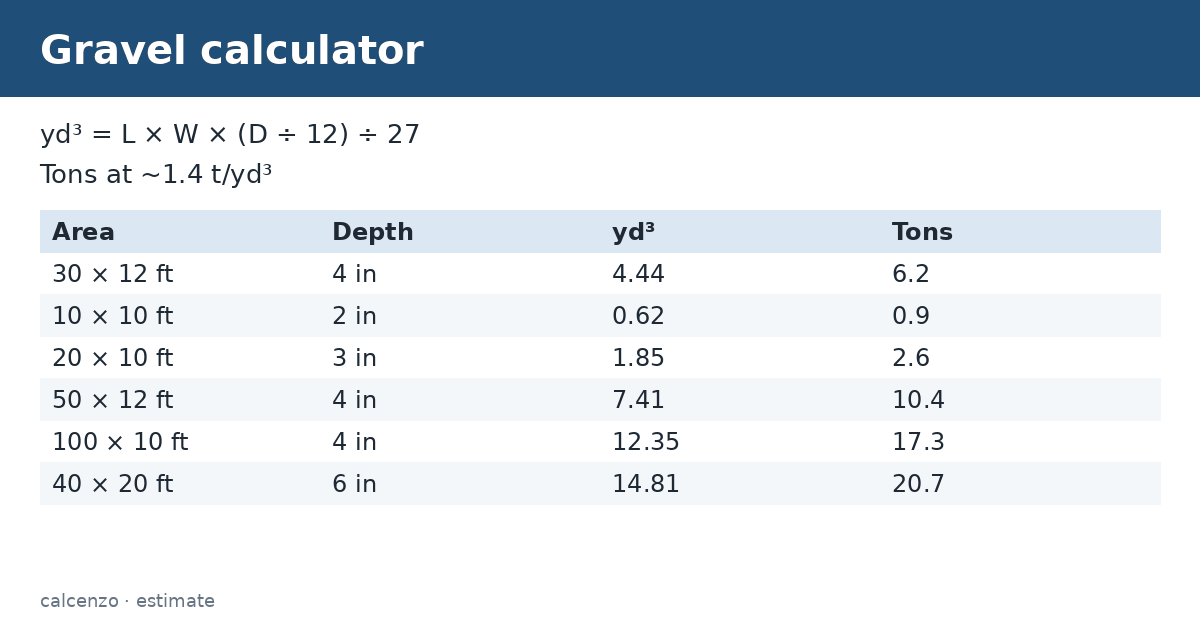
| Area | Depth | Cubic yards | Approx. tons at 1.4 t/yd³ |
|---|---|---|---|
| 30 × 12 ft | 4 in | 4.44 | 6.2 |
| 10 × 10 ft | 2 in | 0.62 | 0.9 |
| 20 × 10 ft | 3 in | 1.85 | 2.6 |
| 50 × 12 ft | 4 in | 7.41 | 10.4 |
| 100 × 10 ft | 4 in | 12.35 | 17.3 |
| 40 × 20 ft | 6 in | 14.81 | 20.7 |
Converting cubic yards to tons
Gravel weight depends on the stone type, size and moisture. A commonly used rule of thumb is about 1.4 tons per cubic yard for typical crushed stone or pea gravel, with a range of roughly 1.3 to 1.5 tons. Ask your supplier for the weight of the specific product, then multiply the gravel calculator result by it. At 1.4 tons per yard, 4.44 cubic yards is about 6.2 tons.
How deep should gravel be?
- Walkways and decorative beds: about 2 to 3 inches.
- Patios and shed bases: about 4 inches of compacted base.
- Driveways: often 4 to 6 inches or more, sometimes in layers of larger base stone topped with finer gravel, especially on soft soil.
These are general guidelines; local soil, drainage and traffic matter. Compacted gravel settles, so many installers order 5% to 10% extra.
Irregular and round areas
Break an irregular area into rectangles, run each through the gravel calculator and add the results. For a circle, use the area π × r² in square feet, multiply by the depth in feet and divide by 27. A round bed 10 feet across (radius 5 ft) at 3 inches deep is 3.14 × 25 × 0.25 ÷ 27 = 0.73 cubic yards. For a triangle, use half of base × height for the area.
Choosing gravel
- Crushed stone: angular pieces that lock together; good for driveways and bases.
- Pea gravel: small, rounded stones that are comfortable to walk on but shift under tires.
- Crusher run or road base: a mix of stone and fines that compacts into a firm surface.
- River rock: larger rounded stones for decoration and drainage.
Estimating cost
Multiply the cubic yards or tons by the supplier’s price, then add delivery, which is often a flat fee per load. Buying in bulk is usually much cheaper than bags: a cubic yard equals about 54 half-cubic-foot bags. Use landscape fabric under decorative gravel to slow weeds.
Preparing the site
Good preparation makes gravel last. Remove grass and topsoil, level the area and slope it slightly so water drains away from buildings. Edging made of steel, plastic or stone keeps gravel from spreading into the lawn. On soft or clay soil, a geotextile fabric under the base layer stops stones from sinking. For driveways, spread the gravel in layers of 2 to 3 inches and compact each one with a plate compactor or roller. When you plan a layered driveway, run the gravel calculator separately for each layer, since base stone and top gravel are often different products with different prices and weights.
Related converters and calculators
Related calculators:
- Mulch calculator: mulch
- Concrete calculator: concrete
- Square footage calculator: area
- Volume calculator: volume
Sources
USGS Mineral Commodity Summaries 2025: Crushed stone; NIST: SI units – volume.
Questions about this calculator
How much gravel for a 30 × 12 driveway?
About 4.44 cubic yards at 4 inches deep.
How many tons is a yard of gravel?
Roughly 1.4 tons, depending on the stone.
How deep should driveway gravel be?
Often 4 to 6 inches or more.
How many cubic feet in a yard?
27.
Should I order extra?
Yes, 5% to 10% for settling.
Check the assumptions and units before relying on a result. Financial, tax and health estimates do not replace advice for your individual circumstances.
Report a calculation issue