
A volume calculator works out how much space a solid shape occupies from its dimensions. A 5 × 4 × 3 foot box holds 60 cubic feet, and a sphere with a 3-inch radius holds about 113.1 cubic inches.
On this page
How to use the volume calculator
- Choose box, sphere, cylinder or cone.
- Enter the length or radius, the width (box only) and the height.
- Read the volume in cubic units.
How the volume calculator works
The volume calculator covers four common solids. For a box (rectangular prism), volume = length × width × height. For a sphere, volume = 4/3 × π × r³, where r is the radius. For a cylinder, volume = π × r² × height. For a cone, volume = π × r² × height ÷ 3, exactly one third of a cylinder with the same base and height. The first input is the length for a box and the radius for the round shapes; width is used only for the box.
Volume calculator worked example
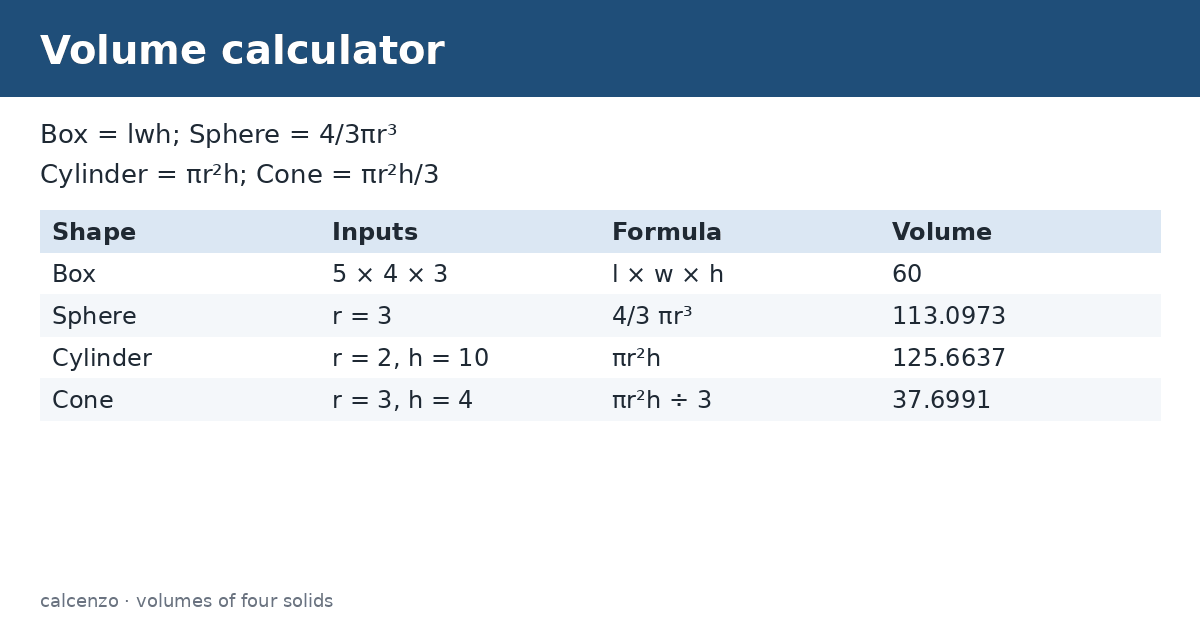
A box 5 by 4 by 3 feet holds 60 cubic feet. A ball with a 3-inch radius has a volume of 36π, about 113.0973 cubic inches. A cylinder with radius 2 and height 10 is 40π, about 125.6637 cubic units, and a cone with radius 3 and height 4 is 12π, about 37.6991. The volume calculator shows four decimal places.
| Shape | Inputs | Formula | Volume |
|---|---|---|---|
| Box | 5 × 4 × 3 | l × w × h | 60 |
| Sphere | r = 3 | 4/3 πr³ | 113.0973 |
| Cylinder | r = 2, h = 10 | πr²h | 125.6637 |
| Cone | r = 3, h = 4 | πr²h ÷ 3 | 37.6991 |
Radius, not diameter
The round shapes use the radius, half the diameter. Entering a diameter by mistake makes a sphere eight times too big and a cylinder four times too big, because radius is cubed or squared. Measure across the widest part and divide by two, or measure the circumference and divide by 2π.
Units and conversions
Use one length unit for every input; the volume is in the cube of that unit. To convert, 1 cubic foot is 1,728 cubic inches and about 7.48 US gallons, and 1 cubic meter is 1,000 liters. For concrete or soil, 27 cubic feet make one cubic yard. A volume converter handles less common units such as quarts, pints and imperial gallons.
Real-world uses
Use it to size a planter, estimate water in a round tank, compare packaging, or work out how much concrete a footing needs. For a tank, compute the volume in cubic feet and multiply by 7.48 to get gallons. Remember that real containers have wall thickness and rounded corners, so the inside dimensions give the usable capacity and the outside dimensions give the space the item takes up.
Composite shapes
Many objects combine simple solids. A silo is a cylinder with a cone or hemisphere on top: add the volumes. A hollow pipe is the outer cylinder minus the inner one. Split the object into parts, work out each part, and add or subtract as needed.
Volume calculator for capacity
When you need liquid capacity, run the volume calculator with dimensions in centimeters and divide the answer by 1,000 to get liters, because one liter is 1,000 cubic centimeters. A fish tank 60 by 30 by 40 centimeters holds 72,000 cubic centimeters, or 72 liters, before you subtract gravel and decorations. In inches, divide cubic inches by 231 to get US gallons.
Measurement accuracy
Small errors in measurement grow in volume. A 2% error in each of three box dimensions can produce about a 6% error in volume, and a 2% error in a radius produces about a 6% error in a sphere. Measure carefully, take each dimension twice, use the same tape for every dimension, and round only the final answer, not the inputs.
Tips
- Enter positive dimensions; zero or negative values are rejected.
- Measure inside dimensions for capacity.
- Keep all inputs in the same unit.
- Round the final answer to match your measurements.
Related converters and calculators
Related calculators:
- Surface area calculator: surface area
- Volume converter: units
- Concrete calculator: cubic yards
- Circle calculator: circles
Sources
OpenStax Prealgebra 2e, 9.6: Volume and surface area.
Formula and method
Box: LxWxH. Sphere: (4/3)πr³ (r in L). Cylinder: πr²h. Cone: (1/3)πr²h.
Shape switch selects the solid formula. Field L is length for a box or radius for round solids.
Questions about this calculator
What is the volume of a sphere?
4/3 × π × r³.
How is a cone related to a cylinder?
It has one third of the volume.
Do I enter radius or diameter?
Radius.
What unit is the answer?
The cube of the input unit.
How many gallons in a cubic foot?
About 7.48 US gallons.
Check the assumptions and units before relying on a result. Financial, tax and health estimates do not replace advice for your individual circumstances.
Report a calculation issue