
A volume converter changes a capacity from one unit to another, such as liters to US gallons or cups to milliliters. Formula: L = US gal × 3.785411784; L = Imperial gal × 4.54609. 1 US gallon is exactly 3.785411784 liters.
On this page
How to use the volume converter
- Enter the value.
- Choose the unit to convert from.
- Choose the unit to convert to.
- Read the converted volume.
How the volume converter works
The volume converter supports 20 units, including milliliters, liters, cubic meters, cubic inches and feet, teaspoons, tablespoons, fluid ounces, cups, pints, quarts and gallons in both US and imperial measures. It converts your value to liters with each unit’s defined factor, then from liters to the target unit. The default converts liters to US gallons, a common need when comparing fuel or water containers.
US versus imperial units
The US gallon is exactly 231 cubic inches, or 3.785411784 liters. The imperial gallon used in the UK is exactly 4.54609 liters, about 20% larger. Pints, quarts and fluid ounces differ too: a US pint is 16 US fluid ounces, while an imperial pint is 20 imperial fluid ounces, and the two kinds of fluid ounce are not the same size. Always pick the right system in the volume converter, especially for fuel economy and recipes from another country.
Volume converter worked example
A 2-liter bottle holds 2 × 0.264172 = 0.528344 US gallons. A 5-gallon US bucket holds 18.927 liters. One US cup is 8 US fluid ounces, or 236.5882 milliliters, and a US tablespoon is about 14.787 milliliters. A cubic meter is 1,000 liters, or about 264.17 US gallons. The volume converter shows these at full precision.
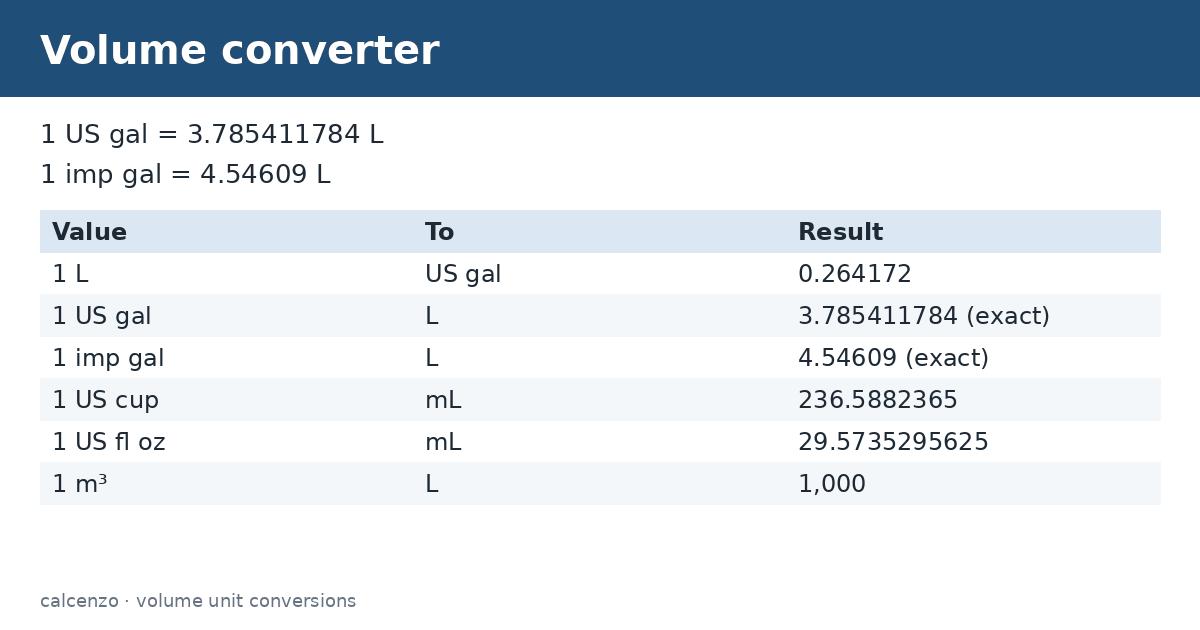
| Value | To | Result |
|---|---|---|
| 1 L | US gal | 0.264172 |
| 1 US gal | L | 3.785411784 (exact) |
| 1 imp gal | L | 4.54609 (exact) |
| 1 US cup | mL | 236.5882365 |
| 1 US fl oz | mL | 29.5735295625 |
| 1 m³ | L | 1,000 |
Cooking measures
US recipe cups and spoons are fixed fractions of the US gallon: 16 cups to the gallon, 16 tablespoons to the cup and 3 teaspoons to the tablespoon. Nutrition labels in the US use a rounded cup of 240 milliliters and a fluid ounce of 30 milliliters. Metric cups used in Australia and elsewhere are 250 milliliters. For baking, weighing dry ingredients is more accurate than measuring their volume.
Volume is not weight
A volume converter cannot turn liters into kilograms without knowing the density. One liter of water has a mass of about 1 kilogram, but a liter of flour weighs roughly half that and a liter of honey about 1.4 kilograms. Fluid ounces measure volume and ordinary ounces measure weight; they match only for water, and only approximately.
Cubic units
Cubic units come from length: a cube 10 centimeters on a side holds 1,000 cubic centimeters, which is one liter, and one milliliter equals one cubic centimeter. A cubic foot is 1,728 cubic inches, or about 28.317 liters and 7.48 US gallons. Compute a volume from dimensions with a volume calculator, then convert it here.
Everyday volume converter examples
A standard 750 mL wine bottle holds about 25.36 US fluid ounces. A 12-ounce US soda can holds about 355 milliliters. Car fuel tanks listed at 50 liters hold about 13.21 US gallons or 11 imperial gallons. A 1.5-liter bottle of water is about 6.34 US cups. Each result can be rounded to suit the label or recipe.
Fuel economy across systems
Fuel economy figures expressed in miles per gallon differ between the US and the UK because the gallons differ. A car rated at 40 mpg with imperial gallons manages about 33.3 mpg with US gallons. Convert the gallons separately before comparing, or use liters per 100 kilometers, which avoids the problem. Most countries outside the US and UK already report fuel use that way.
Tips
- Choose US or imperial units deliberately.
- Remember 1 mL = 1 cm³.
- Do not convert volume to weight without density.
- Round to the precision of your measuring tool or container.
Related converters and calculators
Related calculators:
- Gallons to liters: gallons
- Liters to gallons: liters
- Cups to mL: cooking
- Volume calculator: shapes
Sources
NIST: SI units – volume; NIST Guide to the SI, Appendix B.8: Factors for units listed alphabetically.
Formula and method
Target = value × factor(source) ÷ factor(target); factors are in cubic meters.
Your value is multiplied by the source unit factor and divided by the target unit factor (both expressed in the base unit). Results are shown rounded; the calculation uses full precision.
Questions about this calculator
How many liters in a US gallon?
3.785411784 exactly.
How big is an imperial gallon?
4.54609 liters.
How many mL in a US cup?
About 236.59.
Is 1 mL the same as 1 cm³?
Yes.
Can I convert liters to kilograms?
Only with the density.
Check the assumptions and units before relying on a result. Financial, tax and health estimates do not replace advice for your individual circumstances.
Report a calculation issue