
An invoice factoring calculator shows how much cash you get when you sell an unpaid invoice, what the factor charges and what that costs as an annual rate. The invoice factoring calculator uses this formula: Advance = invoice x advance % / 100. Fee = invoice x fee % / 100. Reserve = invoice – advance – fee. Approx APR = (fee / advance) x (365 / days) x 100. A $25,000 invoice with an 85% advance and a 3% fee gives you $21,250 now and $3,000 later; if your customer pays in 45 days, the cost works out to about 28.6% a year.
On this page
How to use the invoice factoring calculator
- Enter the invoice amount.
- Enter the advance rate the factor offers.
- Enter the total factoring fee as a percentage of the invoice.
- Enter the expected days until your customer pays.
What formula does the invoice factoring calculator use?
- Advance = invoice amount × advance rate
- Factoring fee = invoice amount × fee %
- Reserve released when your customer pays = invoice − advance − fee
- Annualized cost = fee ÷ advance × 365 ÷ days until your customer pays
Invoice factoring calculator worked example
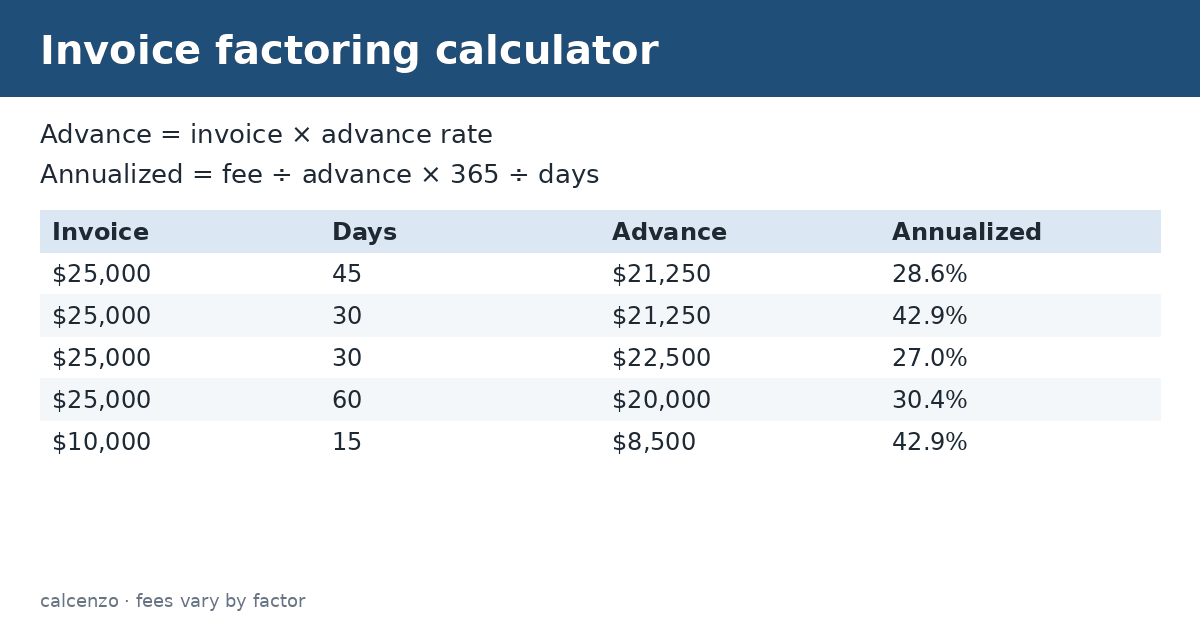
| Invoice | Advance rate | Fee | Days | Advance | Fee $ | Reserve | Annualized |
|---|---|---|---|---|---|---|---|
| $25,000 | 85% | 3% | 45 | $21,250 | $750 | $3,000 | 28.6% |
| $25,000 | 85% | 3% | 30 | $21,250 | $750 | $3,000 | 42.9% |
| $25,000 | 90% | 2% | 30 | $22,500 | $500 | $2,000 | 27.0% |
| $25,000 | 80% | 4% | 60 | $20,000 | $1,000 | $4,000 | 30.4% |
| $10,000 | 85% | 1.5% | 15 | $8,500 | $150 | $1,350 | 42.9% |
On a $25,000 invoice with an 85% advance and a 3% fee, you receive $21,250 now. The factor keeps $750 as its fee and releases the $3,000 reserve when your customer pays. If that takes 45 days, the fee is equal to an annual rate of about 28.6% on the money advanced.
How factoring fees are charged
Fees are quoted in different ways, and the structure matters as much as the headline rate. A flat fee is charged once per invoice. A tiered or time-based fee rises the longer your customer takes to pay, for example a set percentage for each 10 or 30 days. Some factors also charge application, due diligence, wire or minimum volume fees. Enter the total fee you expect to pay as a percentage of the invoice so the invoice factoring calculator compares offers on the same basis.
Recourse and non-recourse factoring
With recourse factoring, you must buy back or replace an invoice if your customer does not pay. Non-recourse factoring moves some of that risk to the factor, usually only when the customer cannot pay because of insolvency, and costs more. Read the agreement for what counts as a non-payment and how long the factor waits before charging an invoice back to you.
When factoring makes sense
- Your customers are creditworthy businesses that pay reliably but slowly.
- Waiting for payment stops you taking on new work or meeting payroll.
- Bank credit is not available or would take too long.
Compare the annualized cost with a business line of credit or an SBA-backed loan before signing. Factoring is usually more expensive per year, but it is based on your customers’ credit rather than yours, and it can grow with your sales.
Estimates for planning only, not legal, tax or financial advice. Check carrier, card network, lender and state rules before relying on a figure.
Choosing a factoring company
Ask several factors for quotes on the same invoices and enter each one in the invoice factoring calculator. Beyond price, compare how quickly they fund, whether you must factor all invoices or can choose which ones, the length of the contract and any notice period or exit fee. Check how the factor contacts your customers, since it will usually collect payment directly and its manner reflects on your business.
Ask for a full list of fees in writing. A low headline rate can be offset by monthly minimums, wire fees or charges for invoices that take longer than expected to pay. Entering the total cost for a typical month into the invoice factoring calculator gives a fairer comparison than the advertised rate alone.
Shortening payment terms instead
Factoring solves a cash gap, but it is worth tackling the cause too. Invoice promptly, offer a small discount for early payment, accept electronic payments and follow up on overdue invoices quickly. If customers pay in 30 days instead of 45, you may need less factoring, and each factored invoice costs less.
Related converters and calculators
Related calculators:
- Merchant cash advance APR calculator: MCA
- Business loan calculator: loans
- APR calculator: APR
Sources
SBA: Fund your business; SBA: Loans; SBA: Manage your finances.
Questions about this calculator
How does invoice factoring work?
You sell an unpaid invoice to a factor for an advance now and the rest, minus a fee, when your customer pays.
What is a typical advance rate?
Offers vary; the calculator’s default is 85%.
How is the annual cost worked out?
Fee ÷ advance × 365 ÷ days to payment.
What is recourse factoring?
You must cover invoices your customer does not pay.
Is factoring a loan?
It is usually a sale of receivables, not a loan.
Check the assumptions and units before relying on a result. Financial, tax and health estimates do not replace advice for your individual circumstances.
Report a calculation issue