
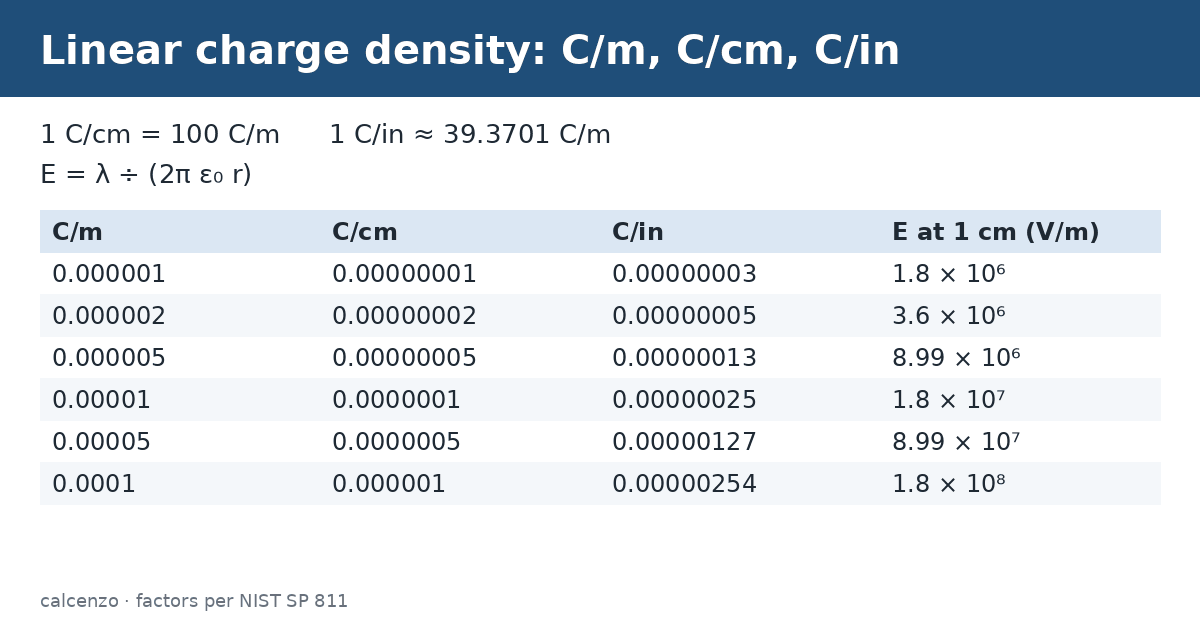
This linear charge density converter changes charge per unit length between coulombs per meter, per centimeter and per inch, abcoulombs per centimeter and statcoulombs per centimeter. The SI unit is C/m. 1 C/cm is exactly 100 C/m, and 1 C/in is about 39.3701 C/m because 1 in = 0.0254 m.
On this page
How to use the linear charge density converter
- Enter the value, for example 2 µC/m entered as 0.000002 C/m.
- In the linear charge density converter, choose its unit and the target unit, such as C/m to C/cm.
- Read the linear charge density converter result: 2 µC/m = 0.00000002 C/cm (2 × 10⁻⁸).
For C/m to C/cm, divide by 100; for C/in to C/m, multiply by 39.3701. For µC/m to C/m, divide by 1,000,000.
What is linear charge density?
Linear charge density is electric charge per unit length along a line or wire, in coulombs per meter (C/m). It appears in electrostatics problems involving charged rods and cables.
Conversion formula
The linear charge density converter stores every unit as a multiple of the base unit, the coulomb per meter (C/m). To convert:
value in target unit = value × (factor of source unit ÷ factor of target unit)
where each factor is the size of the unit in coulombs per meter.
Common linear charge density conversions
| From | To | 1 unit equals |
|---|---|---|
| coulomb per meter (C/m) | coulomb per centimeter (C/cm) | 0.01 C/cm |
| coulomb per centimeter (C/cm) | coulomb per meter (C/m) | 100 C/m |
| coulomb per meter (C/m) | coulomb per inch (C/in) | 0.0254 C/in |
Linear charge density converter worked example
Convert 25 coulombs per meter to coulombs per centimeter:
- Factor of C/m = 1 C/m
- Factor of C/cm = 100 C/m
- 25 × 1 ÷ 100 = 0.25 C/cm
Linear charge density unit reference
| Unit | Symbol | Group | Equals (C/m) |
|---|---|---|---|
| Coulomb per Meter | C/m | SI | 1 |
| Coulomb per Centimeter | C/cm | SI | 100 |
| Coulomb per Inch | C/in | US/Imperial | 39.37007874 |
| Abcoulomb per Centimeter | abC/cm | CGS-EMU | 1,000 |
| Statcoulomb per Centimeter | statC/cm | CGS-ESU | 3.33564 × 10⁻⁸ |
Reverse factors for each linear charge density unit
The reference table gives each unit in coulomb per meters. To go the other way, divide by that factor; the list below does the division for you.
- Coulomb per Centimeter (C/cm), SI: 1 C/cm = 100 C/m, so 1 C/m = 0.01 C/cm.
- Coulomb per Inch (C/in), US/Imperial: 1 C/in = 39.37008 C/m, so 1 C/m = 0.0254 C/in.
- Abcoulomb per Centimeter (abC/cm), CGS-EMU: 1 abC/cm = 1,000 C/m, so 1 C/m = 0.001 abC/cm.
- Statcoulomb per Centimeter (statC/cm), CGS-ESU: 1 statC/cm = 3.33564 × 10⁻⁸ C/m, so 1 C/m = 2.99793 × 10⁷ statC/cm.
Electric field of a line charge
Gauss’s law gives the field at distance r from a long, straight line charge: E = λ ÷ (2π ε₀ r), with ε₀ ≈ 8.8541878188 × 10⁻¹² F/m (CODATA). The field falls as 1/r:
| λ (C/m) | E at 1 cm (V/m) | E at 10 cm (V/m) |
|---|---|---|
| 1 × 10⁻⁹ | 1.8 × 10³ | 1.8 × 10² |
| 1 × 10⁻⁸ | 1.8 × 10⁴ | 1.8 × 10³ |
| 1 × 10⁻⁶ | 1.8 × 10⁶ | 1.8 × 10⁵ |
Values assume a very long line in vacuum or air and λ in C/m, so convert to SI units before applying the formula. Air breaks down at roughly 3 × 10⁶ V/m, which limits how much charge a thin wire can hold in practice.
Linear charge density and current
When charges with density λ move along a wire at speed v, the current is I = λ × v. A line charge of 1 µC/m moving at 1,000 m/s is a current of 1 mA. Convert the total charge with the electric charge converter and the field with the electric field strength converter.
From total charge to density
For a uniformly charged wire, divide the total charge by the length. A 25 cm wire carrying 5 nC has a linear charge density of 20 nC/m. The linear charge density converter turns that into 0.2 nC/cm or about 0.51 nC/in. The jump between per meter and per centimeter is a factor of 100, and between per meter and per inch it is about 39.37, which is where most hand errors creep in.
If the charge is not uniform, the density varies along the wire and the total charge is the integral of λ over the length. Textbook problems state λ in C/m because it drops straight into the field formula without extra factors.
Related converters and calculators
Related electrical tools:
- Surface charge density converter: C/m²
- Volume charge density converter: C/m³
- Electric charge converter: C and mAh
- Electric field strength converter: V/m
- Length converter: m, ft, in
Sources
NIST CODATA: Vacuum electric permittivity; NIST Special Publication 811, Appendix B.
Questions about this calculator
What is the SI unit of linear charge density?
Coulomb per meter (C/m).
How do I convert C/m to C/cm?
Divide by 100. For example, 5 C/m = 0.05 C/cm.
How do I convert C/in to C/m?
Multiply by 39.3701. For example, 0.1 C/in ≈ 3.937 C/m.
What is the field of a line charge?
E = λ ÷ (2π ε₀ r). 1 nC/m gives about 1,798 V/m at 1 cm.
How is linear charge density related to current?
I = λ × v for charges moving along the line at speed v.
Check the assumptions and units before relying on a result. Financial, tax and health estimates do not replace advice for your individual circumstances.
Report a calculation issue