
An overweight calculator checks whether your body mass index is 25 or higher, the adult threshold for overweight. Formula: BMI = weight kg / (height m)^2 where height m = height cm / 100. <18.5 underweight; 18.5-24.9 healthy; 25-29.9 overweight; 30-34.9 obesity class 1; 35-39.9 class 2; 40+ class 3. At 85 kg and 175 cm, BMI is 27.8.
On this page
How to use the overweight calculator
- Enter your weight in kilograms.
- Enter your height in centimeters.
- Read your BMI and status, then compare it with the categories.
How the overweight calculator works
The overweight calculator works out body mass index (BMI) from your weight in kilograms and height in centimeters: BMI = weight ÷ (height in meters)². It then reports whether the result is 25 or higher, the adult threshold for overweight used by the NIH and most health agencies. The status line uses the CDC adult categories: underweight, healthy weight, overweight (25 to 29.9) and obesity classes 1, 2 and 3 (30 or higher).
Overweight calculator worked example
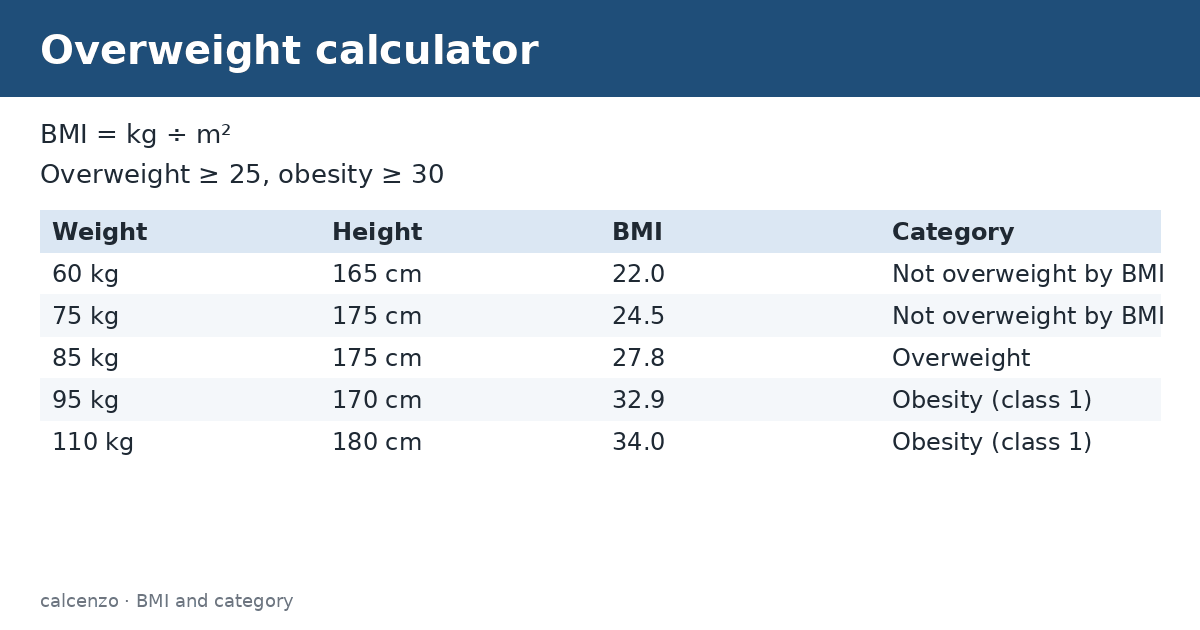
A person who weighs 85 kg and is 175 cm tall has a BMI of 85 ÷ 1.75² = 27.8. The overweight calculator flags that as overweight or higher. At 75 kg and the same height, BMI is 24.5, just inside the healthy range. At 95 kg and 170 cm, BMI is 32.9, which is in the obesity range. To convert from pounds, divide by 2.2046; from inches, multiply by 2.54.
| Weight | Height | BMI | Category |
|---|---|---|---|
| 60 kg | 165 cm | 22.0 | Not overweight by BMI |
| 75 kg | 175 cm | 24.5 | Not overweight by BMI |
| 85 kg | 175 cm | 27.8 | Overweight |
| 95 kg | 170 cm | 32.9 | Obesity (class 1) |
| 110 kg | 180 cm | 34.0 | Obesity (class 1) |
Adult BMI categories
- Below 18.5: underweight
- 18.5 to 24.9: healthy weight
- 25 to 29.9: overweight
- 30 to 34.9: obesity class 1
- 35 to 39.9: obesity class 2
- 40 and above: obesity class 3
These cut-offs come from NIH guidance and apply to adults aged 20 and over. Children and teens are assessed with BMI-for-age percentiles instead, so this tool is not suitable for them.
Waist size adds information
The NHLBI pairs BMI with waist circumference because fat carried around the abdomen raises the risk of type 2 diabetes, high blood pressure and heart disease. A waist over 40 inches (102 cm) for men or over 35 inches (88 cm) for women adds to the risk at any BMI between 25 and 34.9. Measure just above the hip bones after breathing out.
Limits of BMI
BMI does not measure body fat directly. Muscular athletes can score as overweight while carrying little fat, and older adults may have a normal BMI with low muscle and more fat. Risk at a given BMI also differs between ethnic groups; some guidelines use lower thresholds for people of Asian descent. Pregnancy changes weight in ways BMI cannot interpret. The overweight calculator is a screening step, not a diagnosis.
If you are above 25
NIDDK notes that even a modest loss of 5% to 10% of body weight can improve blood pressure, blood sugar and cholesterol in adults with overweight or obesity. Sustainable changes in eating, physical activity and sleep work better than short diets. A doctor can check related conditions and discuss options, including programs, medicines or surgery where appropriate.
Tips for an accurate result
- Weigh yourself in the morning in light clothing.
- Measure height without shoes, standing straight against a wall.
- Enter weight in kg and height in cm.
- Track the trend over months rather than daily changes.
How much change moves the category?
To find the weight for a given BMI, multiply the target BMI by height in meters squared. At 175 cm, a BMI of 25 corresponds to 25 × 1.75² ≈ 76.6 kg, so a person weighing 85 kg would be about 8.4 kg above the overweight threshold. A 5% loss from 85 kg is 4.25 kg, which lowers BMI from 27.8 to about 26.4 and can already improve health markers. Run the overweight calculator again after each change to see the new BMI.
For general information only, not medical or nutrition advice. A doctor or registered dietitian can give advice for your health and goals.
Related converters and calculators
Related calculators:
- BMI calculator: full BMI ranges
- Healthy weight calculator: target range
- Body fat calculator: body fat
- Ideal weight calculator: ideal weight
Sources
CDC: Adult BMI categories; NHLBI: Assessing your weight and health risk; NIDDK: Overweight and obesity.
Formula and method
BMI = weight_kg / (height_m)^2 where height_m = height_cm / 100. <18.5 underweight; 18.5-24.9 healthy; 25-29.9 overweight; 30-34.9 obesity class 1; 35-39.9 class 2; 40+ class 3.
Standard BMI with CDC adult categories. Educational only, not a diagnosis.
Questions about this calculator
What BMI is overweight?
25 to 29.9 for adults; 30 or higher is obesity.
Does it show obesity?
Yes, it shows obesity class 1, 2 or 3 from a BMI of 30.
Is it accurate for athletes?
Not always; muscle can raise BMI.
Can children use it?
No, children use BMI-for-age percentiles.
What units does it use?
Kilograms and centimeters.
Check the assumptions and units before relying on a result. Financial, tax and health estimates do not replace advice for your individual circumstances.
Report a calculation issue