
A payback period calculator shows how many years an investment takes to return its cost from the cash it generates. Formula: Payback years = investment / annual net cashflow (both positive). A $50,000 machine saving $12,500 a year pays back in 4 years.
On this page
How to use the payback period calculator
- Enter the initial investment.
- Enter the annual net cash flow.
- Read the payback period in years.
How the payback period calculator works
The payback period calculator divides the initial investment by the cash flow the project returns each year: payback period = investment ÷ annual cash flow. The result is the number of years it takes to get your money back. Both values must be positive. The calculation assumes an even cash flow every year and ignores the time value of money, so it is a quick screening measure rather than a full appraisal.
Payback period calculator worked example
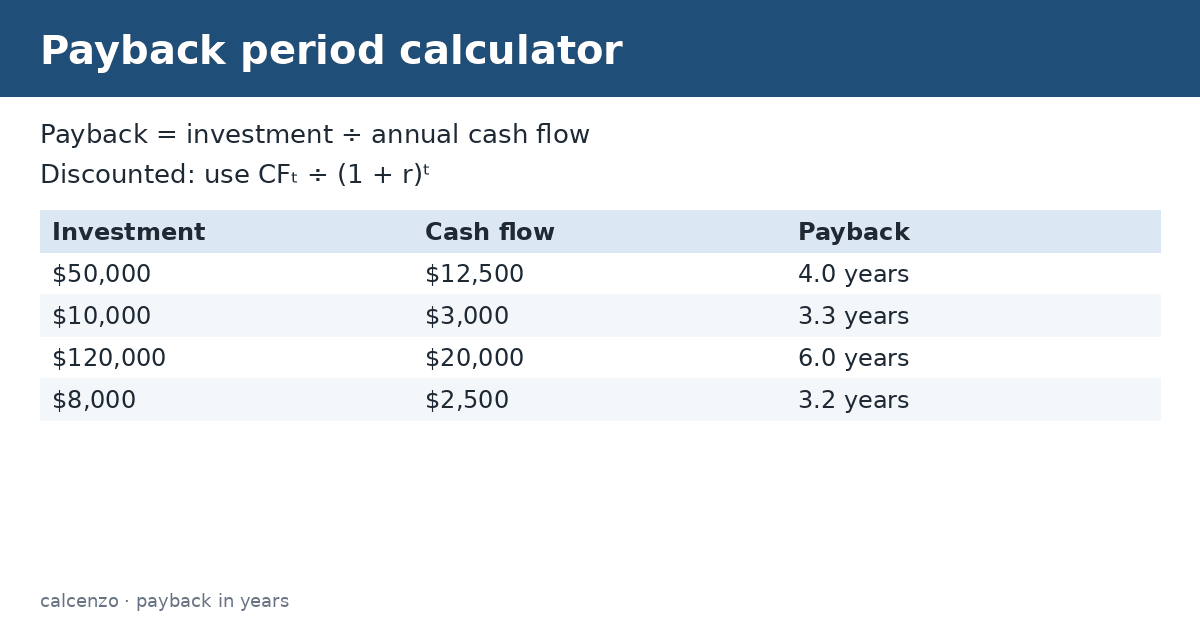
A business buys a $50,000 machine that saves $12,500 a year. The payback period calculator returns 50,000 ÷ 12,500 = 4.0 years. A $10,000 solar add-on that saves $3,000 a year pays back in about 3.3 years, or 3 years and 4 months. The table shows several cases.
| Investment | Annual cash flow | Payback period |
|---|---|---|
| $50,000 | $12,500 | 4.0 years |
| $10,000 | $3,000 | 3.3 years |
| $120,000 | $20,000 | 6.0 years |
| $8,000 | $2,500 | 3.2 years |
Uneven cash flows
When returns change from year to year, add them up cumulatively until the total reaches the investment. Suppose a $30,000 project returns $8,000, $10,000, $12,000 and $14,000 over four years. After three years the cumulative total is exactly $30,000, so payback is 3 years. If it had needed $34,000, you would be $4,000 short after year three and recover that in 4,000 ÷ 14,000 ≈ 0.29 of year four, a payback of about 3.3 years. This tool handles the even case; do the cumulative sum for uneven flows.
Discounted payback
A dollar received in five years is worth less than a dollar today. Discounted payback first divides each year’s cash flow by (1 + r)ᵗ, where r is your required rate of return, then counts the years to recover the investment. At 8%, the $12,500 yearly saving is worth about $11,574 in year one and $9,188 in year four in today’s money, so the discounted payback of the machine example is about 5.0 years instead of 4.0.
Strengths and weaknesses
Payback is easy to explain and highlights liquidity and risk: shorter is safer when the future is uncertain or cash is tight. Its main flaw is that it ignores everything after the payback date. A project that pays back in three years and then stops can look better than one that pays back in four and keeps earning for twenty. Corporate finance texts therefore pair it with net present value (NPV) and internal rate of return (IRR), which value all cash flows. Use the payback period calculator as a first filter, then compare finalists with NPV.
Where it is used
Homeowners use payback to judge energy upgrades such as insulation, heat pumps or solar panels: divide the net installed cost after rebates and tax credits by the yearly bill savings. Businesses set cut-offs, such as accepting equipment that pays back within three years. Remember to include maintenance, financing costs and any change in savings over time.
Tips
- Use net cash flow after operating costs and taxes.
- Subtract grants and rebates from the investment.
- Compare payback with the asset’s useful life.
- Check NPV or IRR before committing large sums.
Home energy example
A heat pump costs $14,000 installed. After a $2,000 rebate the net cost is $12,000, and it cuts heating and cooling bills by $1,500 a year. The payback period calculator gives 12,000 ÷ 1,500 = 8 years. If the system is expected to last 15 years, it recovers its cost with seven years of savings to spare. If energy prices rise, payback comes sooner; if savings fall short, it takes longer.
Estimates for education only, not financial advice. Your lender’s figures are final.
Related converters and calculators
Related calculators:
- ROI calculator: return on investment
- IRR calculator: rate of return
- Break-even calculator: break-even units
Sources
OpenStax Principles of Managerial Accounting, 11.2: Payback and accounting rate of return.
Formula and method
Payback years = investment / annual_net_cashflow (both positive).
Undiscounted simple payback. No mid-year timing, salvage, or changing cash-flow schedule.
Questions about this calculator
What is the payback period formula?
Investment ÷ annual cash flow.
What is a good payback period?
It depends; many firms want 2 to 5 years and well within the asset life.
Does it include the time value of money?
No; use discounted payback or NPV for that.
Can it handle uneven cash flows?
Add yearly flows cumulatively by hand.
Why use NPV too?
Payback ignores cash after the break-even date.
Check the assumptions and units before relying on a result. Financial, tax and health estimates do not replace advice for your individual circumstances.
Report a calculation issue