
An investment calculator projects how a starting amount and regular monthly contributions could grow at a steady annual return. $10,000 plus $200 a month at 7% for 20 years grows to about $144,573.
On this page
How to use the investment calculator
- Enter the starting amount and monthly contribution.
- Enter an annual return and number of years.
- Read the future value, contributions and growth.
How the investment calculator works
The investment calculator projects a starting amount plus a fixed monthly contribution at a steady annual return. It compounds monthly, using the annual rate divided by 12, and adds each contribution at the end of the month:
- FV = P(1 + r)n + C × ((1 + r)n − 1) ÷ r
- r = annual rate ÷ 12, n = years × 12
- Growth = FV − starting amount − total contributions
Investment calculator worked example
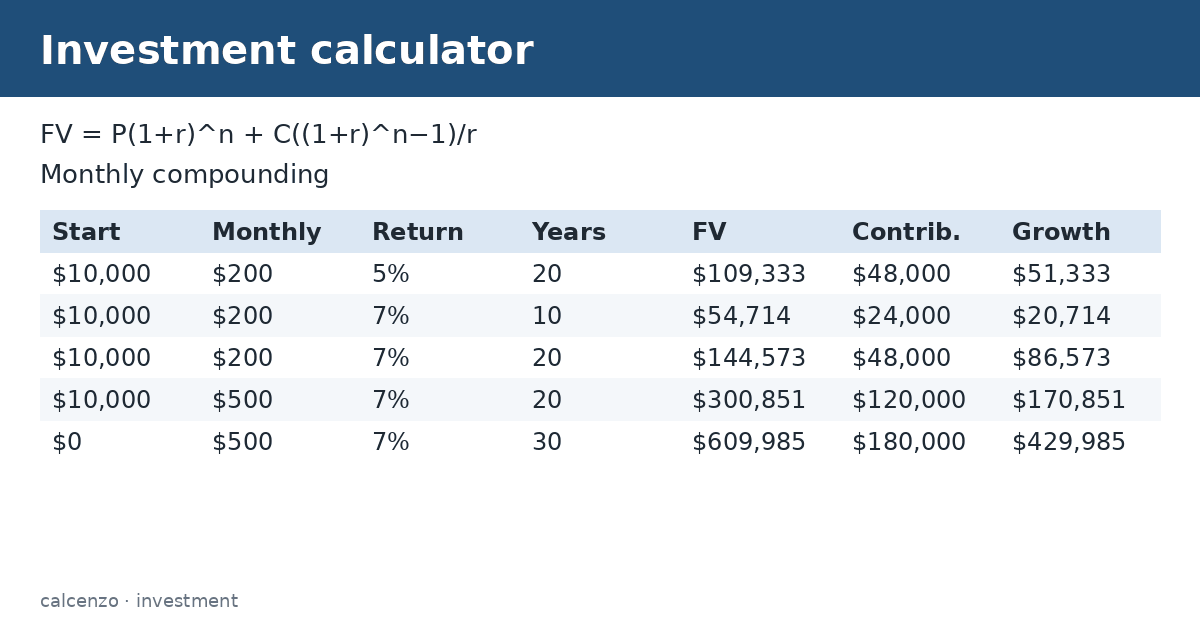
Start with $10,000, add $200 a month and assume 7% a year for 20 years. The investment calculator shows about $144,573. You put in $48,000 of contributions on top of the $10,000, so growth is about $86,573. Raising the contribution to $500 a month roughly doubles the result, and doubling the time from 10 to 20 years more than doubles it, which is compounding at work.
| Start | Monthly | Return | Years | Future value | Contributions | Growth |
|---|---|---|---|---|---|---|
| $10,000 | $200 | 5% | 20 | $109,333 | $48,000 | $51,333 |
| $10,000 | $200 | 7% | 10 | $54,714 | $24,000 | $20,714 |
| $10,000 | $200 | 7% | 20 | $144,573 | $48,000 | $86,573 |
| $10,000 | $500 | 7% | 20 | $300,851 | $120,000 | $170,851 |
| $0 | $500 | 7% | 30 | $609,985 | $180,000 | $429,985 |
Choosing a return rate
Investor.gov, the SEC’s investor education site, reminds investors that returns are not guaranteed and that past performance does not predict future results. Try a low, middle and high rate so you see a range rather than one number. Fees reduce the return you keep, so subtract fund expense ratios and advisory fees from the rate you enter.
Inflation and taxes
The investment calculator shows nominal dollars. To see the result in today’s money, use a real rate, roughly your return minus expected inflation. Taxes on dividends and gains are also ignored; the result fits a tax-deferred account better than a taxable one.
Tips
- Start early: time matters more than the rate in most examples.
- Raise the monthly amount when your income rises.
- Check results against the Investor.gov compound interest calculator.
Estimates for education only, not financial advice. Your lender’s figures are final.
Why steady contributions matter
The investment calculator assumes the same contribution every month and the same return every year. Real markets do not move in a straight line: some years are up sharply and others are down. Regular contributions help because you keep buying through the ups and downs, a habit sometimes called dollar-cost averaging. Investor.gov notes that diversifying across asset types can reduce risk, and that higher expected returns usually come with more risk.
Because the tool uses an average return, it cannot show the effect of a bad year just before you need the money. If you will need the funds within a few years, use a lower rate or a safer mix in your plan. For long goals, the effect of extra years is large: in the table, the same $10,000 and $200 a month grows to about $54,714 after 10 years and $144,573 after 20 years.
Using the result for goals
Work backward from a goal. If you need $300,000 in 20 years and expect 7%, the table shows that $10,000 plus about $500 a month gets there. Try changing one input at a time in the investment calculator to see which lever matters most for you: the monthly amount, the time or the rate. Review the plan once a year and update the starting amount with your real balance, so the projection stays close to your actual account rather than drifting from it. If your employer offers a match in a retirement plan, capture the full match first, because it is an immediate return that no market can reliably beat.
Related converters and calculators
Related calculators:
- Compound interest calculator: compounding
- SIP calculator: monthly investing
- ROI calculator: returns
- Retirement calculator: retirement
Sources
Investor.gov (SEC): Compound interest calculator; Investor.gov (SEC): Compound interest.
Formula and method
Future value with monthly compounding: FV = P*(1+r)^n + PMT*(( (1+r)^n - 1 )/r), where r = annual_rate/100/12 and n = years*12. If r = 0, FV = P + PMT*n. Growth = FV - P - (PMT*n).
Same monthly future-value engine as the retirement calculator; this page frames general investing, not a retirement-only horizon.
Questions about this calculator
How often does it compound?
Monthly.
When are contributions added?
At the end of each month.
Does it include fees or taxes?
No. Lower the rate to allow for them.
What return should I use?
Try several; returns are not guaranteed.
Is the result in today’s dollars?
No, nominal dollars unless you enter a real rate.
Check the assumptions and units before relying on a result. Financial, tax and health estimates do not replace advice for your individual circumstances.
Report a calculation issue