
A retirement calculator projects how much your savings could grow by the time you retire. $50,000 saved now plus $500 a month at 7% for 25 years grows to about $691,307.
On this page
How to use the retirement calculator
- Enter your current savings.
- Enter your monthly contribution.
- Enter an expected yearly return.
- Enter years until retirement and, optionally, a goal.
- Read the projected balance and goal gap.
How the retirement calculator works
The retirement calculator projects how much your savings could grow by retirement. You enter what you have saved now, how much you add each month, an expected yearly return and the years until you retire. It compounds monthly:
- FV = P(1 + i)ⁿ + PMT × ((1 + i)ⁿ − 1) ÷ i
P is current savings, PMT the monthly contribution, i the yearly rate divided by 12 and n the number of months. It shows the future value, your total contributions and the growth. If you enter a goal, it also shows your progress toward it, the shortfall or surplus, and the monthly contribution that would reach the goal exactly:
- Needed PMT = (goal − P(1 + i)ⁿ) × i ÷ ((1 + i)ⁿ − 1)
With $50,000 saved, 7% and 25 years, a $1,000,000 goal needs about $881.07 a month; the default $500 reaches 69.1% of it, a shortfall of about $308,693.
Retirement calculator worked example
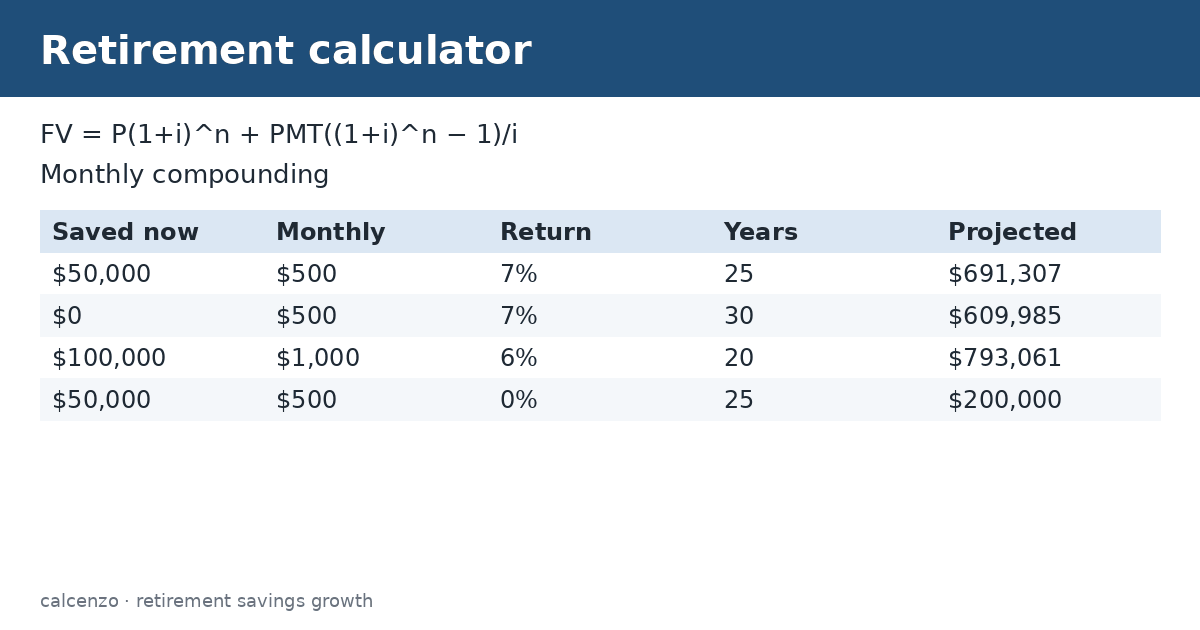
You are 40 with $50,000 saved and add $500 a month. At 7% a year for 25 years, the retirement calculator projects about $691,307. You contribute $150,000 over that time, and growth supplies about $491,307, more than the money you put in. At 0% the same plan reaches only $200,000, showing how much of the result depends on returns.
| Saved now | Monthly | Return | Years | Projected |
|---|---|---|---|---|
| $50,000 | $500 | 7% | 25 | $691,307 |
| $0 | $500 | 7% | 30 | $609,985 |
| $100,000 | $1,000 | 6% | 20 | $793,061 |
| $50,000 | $500 | 0% | 25 | $200,000 |
Choosing a return
Returns are not guaranteed. A diversified stock portfolio has historically earned more than bonds or cash over long periods, with large swings along the way. Many planners use a cautious figure such as 5% to 7% before inflation, and lower for a portfolio heavy in bonds. Fees reduce returns directly; a 1% annual fee lowers a 7% return to about 6%. Try several rates to see a range rather than relying on one number.
Inflation
The projection is in future dollars. At 2.5% inflation, prices roughly double in 28 years, so $691,307 in 25 years would buy what about $373,000 buys today. To see results in today’s dollars, enter a real return, roughly the expected return minus inflation, such as 4.5% instead of 7%.
How much is enough?
A common starting point is that a portfolio can support withdrawals of about 4% in the first year, adjusted for inflation after that, over a 30-year retirement. By that rule, $691,307 supports about $27,650 a year. Add expected Social Security or a pension to estimate total income, and compare it with your planned spending. The rule of thumb has limits, so treat it as a check, not a promise.
Tax-advantaged accounts
Saving through a 401(k), 403(b) or IRA can lower taxes now or later. Many employers match part of 401(k) contributions, which is an immediate return. The IRS sets yearly contribution limits, and catch-up contributions are allowed from age 50. The retirement calculator does not model taxes or employer matches; add any match to your monthly contribution to include it.
Starting early
Time is the strongest lever. Saving $500 a month from zero at 7% grows to about $609,985 in 30 years. Starting 10 years later, the same saving for 20 years reaches only about $260,000. Increasing contributions with each raise is a painless way to catch up.
If you are behind
Starting late is common. Options include saving a larger share of income, working a few years longer, delaying Social Security to raise the benefit, and cutting fees. Each extra year of work adds contributions and growth and shortens the time savings must last. Run the retirement calculator with a higher monthly figure or more years to see which change helps most.
Tips
- Use a real return to see results in today’s money.
- Include employer matching in your monthly figure.
- Review the retirement calculator projection every year.
- Enter a goal to see the monthly saving that would reach it.
Estimates for education only, not financial advice. Your lender’s figures are final.
Related converters and calculators
Related calculators:
- 401(k) calculator: workplace plan
- Compound interest calculator: growth
- Social Security calculator: benefits
- Inflation calculator: purchasing power
Planning to stop work early? The Coast FIRE calculator shows when your savings can grow on their own.
Sources
IRS: IRA contribution limits; Investor.gov (SEC): Compound interest calculator.
Formula and method
FV = P*(1+r)^n + PMT*((1+r)^n - 1)/r, r = rate/100/12, n = years*12. If goal > 0: progress = FV/goal; needed PMT = (goal - P(1+r)^n)*r/((1+r)^n - 1).
Retirement framing of the monthly future-value model. Not Social Security, pension, or withdrawal (4% rule) math.
Questions about this calculator
How much will I have at retirement?
It depends on savings, contributions, return and years; try several returns.
Does it adjust for inflation?
No; enter a real return to see today’s dollars.
Does it use the goal field?
Yes. It shows progress, the gap and the monthly contribution needed.
What return should I use?
Many planners use 5% to 7% before inflation.
Does it include taxes?
No.
Check the assumptions and units before relying on a result. Financial, tax and health estimates do not replace advice for your individual circumstances.
Report a calculation issue