
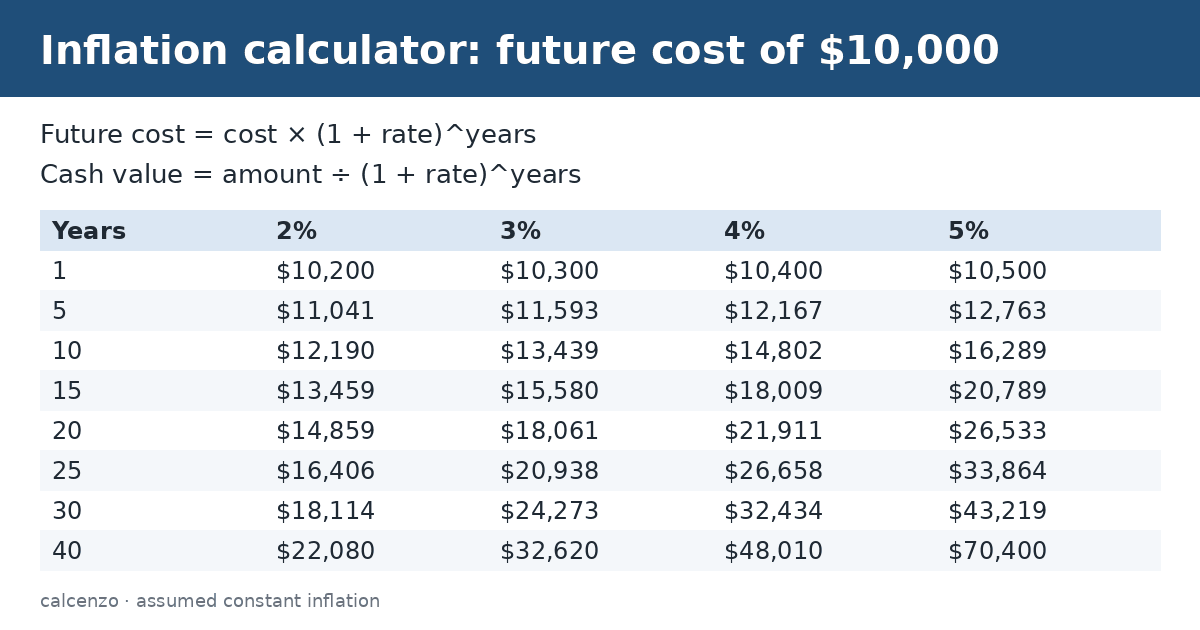
This inflation calculator projects what today’s prices will cost in the future at a steady inflation rate: future cost = today’s cost × (1 + rate)years. At 3% a year, something that costs $10,000 today will cost about $13,439 in 10 years and $18,061 in 20 years.
For past prices, the BLS CPI Inflation Calculator uses actual Consumer Price Index data.
On this page
How to use the inflation calculator
- Enter today’s amount.
- Enter an assumed annual inflation rate, for example 3.
- Enter the number of years.
- Read the future cost. Divide today’s amount by the same factor to see what cash will be worth.
The inflation calculator assumes the same rate every year. Real inflation varies, so run it at two or three rates to see a range rather than a single answer.
What is the inflation formula?
- Future cost = today’s cost × (1 + i)n
- Future buying power of cash = amount ÷ (1 + i)n
- Price increase = future cost − today’s cost
Here i is the yearly inflation rate as a decimal and n is the number of years.
Future cost of $10,000
| Inflation rate | 10 years | 20 years | 30 years |
|---|---|---|---|
| 2% | $12,190 | $14,859 | $18,114 |
| 3% | $13,439 | $18,061 | $24,273 |
| 4% | $14,802 | $21,911 | $32,434 |
What $100 in cash is worth later
| Inflation rate | 10 years | 20 years | 30 years |
|---|---|---|---|
| 2% | $82.03 | $67.30 | $55.21 |
| 3% | $74.41 | $55.37 | $41.20 |
| 4% | $67.56 | $45.64 | $30.83 |
Choosing an inflation rate
The Federal Reserve’s longer-run goal is 2% inflation, measured by the PCE price index. Actual inflation has been well above and below that in different years, so test a range such as 2%, 3% and 4%. For the latest measured rate, check the BLS Consumer Price Index release.
How fast prices double: the rule of 70
Divide 70 by the inflation rate to estimate how many years it takes prices to double.
| Inflation rate | Rule of 70 | Exact years to double |
|---|---|---|
| 2% | 35 years | 35.0 years |
| 3% | 23.3 years | 23.4 years |
| 4% | 17.5 years | 17.7 years |
| 5% | 14 years | 14.2 years |
CPI vs PCE: how inflation is measured
- CPI (Consumer Price Index), published monthly by the Bureau of Labor Statistics, tracks prices of a basket of goods and services bought by urban consumers. It is the figure in most news reports and is used to adjust Social Security benefits.
- PCE price index, published by the Bureau of Economic Analysis, covers a broader range of spending and is the measure the Federal Reserve targets.
- Core versions of both exclude food and energy, which swing more from month to month.
Using inflation in your plans
- Retirement: a $60,000 lifestyle today needs about $108,400 a year in 20 years at 3%.
- Savings: money earning less than inflation loses buying power. Compare your savings rate with your assumption.
- Real return: real return ≈ (1 + nominal return) ÷ (1 + inflation) − 1. A 7% return with 3% inflation is a real return of about 3.9%.
Will your salary keep up?
One practical use of an inflation calculator is checking whether pay rises have kept pace. If you earned $50,000 ten years ago and prices rose at an average 3% a year, you would need about $67,196 today to buy the same things. If you now earn $62,000, your income has risen in dollars but fallen by about 8% in purchasing power.
The same check helps with fixed payments. A pension or annuity of $2,000 a month that does not adjust for inflation buys only about $1,488 of today’s goods after ten years at 3%, and about $1,107 after twenty. Social Security benefits get an annual cost-of-living adjustment tied to the CPI-W, so they hold their value better than a fixed private pension.
When you compare figures over time, say which index and period you used. An inflation calculator run with 2% gives a very different answer from one run with 4%, and the official CPI from the Bureau of Labor Statistics is the usual reference for U.S. consumer prices. For your own budget, your personal rate may differ: rent, childcare and health costs often rise faster than the overall index.
Related converters and calculators
Related tools:
- Retirement calculator: income needs
- Compound interest calculator: growth
- Future value calculator: any rate
- Salary tax calculator: does a raise beat inflation?
Sources
BLS: CPI Inflation Calculator; Federal Reserve: Why does the Fed aim for 2 percent inflation?; BEA: PCE price index.
Questions about this calculator
How do I calculate future inflation?
Multiply today’s amount by (1 + inflation rate)^years. At 3% for 10 years, $10,000 × 1.03^10 ≈ $13,439.
How much will $100 be worth in 20 years?
Held as cash at 3% inflation, it will buy about what $55.37 buys today.
What inflation rate should I use?
Many people test 2% (the Federal Reserve’s longer-run goal), 3% and 4%.
Can I use this calculator for past inflation?
No. For historical prices, use the BLS CPI Inflation Calculator.
What is the rule of 70?
Divide 70 by the inflation rate to estimate the years for prices to double: about 23 years at 3%.
Check the assumptions and units before relying on a result. Financial, tax and health estimates do not replace advice for your individual circumstances.
Report a calculation issue