
A future value calculator shows what your savings or investments will be worth in the future, based on a starting amount, regular deposits, an interest rate and time. Formula: FV = P(1+r)^n + PMT[((1+r)^n – 1)/r] with r = annual/100/12 and n = years×12. $10,000 plus $200 a month at 7% for 20 years grows to about $144,572.72.
On this page
How to use the future value calculator
- Enter the starting amount.
- Enter your monthly deposit.
- Enter the expected annual return.
- Enter the number of years and read the future value, contributions and growth.
What is the future value formula?
Future value is what money will be worth at a later date after it earns compound interest. The future value calculator combines a starting balance and regular monthly deposits, compounding monthly:
- FV = P × (1 + r)n + PMT × [(1 + r)n − 1] ÷ r
- P = starting amount, PMT = monthly deposit
- r = annual rate ÷ 12, n = years × 12
Deposits are assumed at the end of each month. The result also shows how much you put in and how much came from growth.
Future value calculator worked example
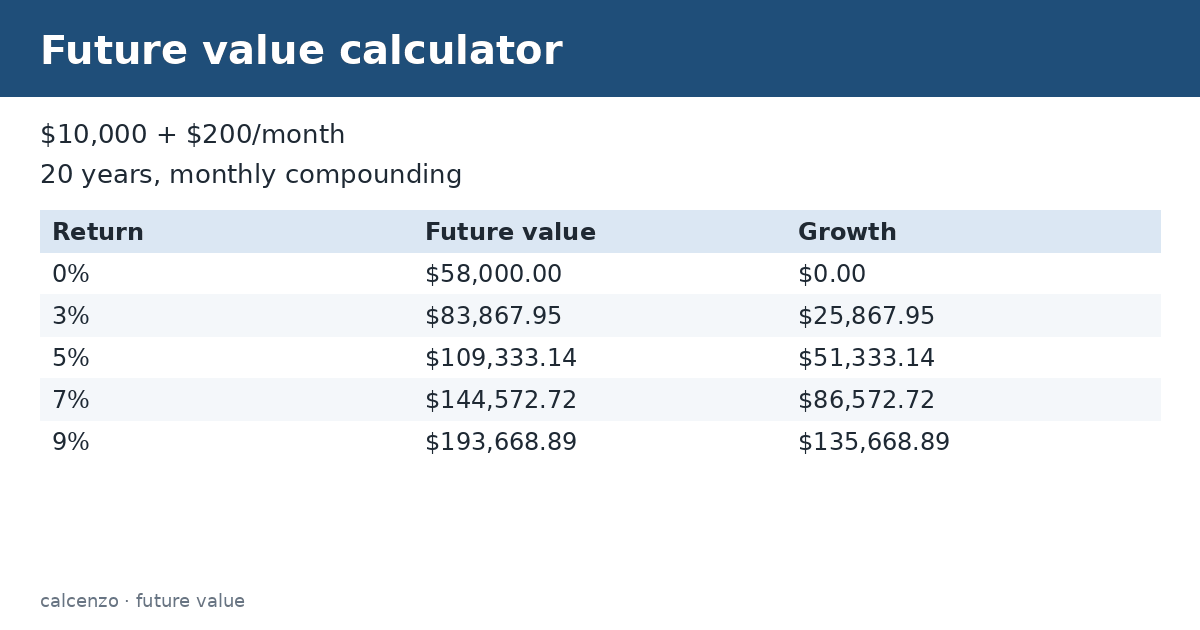
Start with $10,000, add $200 a month and earn 7% a year for 20 years. The future value is $144,572.72. You contribute $48,000 in deposits plus the original $10,000, so $86,572.72 comes from growth, more than your total deposits.
| Annual return | Future value after 20 years | Growth |
|---|---|---|
| 0% | $58,000.00 | $0.00 |
| 3% | $83,867.95 | $25,867.95 |
| 5% | $109,333.14 | $51,333.14 |
| 7% | $144,572.72 | $86,572.72 |
| 9% | $193,668.89 | $135,668.89 |
The 0% row shows only your own money: $58,000. Each extra percentage point of return makes a large difference over 20 years because growth compounds on earlier growth.
Why time matters most
The exponent n in the formula means time has the biggest effect. $10,000 at 7% compounded monthly grows to about $20,097 in 10 years, $40,387 in 20 years and $81,165 in 30 years: roughly doubling every decade. Starting early, even with small deposits, usually beats starting later with larger ones.
Choosing a rate
Use a rate that fits how the money is invested. Savings accounts and certificates of deposit pay a stated rate. Stock and bond investments have no guaranteed return, and results vary widely year to year, so many people test several rates, such as 4%, 6% and 8%, to see a range of outcomes. The SEC’s Investor.gov reminds investors that past returns do not guarantee future results.
Inflation and taxes
The future value calculator shows nominal dollars. Prices also rise over time, so $144,573 in 20 years will buy less than it would today. To see today’s buying power, subtract an inflation estimate from the rate: at 7% returns and 3% inflation, use about 4%. Taxes on interest, dividends or gains in a taxable account also reduce growth; tax-advantaged retirement accounts can defer or avoid them.
Common uses
- Retirement savings projections
- College savings plans
- Comparing a lump-sum investment with monthly contributions
- Checking how long until a savings goal is reached
Estimates for education only, not financial advice. Your lender’s figures are final.
Lump sum or monthly deposits?
The two parts of the formula can be compared directly. With no deposits, $10,000 at 7% for 20 years grows to about $40,387. With no starting balance, $200 a month for 20 years grows to about $104,185. Together they make the full result. If you can invest a lump sum now, it gets the most time to compound; monthly deposits build the habit and smooth out market ups and downs. Use the future value calculator with each part alone to see which one matters more for your plan.
Working backward from a goal
If you have a target in mind, such as $250,000 for retirement, try different monthly deposits until the result reaches it. At 7% for 20 years with a $10,000 start, a deposit of about $402 a month reaches it. Adding a few years often lowers the deposit you need more than raising it does. Rerun the future value calculator each year with your actual balance so your plan stays on track.
Related converters and calculators
Related calculators:
- Present value calculator: present value
- Compound interest calculator: compound interest
- Retirement calculator: retirement
- Finance calculator: TVM
Sources
Investor.gov (SEC): Compound interest calculator.
Questions about this calculator
What is the future value of $10,000 plus $200 a month at 7% for 20 years?
About $144,572.72.
Are deposits at the start or end of the month?
At the end of each month.
Does the result include inflation?
No, it is in future dollars.
What rate should I use?
Test several realistic rates; returns are not guaranteed.
What has the biggest effect?
Time, because growth compounds.
Check the assumptions and units before relying on a result. Financial, tax and health estimates do not replace advice for your individual circumstances.
Report a calculation issue