
A savings calculator projects how your savings grow with regular deposits and compound interest. $10,000 plus $200 a month at 7% for 20 years grows to about $144,573.
On this page
How to use the savings calculator
- Enter your starting balance.
- Enter your monthly deposit.
- Enter the yearly interest rate.
- Enter the number of years.
- Read the balance, deposits and interest.
How the savings calculator works
The savings calculator projects how a balance grows with regular deposits and compound interest. You enter a starting amount, a monthly deposit, a yearly interest rate and the number of years. It compounds monthly and adds each deposit at the end of the month:
- FV = P(1 + i)ⁿ + PMT × ((1 + i)ⁿ − 1) ÷ i
i is the yearly rate divided by 12 and n is the number of months. The result shows the future value, your total deposits and the interest earned. A rate of 0 simply adds up the deposits.
Savings calculator worked example
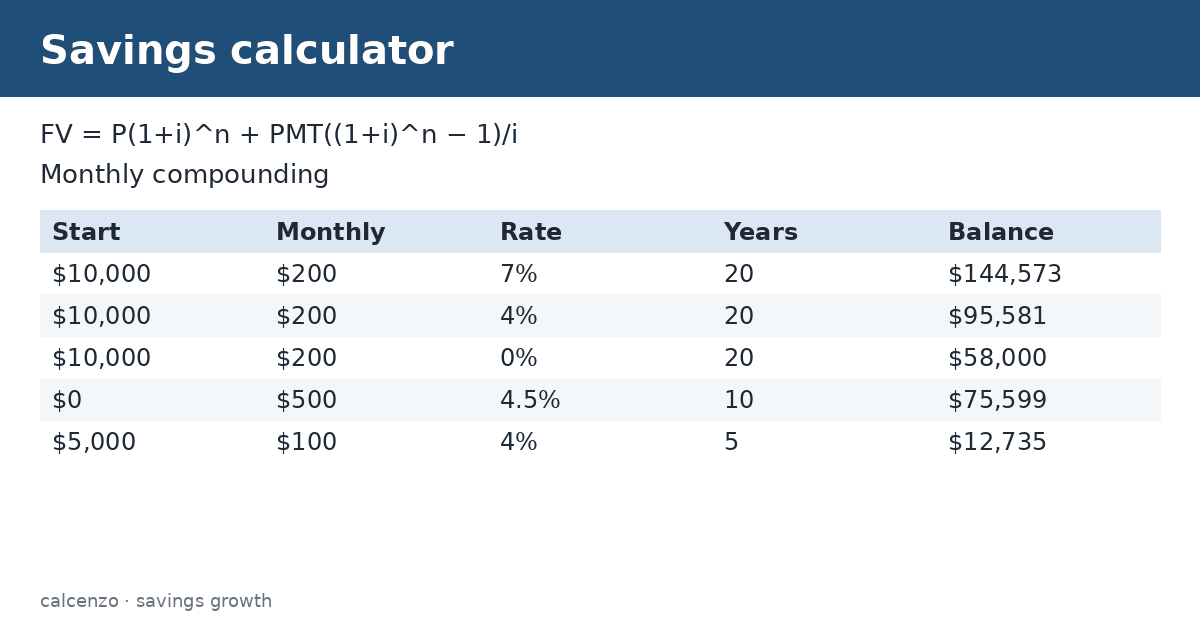
You start with $10,000 and save $200 a month. At 7% a year for 20 years, the savings calculator projects about $144,573. You deposit $48,000 on top of the starting $10,000, so about $86,573 is interest. At 4% the same plan reaches about $95,581, and at 0% it reaches $58,000. The rate and the time matter as much as the deposits.
| Start | Monthly | Rate | Years | Balance |
|---|---|---|---|---|
| $10,000 | $200 | 7% | 20 | $144,573 |
| $10,000 | $200 | 4% | 20 | $95,581 |
| $10,000 | $200 | 0% | 20 | $58,000 |
| $0 | $500 | 4.5% | 10 | $75,599 |
| $5,000 | $100 | 4% | 5 | $12,735 |
Choosing a rate
Savings accounts, money market accounts and certificates of deposit pay rates that change with market interest rates. A high-yield savings account usually pays more than a standard one. A 7% figure is closer to a long-run stock return, which comes with risk. For money you need soon, use the rate your bank actually offers. For long-term investing, try a cautious return.
APR, APY and compounding
Banks quote the annual percentage yield, which already includes compounding. A 4.00% rate compounded monthly gives an APY of about 4.07%. The savings calculator compounds the rate you enter monthly, so if you have an APY, you can enter a slightly lower nominal rate, or accept a small overstatement. Over a few years the difference is tiny.
Saving for a goal
To reach a target, try different monthly amounts until the result matches it. For an emergency fund of $15,000 in three years at 4%, about $393 a month is enough. Many people aim for three to six months of expenses in an easy-to-reach account before investing for the long term. Automatic transfers on payday make regular saving easier.
Keeping savings safe
Deposits at FDIC-insured banks are protected up to $250,000 per depositor, per insured bank, for each account ownership category. Credit unions have similar coverage through the NCUA. Investments such as stocks and mutual funds are not insured and can lose value.
Inflation and taxes
The projection is in future dollars. If inflation runs at 3% and your account pays 4%, your real gain is about 1% a year. Interest is usually taxable each year, which lowers the net growth unless the savings sit in a tax-advantaged account. The savings calculator ignores both, so treat its result as a before-tax, nominal figure.
Why starting early matters
Compound interest earns interest on past interest, so time does much of the work. Saving $200 a month at 7% from age 25 to 65 builds far more than saving $400 a month from 45 to 65, even though the total deposits are the same. Small, steady amounts started early usually beat larger amounts started late. If you can only save a little now, start anyway and increase the amount later.
Tips
- Use your bank’s actual rate for short-term savings.
- Set up automatic monthly transfers.
- Raise deposits when your income rises.
- Rerun the savings calculator when rates change.
Estimates for education only, not financial advice. Your lender’s figures are final.
Related converters and calculators
Related calculators:
- Compound interest calculator: growth
- Simple interest calculator: simple interest
- Inflation calculator: buying power
- Future value calculator: future value
Sources
FDIC: Deposit insurance; Investor.gov (SEC): Compound interest calculator.
Formula and method
With r = annual/100/12 and n = years x 12: FV = starting x (1+r)^n + monthly x ((1+r)^n - 1) / r. If r = 0: FV = starting + monthly x n. Contributions = monthly x n. Growth = FV - starting - contributions.
Future value of a present balance plus end-of-month contributions at a constant monthly rate.
Questions about this calculator
How is savings growth calculated?
Monthly compounding with deposits at month end.
What rate should I use?
Your bank’s rate for savings, or a cautious return for investing.
What is APY?
The yearly yield including compounding.
Are deposits insured?
FDIC insurance covers up to $250,000 per depositor, per bank, per ownership category.
Does it include taxes?
No.
Check the assumptions and units before relying on a result. Financial, tax and health estimates do not replace advice for your individual circumstances.
Report a calculation issue