
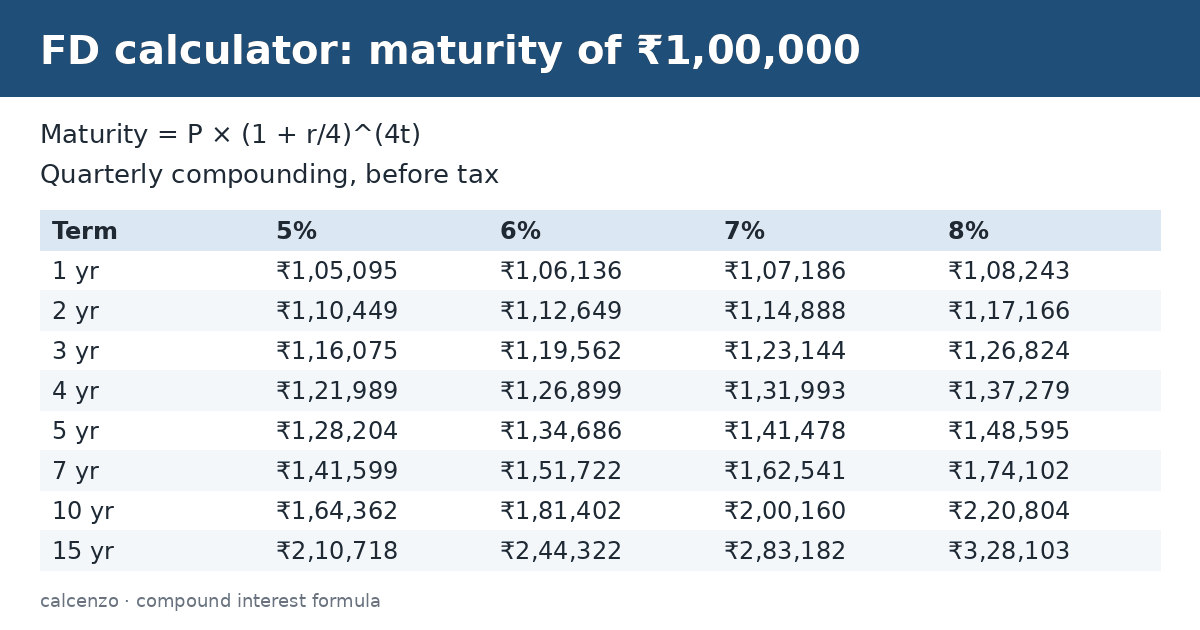
An FD calculator estimates the maturity value of a fixed deposit: maturity = P × (1 + r ÷ n)n × t. For example, ₹1,00,000 at 7% for 5 years with quarterly compounding matures at about ₹1,41,478, so you earn about ₹41,478 in interest before tax.
On this page
How to use the FD calculator
- Enter the deposit amount.
- Enter the annual interest rate the bank offers.
- Enter the term in years; use decimals for months (6 months = 0.5).
- Choose the compounding frequency from the bank’s terms, usually quarterly.
- Read the maturity amount and the interest earned.
What formula does the FD calculator use?
Maturity = P × (1 + r ÷ n)n × t
- P = deposit amount
- r = annual interest rate as a decimal (7% = 0.07)
- n = compounding periods per year: 4 for quarterly, which most Indian bank FDs use
- t = term in years
Interest earned = maturity − P.
FD calculator worked example
₹1,00,000 at 7% for 5 years, compounded quarterly:
- r ÷ n = 0.07 ÷ 4 = 0.0175; n × t = 20
- Maturity = 1,00,000 × 1.017520 ≈ ₹1,41,478
- Interest earned ≈ ₹41,478
Quarterly compounding turns a 7% rate into an effective annual yield of about 7.19%.
How compounding changes the result
₹1,00,000 at 7% for 5 years:
| Compounding | Maturity | Interest |
|---|---|---|
| Yearly | ₹1,40,255 | ₹40,255 |
| Half-yearly | ₹1,41,060 | ₹41,060 |
| Quarterly | ₹1,41,478 | ₹41,478 |
| Monthly | ₹1,41,763 | ₹41,763 |
With simple interest and no compounding, for example when interest is paid out every quarter instead of reinvested, the same deposit earns ₹35,000.
Maturity by term and rate
| Term | 6% | 7% | 8% |
|---|---|---|---|
| 1 years | ₹1,06,136 | ₹1,07,186 | ₹1,08,243 |
| 2 years | ₹1,12,649 | ₹1,14,888 | ₹1,17,166 |
| 3 years | ₹1,19,562 | ₹1,23,144 | ₹1,26,824 |
| 5 years | ₹1,34,686 | ₹1,41,478 | ₹1,48,595 |
| 7 years | ₹1,51,722 | ₹1,62,541 | ₹1,74,102 |
| 10 years | ₹1,81,402 | ₹2,00,160 | ₹2,20,804 |
Tax, early withdrawal and deposit insurance
- Tax: FD interest is taxable as income. Banks in India deduct TDS when interest crosses the yearly threshold; you can submit Form 15G or 15H if eligible.
- Early withdrawal: most banks pay a lower rate and may charge a penalty if you break the deposit before maturity.
- Insurance: in India, DICGC insures bank deposits up to ₹5 lakh per depositor per bank, including interest. In the US, FDIC insurance covers certificates of deposit (CDs) up to $250,000 per depositor, per insured bank, per ownership category.
Cumulative vs payout FDs
In a cumulative FD, interest is added to the deposit and compounds until maturity, which is what the fd calculator shows. In a payout FD, the bank pays interest out monthly or quarterly, so nothing compounds: ₹1,00,000 at 7% pays ₹1,750 a quarter, or about ₹583 a month, though banks often pay monthly interest at a slightly discounted rate. Choose payout if you need regular income and cumulative if you want the money to grow.
Real return after inflation
An FD rate is a nominal return. If inflation runs at 5% while your FD earns 7%, the real return is about (1.07 ÷ 1.05) − 1 ≈ 1.9% a year, and lower still after tax. Compare the rate with current inflation, and use the inflation calculator to see what the maturity amount will buy.
Estimates for education only, not financial advice. Your lender’s figures are final.
Breaking a deposit early
Most banks let you close a fixed deposit before maturity, but they usually pay a lower rate for the time the money was held and may deduct a penalty, often 0.5% to 1%. Before breaking a deposit, run the FD calculator twice, once for each scenario.
Say ₹1,00,000 is placed for five years at 7% with quarterly compounding. Held to maturity it grows to about ₹1,41,478. If you break it after two years and the bank pays the two-year card rate, say 6.5%, minus a 1% penalty, the effective rate is 5.5% for those two years, and the FD calculator shows about ₹1,11,600. The gap from the original plan tells you what liquidity costs.
Ways to keep access to money without paying that cost:
- Split one large deposit into several smaller ones with different terms, checking each in the FD calculator, so you can break only the one you need.
- Check whether the bank offers a loan or overdraft against the deposit, often at 1% to 2% above the FD rate, which may be cheaper than breaking it.
- Keep a few months of expenses in a savings account so the FD can run its full term.
Related converters and calculators
Related tools:
- Compound interest calculator: any compounding
- Simple interest calculator: interest paid out
- SIP calculator: monthly investing
- Inflation calculator: real value
- Savings calculator: regular deposits
Sources
DICGC (RBI): Deposit insurance; FDIC: Deposit insurance; Investor.gov (SEC): Compound interest calculator.
Questions about this calculator
How is FD interest calculated?
Maturity = P × (1 + r ÷ n)^(n × t), with quarterly compounding (n = 4) at most Indian banks.
What is ₹1 lakh at 7% for 5 years?
About ₹1,41,478 with quarterly compounding.
Is FD interest taxable?
Yes, as income. Banks deduct TDS when interest crosses the yearly threshold.
Is my FD insured?
In India, DICGC insures deposits up to ₹5 lakh per depositor per bank. US CDs are FDIC-insured up to $250,000 per depositor, per bank, per ownership category.
What happens if I break an FD early?
Banks usually pay a lower rate for the period held and may charge a penalty.
Check the assumptions and units before relying on a result. Financial, tax and health estimates do not replace advice for your individual circumstances.
Report a calculation issue