
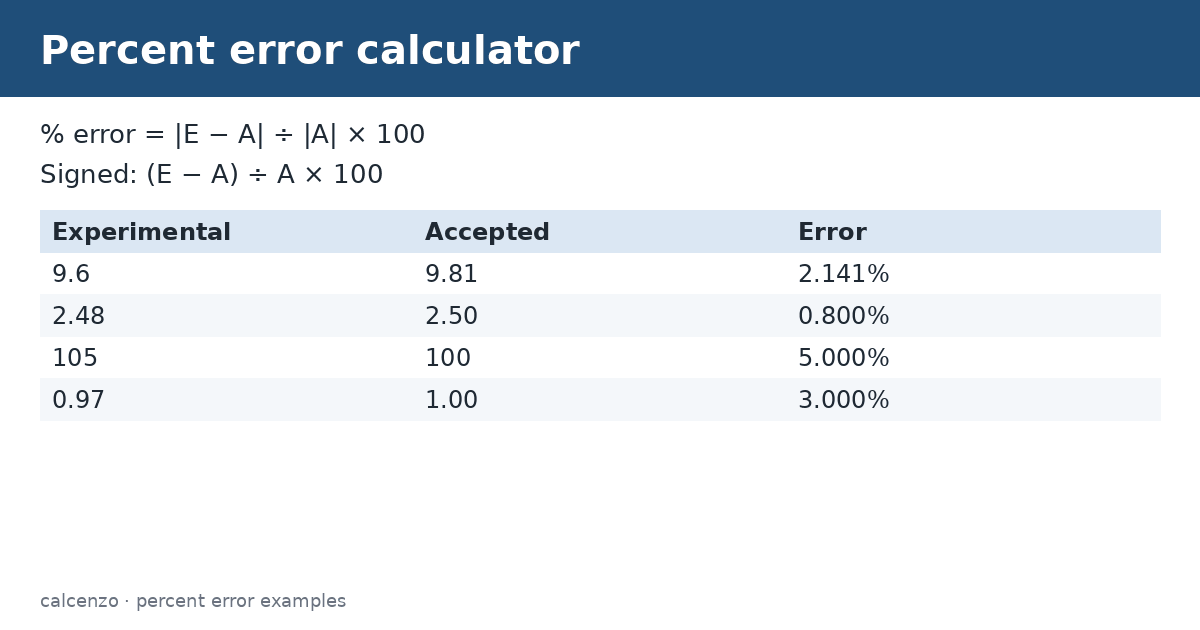
A percent error calculator shows how far a measured value is from the accepted value as a percentage of the accepted value. Formula: Percent error = |experimental – accepted| / |accepted| × 100 (accepted != 0). Measuring 9.6 m/s² for gravity, against 9.81 m/s², is a 2.141% error.
On this page
How to use the percent error calculator
- Enter your experimental or measured value.
- Enter the accepted or true value.
- Read the percent error.
How the percent error calculator works
The percent error calculator compares a measured or experimental value with an accepted or true value: percent error = |experimental − accepted| ÷ |accepted| × 100. The absolute value makes the answer positive whether you measured too high or too low. The accepted value cannot be zero, because the division would be undefined. Enter both numbers in the same unit.
Percent error calculator worked example
In a pendulum lab you measure gravitational acceleration as 9.6 m/s², while the accepted value is 9.81 m/s². The percent error calculator gives |9.6 − 9.81| ÷ 9.81 × 100 = 2.141%. A 2.48 g sample with a true mass of 2.50 g has 0.8% error. A reading of 105 against 100 is 5% off. The table lists more examples.
| Experimental | Accepted | Percent error |
|---|---|---|
| 9.6 | 9.81 | 2.141% |
| 2.48 | 2.50 | 0.800% |
| 105 | 100 | 5.000% |
| 0.97 | 1.00 | 3.000% |
Signed percent error
Some courses keep the sign to show direction: (experimental − accepted) ÷ accepted × 100. With 9.6 and 9.81, that is −2.141%, meaning the measurement was low. A positive result means it was high. This tool reports the absolute value, so add the sign yourself if your instructor asks for it.
Percent error vs percent difference
Use percent error when one value is known to be correct. When you compare two measurements and neither is the reference, use percent difference, which divides the gap by their average: |a − b| ÷ ((a + b) ÷ 2) × 100. Percent change, by contrast, compares a new value with an old one over time and keeps its sign.
Sources of error
Random errors scatter readings above and below the true value; averaging several trials reduces them. Systematic errors push every reading the same way, for example an uncalibrated scale or a reaction time delay when starting a stopwatch, and averaging does not remove them. NIST guidance on measurement uncertainty explains how to estimate and report uncertainty, which is different from percent error: uncertainty describes how confident you are in a measurement, while percent error compares it with a known value.
What is a good percent error?
It depends on the equipment and method. In a school lab, under about 5% is often acceptable, while precise analytical chemistry may expect well under 1%. If your error is larger than the stated uncertainty of your instruments, look for a systematic problem. Report your result with sensible significant figures, and use the percent error calculator to compare trials quickly.
Tips
- Use the same units for both values.
- Do not round intermediate results too early.
- Repeat measurements and average them.
- State whether you report absolute or signed error.
Chemistry example
A student titrates vinegar and finds 4.6% acetic acid, while the label states 5.0%. The percent error calculator gives |4.6 − 5.0| ÷ 5.0 × 100 = 8%. That is high for a titration, so the student checks the burette readings, the concentration of the sodium hydroxide and whether the endpoint was overshot or missed. After repeating the titration three times and averaging 4.9%, the error drops to 2%, which suggests the first run had a reading or endpoint mistake.
Accuracy and precision
Percent error measures accuracy, how close a result is to the true value. Precision describes how close repeated results are to each other. A set of readings can be precise but inaccurate if a systematic error shifts them all. Check both: a low standard deviation across trials and a low percent error together show a reliable method.
For study and planning only. Check lab, engineering and safety work against your course, instrument or a qualified professional.
Related converters and calculators
Related calculators:
- Percentage calculator: percentages
- Standard deviation calculator: spread of trials
- Confidence interval calculator: intervals
Sources
OpenStax Chemistry 2e, 1.5: Measurement uncertainty, accuracy and precision; NIST Technical Note 1297: Guidelines for evaluating and expressing uncertainty.
Formula and method
Percent error = |experimental - accepted| / |accepted| * 100 (accepted != 0).
Unsigned relative error versus a known accepted value. Not percent change between two arbitrary times.
Questions about this calculator
What is the percent error formula?
|experimental − accepted| ÷ |accepted| × 100.
Can percent error be negative?
The signed version can; this tool shows the absolute value.
What if the accepted value is 0?
Percent error is undefined.
What is a good percent error?
Often under 5% in school labs.
How is it different from percent difference?
Percent difference compares two measurements using their average.
Check the assumptions and units before relying on a result. Financial, tax and health estimates do not replace advice for your individual circumstances.
Report a calculation issue