
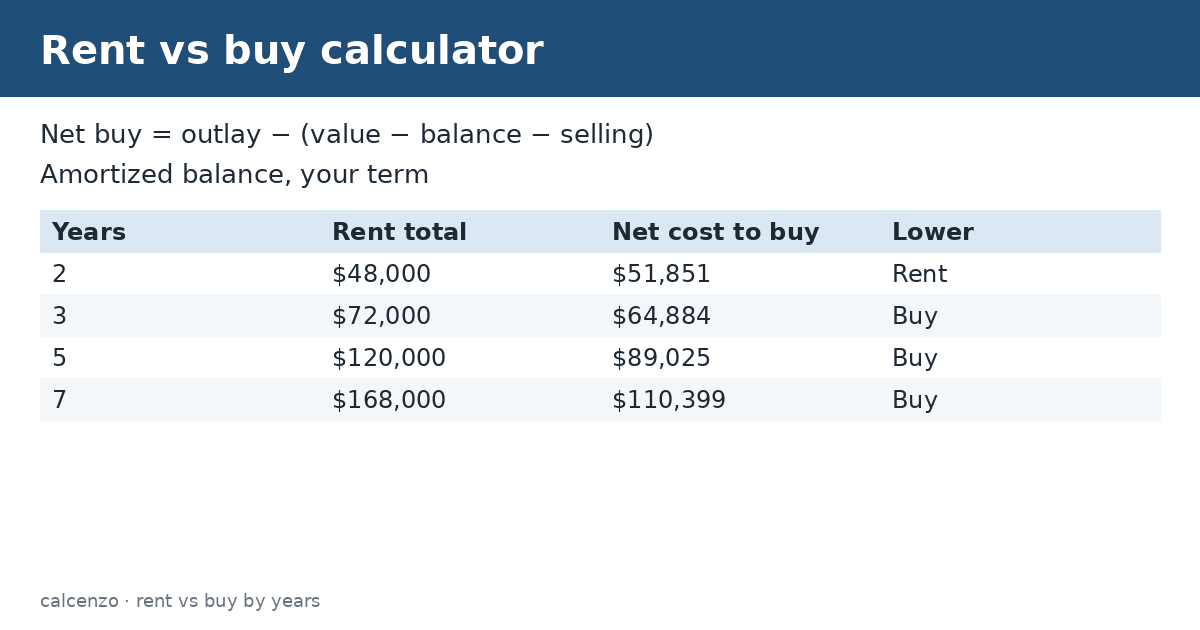
A rent vs buy calculator compares the total cost of renting with the net cost of owning over the years you expect to stay. In the default example, renting wins over 2 years and buying wins from year 3.
On this page
How to use the rent vs buy calculator
- Enter monthly rent.
- Enter the home price, down payment, mortgage rate and loan term.
- Enter the years you expect to stay, yearly appreciation and selling costs.
- Enter extra monthly owner costs.
- Read the verdict and totals.
How the rent vs buy calculator works
The rent vs buy calculator gives a rough verdict on whether renting or buying costs less over a chosen number of years. You enter monthly rent, the home price, down payment, mortgage rate, loan term, years you expect to stay, yearly home appreciation, selling costs and extra monthly owner costs such as tax, insurance and upkeep. The tool then works out:
- Rent total = monthly rent × 12 × years
- Buy cash outlay = down payment + mortgage payments made + extra costs × 12 × years
- Home value = price × (1 + appreciation)^years
- Equity = home value − amortized loan balance − selling costs
- Net cost of buying = buy outlay − equity
Whichever total is lower wins.
Rent vs buy calculator worked example
Rent is $2,000 a month. The home costs $400,000 with $80,000 down at 6.5%, the payment is $2,022.62, owner extras are $400 and prices rise 3% a year. Selling costs are 6%. Over 7 years, renting costs $168,000. Buying costs $283,500 in cash, but the home is worth about $491,950, the loan balance is down to $289,332 and selling costs are $29,517, so equity is about $173,101 and the net cost is about $110,399; the rent vs buy calculator says buying looks better. Over 2 years, the result flips: renting costs $48,000 against a net buying cost of about $51,851.
| Years | Rent total | Net cost to buy | Lower |
|---|---|---|---|
| 2 | $48,000 | $51,851 | Rent |
| 3 | $72,000 | $64,884 | Buy |
| 5 | $120,000 | $89,025 | Buy |
| 7 | $168,000 | $110,399 | Buy |
Simplifying assumptions
The payment uses the loan term you choose, from 1 to 40 years, and the loan balance at the end of your stay comes from the amortization schedule, not a fixed share of the loan. A $320,000 loan at 6.5% over 30 years still has $312,607 owing after 2 years and $289,332 after 7, so early payments are mostly interest. If your stay is longer than the loan term, payments stop when the loan is paid off. Some shortcuts remain: rent is held flat, and there are no closing costs on the purchase, tax effects or investment return on the down payment. Treat the verdict as a first look.
Costs that change the answer
Selling a home often costs 5% to 10% of its price in agent fees, transfer taxes and moving; enter your estimate in the selling costs box, which defaults to 6%. Buying has closing costs of a few percent, which you can add to the down payment. Renters can invest the down payment, which may earn a return. Rents usually rise over time, which helps buying in long stays. Adding these by hand to the totals gives a fairer comparison.
Why time matters most
Buying has large upfront costs that are spread out the longer you stay. That is why short stays usually favour renting and long stays favour buying. Run the rent vs buy calculator for several horizons, such as 3, 5 and 10 years, and note where the verdict changes.
Beyond the numbers
Owning brings stability and the freedom to renovate, but also repair bills and less flexibility to move. Renting is simpler to leave and shifts repairs to the landlord. HUD and the CFPB both suggest checking your credit, savings and job stability before buying.
Finding the breakeven year
With the default inputs, the verdict changes between year 2 and year 3. Try a few years either side of that, with higher selling costs or slower appreciation, to see how stable the answer is.
Tips
- Include property tax, insurance, HOA and maintenance in extra costs.
- Use a cautious appreciation rate, such as 2% to 3%.
- Test the rent vs buy calculator with a shorter stay than you expect.
- Set selling costs to match local agent fees and transfer taxes.
Estimates for education only, not financial advice. Your lender’s figures are final.
Related converters and calculators
Related calculators:
- Rent calculator: rent budget
- Mortgage calculator: payments
- House affordability calculator: home price
- Down payment calculator: down payment
Sources
CFPB: Buying a house; HUD: Buying a home.
Formula and method
pay = PMT(loan, rate, term*12); balance after min(years, term)*12 months; equity = value - balance - selling%; netBuy = down + payments + extra*12*years - equity; verdict rent vs netBuy.
Educational rent-vs-buy sketch with coarse equity proxy. Not a full NPV model.
Questions about this calculator
Is it better to rent or buy?
It depends mainly on how long you stay; short stays tend to favour renting.
What loan term does it use?
The term you enter, 1 to 40 years; 30 by default.
Does it include selling costs?
Yes, as a percentage of the home value at the end; 6% by default.
How is the loan balance estimated?
From the amortization schedule at the end of your stay.
Does rent rise over time?
No, rent is held flat.
Check the assumptions and units before relying on a result. Financial, tax and health estimates do not replace advice for your individual circumstances.
Report a calculation issue