
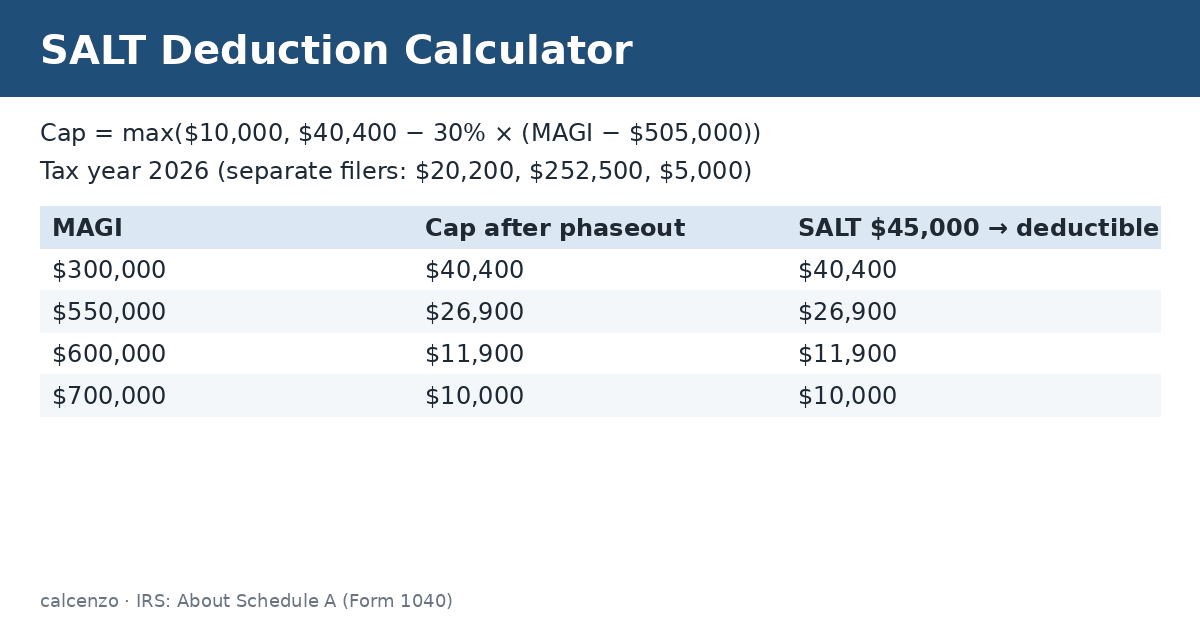
A SALT deduction calculator estimates how much of your state and local taxes you can deduct on Schedule A for tax year 2026 after the cap and the income phaseout. Formula: Cap = max($10,000, $40,400 − 30% × (MAGI − $505,000)); deductible SALT = min(taxes paid, cap). Separate filers use half of each figure. The 2026 cap is $40,400, or $20,200 if married filing separately. A single filer with $18,000 of SALT and $180,000 of MAGI deducts the full $18,000.
On this page
How to use the SALT deduction calculator
- Add up the state and local taxes you paid: income tax (or general sales tax instead), real estate tax and personal property tax.
- Choose your filing status.
- Enter your modified adjusted gross income.
- Read the cap after the phaseout and the deductible amount.
The SALT deduction calculator matters only if you itemize. If your total itemized deductions are below the standard deduction, the cap does not change your tax.
What formula does the SALT deduction calculator use?
- Starting cap for 2026: $40,400 ($20,200 married filing separately).
- Phaseout: the cap falls by 30% of MAGI over $505,000 ($252,500 married filing separately).
- Floor: the cap never drops below $10,000 ($5,000 married filing separately).
- Deductible SALT = the smaller of taxes paid and the cap after the phaseout.
SALT deduction calculator worked example
These returns were run through the SALT deduction calculator:
| Filer | SALT paid | MAGI | Cap after phaseout | Deductible |
|---|---|---|---|---|
| Single | $18,000 | $180,000 | $40,400 | $18,000 |
| Single | $30,000 | $300,000 | $40,400 | $30,000 |
| Joint | $45,000 | $550,000 | $26,900 | $26,900 |
| Single | $45,000 | $600,000 | $11,900 | $11,900 |
| Single | $45,000 | $700,000 | $10,000 (floor) | $10,000 |
| Separate | $12,000 | $300,000 | $5,950 | $5,950 |
For the joint return, MAGI is $45,000 above $505,000. Thirty percent of that is $13,500, so the cap falls from $40,400 to $26,900. Above about $606,333 of MAGI the floor takes over.
What counts as SALT
- State and local income taxes withheld or paid with estimates, or general sales taxes if you elect them instead.
- Real estate taxes on property you own that are not business property.
- Personal property taxes based on value, such as some vehicle registration fees.
Foreign real property taxes and taxes paid for a business on Schedule C or E are handled differently. A SALT deduction calculator only measures the personal itemized deduction.
How the cap changes after 2026
The 2025 law raised the cap to $40,000 for 2025, then 1% more each year through 2029: $40,400 for 2026. In 2030 the cap returns to $10,000. The phaseout line also rises 1% a year, from $500,000 in 2025 to $505,000 in 2026. Rerun the SALT deduction calculator each year with that year’s figures.
When the phaseout bites
Between $505,000 and roughly $606,000 of MAGI, each extra $1,000 of income removes $300 of deduction. In the 35% bracket that adds about $105 of tax per $1,000 on top of the normal tax, so the effective rate on that income is much higher. Timing a bonus, a capital gain or a Roth conversion can matter, and a SALT deduction calculator run for both years shows the gap. Some states offer a pass-through entity tax for business owners that is deducted at the entity level; ask a tax professional whether it applies.
Example: homeowners in a high-tax state
A married couple in New Jersey files jointly with $420,000 of MAGI. They paid $24,000 of state income tax and $16,000 of property tax on their home, $40,000 in total. Their income is under the $505,000 line, so the cap stays at $40,400 and all $40,000 is deductible on Schedule A. Under the old $10,000 limit they could deduct only a quarter of it.
If the same couple earned $560,000 instead, the cap would fall by 30% of $55,000, which is $16,500, to $23,900. They would lose $16,100 of deduction, worth about $5,600 in the 35% bracket. Married couples who file separately each get half of the cap, half of the phaseout line and a $5,000 floor, so splitting the return rarely helps.
Should you itemize in 2026?
Add your deductible SALT, mortgage interest and charitable gifts and compare the total with your standard deduction. With the higher cap, more households in high-tax states will find that itemizing wins again. The SALT deduction calculator gives the first number in that sum; the mortgage and income tax calculators below help with the rest.
Estimates for education only, not tax, legal or financial advice. Check current rules with the tax authority or a qualified adviser.
Related converters and calculators
Related calculators:
- Income tax calculator: federal tax
- Mortgage calculator: interest and taxes
- Marriage tax calculator: filing status
Sources
IRS: About Schedule A (Form 1040); IRS: About Form 1040-ES, Estimated Tax for Individuals; IRS: Topic 503, Deductible taxes; IRS: One Big Beautiful Bill provisions.
Questions about this calculator
What is the SALT cap for 2026?
$40,400, or $20,200 for married filing separately, before the income phaseout.
At what income does the SALT cap phase out in 2026?
The cap falls by 30% of MAGI over $505,000 ($252,500 married filing separately) and stops at a floor of $10,000 ($5,000 separately).
Is the SALT cap the same for married couples filing jointly?
Yes. A joint return has the same $40,400 cap as a single return, so it is not doubled for couples.
Can I deduct both state income tax and sales tax?
No. You choose one, plus real estate and personal property taxes, all within the cap.
When does the SALT cap go back to $10,000?
Under current law, in tax year 2030.
Check the assumptions and units before relying on a result. Financial, tax and health estimates do not replace advice for your individual circumstances.
Report a calculation issue