
This SI prefix converter rescales a number between any two of the 24 SI prefixes, from quecto (10⁻³⁰) to quetta (10³⁰), or to the plain unit. Every prefix is an exact power of ten, so converting is a matter of moving the decimal point by the difference in exponents: kilo to mega is ÷1,000, and milli to micro is ×1,000.
On this page
How to use the SI prefix converter
- In the SI prefix converter, enter the value, for example 4,700 with the prefix kilo.
- Choose the source prefix and the target prefix, such as kilo to mega.
- Read the result: 4,700 k = 4.7 M.
Subtract the target exponent from the source exponent and multiply by 10 to that power: giga to tera is 10⁹⁻¹² = 10⁻³, so 2,500 G = 2.5 T.
What is SI prefixes?
SI prefixes scale a unit by powers of ten, from quecto (10⁻³⁰) to quetta (10³⁰). Kilo means 1,000, mega 1,000,000 and milli 0.001. The newest prefixes, ronna, quetta, ronto and quecto, were adopted in 2022.
Conversion formula
The SI prefix converter stores every unit as a multiple of the base unit, the unity (×1). To convert:
value in target unit = value × (factor of source unit ÷ factor of target unit)
where each factor is the size of the unit in unity.
Common SI prefixes conversions
| From | To | 1 unit equals |
|---|---|---|
| kilo (k) | mega (M) | 0.001 M |
| mega (M) | giga (G) | 0.001 G |
| milli (m) | micro (µ) | 1,000 µ |
| kilo (k) | unity (×1) | 1,000 ×1 |
| unity (×1) | milli (m) | 1,000 m |
SI prefix converter worked example
Convert 25 kilos to megas with the SI prefix converter:
- Factor of k = 1,000 ×1
- Factor of M = 1,000,000 ×1
- 25 × 1,000 ÷ 1,000,000 = 0.025 M
SI prefixes unit reference
| Unit | Symbol | Group | Equals (×1) |
|---|---|---|---|
| Unity (no prefix) | ×1 | Base | 1 |
| Quetta | Q | Large | 1 × 1030 |
| Ronna | R | Large | 1 × 1027 |
| Yotta | Y | Large | 1 × 1024 |
| Zetta | Z | Large | 1 × 10²¹ |
| Exa | E | Large | 1 × 10¹⁸ |
| Peta | P | Large | 1 × 10¹⁵ |
| Tera | T | Large | 1 × 10¹² |
| Giga | G | Large | 1,000,000,000 |
| Mega | M | Large | 1,000,000 |
| Kilo | k | Large | 1,000 |
| Hecto | h | Large | 100 |
| Deca | da | Large | 10 |
| Deci | d | Small | 0.1 |
| Centi | c | Small | 0.01 |
| Milli | m | Small | 0.001 |
| Micro | µ | Small | 1 × 10⁻⁶ |
| Nano | n | Small | 1 × 10⁻⁹ |
| Pico | p | Small | 1 × 10⁻¹² |
| Femto | f | Small | 1 × 10⁻¹⁵ |
| Atto | a | Small | 1 × 10⁻¹⁸ |
| Zepto | z | Small | 1 × 10⁻²¹ |
| Yocto | y | Small | 1 × 10⁻²⁴ |
| Ronto | r | Small | 1 × 10⁻²⁷ |
| Quecto | q | Small | 1 × 10⁻³⁰ |
Reverse factors for each SI prefixes unit
The SI prefix converter reference table gives each unit in unitys. To go the other way, divide by that factor; the list below does the division for you.
- Quetta (Q), Large: 1 Q = 1 × 1030 ×1, so 1 ×1 = 1 × 10⁻³⁰ Q.
- Ronna (R), Large: 1 R = 1 × 1027 ×1, so 1 ×1 = 1 × 10⁻²⁷ R.
- Yotta (Y), Large: 1 Y = 1 × 1024 ×1, so 1 ×1 = 1 × 10⁻²⁴ Y.
- Zetta (Z), Large: 1 Z = 1 × 1021 ×1, so 1 ×1 = 1 × 10⁻²¹ Z.
- Exa (E), Large: 1 E = 1 × 1018 ×1, so 1 ×1 = 1 × 10⁻¹⁸ E.
- Peta (P), Large: 1 P = 1 × 1015 ×1, so 1 ×1 = 1 × 10⁻¹⁵ P.
- Tera (T), Large: 1 T = 1 × 1012 ×1, so 1 ×1 = 1 × 10⁻¹² T.
- Giga (G), Large: 1 G = 1 × 109 ×1, so 1 ×1 = 1 × 10⁻⁹ G.
- Mega (M), Large: 1 M = 1,000,000 ×1, so 1 ×1 = 1 × 10⁻⁶ M.
- Kilo (k), Large: 1 k = 1,000 ×1, so 1 ×1 = 0.001 k.
- Hecto (h), Large: 1 h = 100 ×1, so 1 ×1 = 0.01 h.
- Deca (da), Large: 1 da = 10 ×1, so 1 ×1 = 0.1 da.
- Deci (d), Small: 1 d = 0.1 ×1, so 1 ×1 = 10 d.
- Centi (c), Small: 1 c = 0.01 ×1, so 1 ×1 = 100 c.
- Milli (m), Small: 1 m = 0.001 ×1, so 1 ×1 = 1,000 m.
- Micro (µ), Small: 1 µ = 1 × 10−6 ×1, so 1 ×1 = 1,000,000 µ.
- Nano (n), Small: 1 n = 1 × 10−9 ×1, so 1 ×1 = 1 × 10⁹ n.
- Pico (p), Small: 1 p = 1 × 10−12 ×1, so 1 ×1 = 1 × 10¹² p.
- Femto (f), Small: 1 f = 1 × 10−15 ×1, so 1 ×1 = 1 × 10¹⁵ f.
- Atto (a), Small: 1 a = 1 × 10−18 ×1, so 1 ×1 = 1 × 10¹⁸ a.
- Zepto (z), Small: 1 z = 1 × 10−21 ×1, so 1 ×1 = 1 × 10²¹ z.
- Yocto (y), Small: 1 y = 1 × 10−24 ×1, so 1 ×1 = 1 × 1024 y.
- Ronto (r), Small: 1 r = 1 × 10−27 ×1, so 1 ×1 = 1 × 1027 r.
- Quecto (q), Small: 1 q = 1 × 10−30 ×1, so 1 ×1 = 1 × 1030 q.
All SI prefixes at a glance
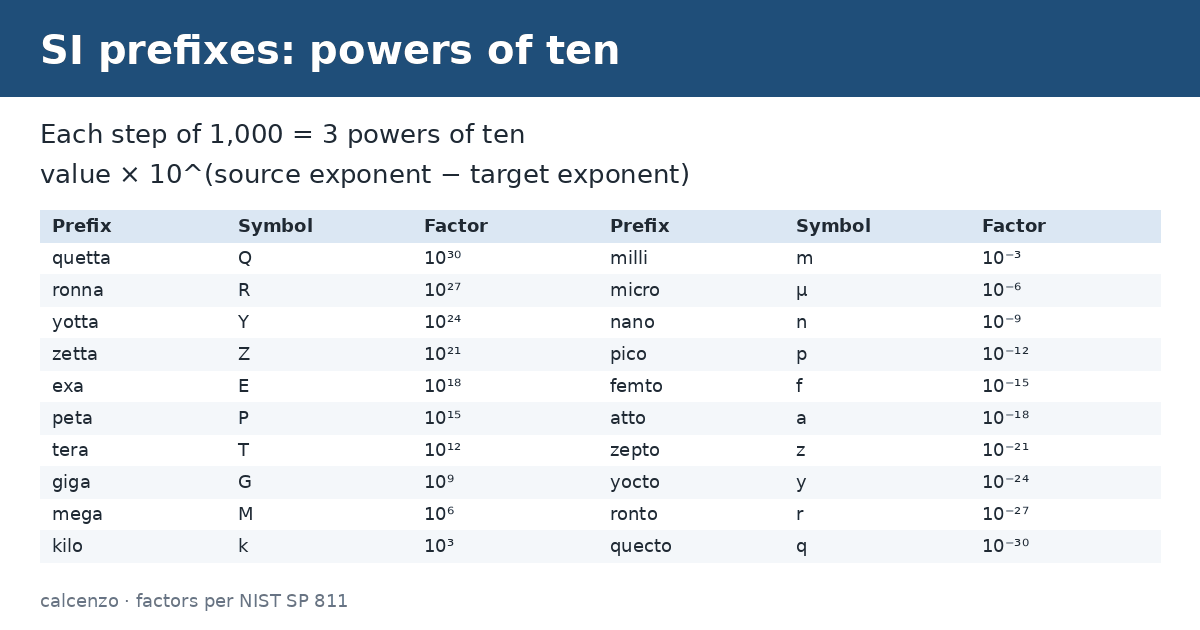
The 20 prefixes in steps of 1,000, from largest to smallest; hecto (10²), deca (10¹), deci (10⁻¹) and centi (10⁻²) fill the gaps near 1:
| Prefix | Symbol | Factor |
|---|---|---|
| quetta | Q | 10³⁰ |
| ronna | R | 10²⁷ |
| yotta | Y | 10²⁴ |
| zetta | Z | 10²¹ |
| exa | E | 10¹⁸ |
| peta | P | 10¹⁵ |
| tera | T | 10¹² |
| giga | G | 10⁹ |
| mega | M | 10⁶ |
| kilo | k | 10³ |
| milli | m | 10⁻³ |
| micro | µ | 10⁻⁶ |
| nano | n | 10⁻⁹ |
| pico | p | 10⁻¹² |
| femto | f | 10⁻¹⁵ |
| atto | a | 10⁻¹⁸ |
| zepto | z | 10⁻²¹ |
| yocto | y | 10⁻²⁴ |
| ronto | r | 10⁻²⁷ |
| quecto | q | 10⁻³⁰ |
Symbols are case-sensitive: M is mega, m is milli; P is peta, p is pico. Common pairs in the SI prefix converter: kilo to mega (÷1,000), milli to micro (×1,000) and giga to tera (÷1,000), with the reverse steps multiplying or dividing by the same 1,000.
Newest prefixes and binary prefixes
Ronna, quetta, ronto and quecto were adopted by the 27th General Conference on Weights and Measures in November 2022, mainly to cover data volumes and the masses of planets and electrons. SI prefixes are always decimal. For computer memory, the IEC defined separate binary prefixes: kibi (2¹⁰ = 1,024), mebi (2²⁰) and gibi (2³⁰), written KiB, MiB, GiB. A 1 TB drive holds 10¹² bytes, about 0.909 TiB. The SI prefix converter covers decimal prefixes only. Use the data storage converter for bytes and the scientific notation calculator for powers of ten.
Related converters and calculators
Related tools:
- Scientific notation calculator: powers of ten
- Data storage converter: MB, GB, GiB
- Length converter: m, ft, in
- Number base converter: binary and hex
- Big number calculator: very large values
Sources
The SI prefix converter is based on these sources: BIPM: SI Brochure; BIPM: CGPM 2022 Resolution 3 on SI prefixes.
Questions about this calculator
How many SI prefixes are there?
24, from quecto (10⁻³⁰) to quetta (10³⁰).
How do I convert kilo to mega?
Divide by 1,000. For example, 2,500 kW = 2.5 MW.
How do I convert milli to micro?
Multiply by 1,000. For example, 0.5 mA = 500 µA.
What are the newest SI prefixes?
Ronna (10²⁷), quetta (10³⁰), ronto (10⁻²⁷) and quecto (10⁻³⁰), adopted in 2022.
Is kibi an SI prefix?
No. Kibi (1,024) is an IEC binary prefix; the SI kilo always means 1,000.
Check the assumptions and units before relying on a result. Financial, tax and health estimates do not replace advice for your individual circumstances.
Report a calculation issue