
This specific heat capacity converter changes a specific heat between joules per kilogram kelvin, kilojoules per kilogram kelvin, calories per gram degree Celsius and BTU per pound degree Fahrenheit. Formula: 1 cal(th)/(g·°C) = 4184 J/(kg·K); 1 kJ/(kg·K) = 1000 J/(kg·K). The SI unit is J/(kg·K). 1 cal/(g·°C) is exactly 4,184 J/(kg·K) with the thermochemical calorie, and 1 BTU/(lb·°F) is exactly 4,186.8 J/(kg·K) with the international-table BTU.
On this page
How to use the specific heat capacity converter
- Enter the value, for example 0.9 from a table in kJ/(kg·K).
- In the specific heat capacity converter, choose its unit and the target unit.
- Read the specific heat capacity converter result: 0.9 kJ/(kg·K) = 900 J/(kg·K) ≈ 0.215 BTU/(lb·°F).
Numerically, BTU/(lb·°F) and cal/(g·°C) are almost equal, because both units were originally based on heating water.
What is specific heat capacity?
Specific heat capacity is the energy needed to raise the temperature of 1 kg of a material by 1 kelvin. Liquid water’s value is about 4,186 J/(kg·K), which equals about 1 cal/(g·°C) or 1 BTU/(lb·°F).
Conversion formula
The specific heat capacity converter stores every unit as a multiple of the base unit, the joule per kilogram kelvin (J/(kg·K)). To convert:
value in target unit = value × (factor of source unit ÷ factor of target unit)
where each factor is the size of the unit in joules per kilogram kelvin.
Common specific heat capacity conversions
| From | To | 1 unit equals |
|---|---|---|
| BTU per pound Fahrenheit (BTU/(lb·°F)) | joule per kilogram kelvin (J/(kg·K)) | 4,186.8 J/(kg·K) |
| calorie per gram Celsius (cal/(g·°C)) | joule per kilogram kelvin (J/(kg·K)) | 4,184 J/(kg·K) |
| joule per kilogram kelvin (J/(kg·K)) | kilojoule per kilogram kelvin (kJ/(kg·K)) | 0.001 kJ/(kg·K) |
Specific heat capacity converter worked example
Convert 25 BTUs per pound Fahrenheit to joules per kilogram kelvin:
- Factor of BTU/(lb·°F) = 4,186.8 J/(kg·K)
- Factor of J/(kg·K) = 1 J/(kg·K)
- 25 × 4,186.8 ÷ 1 = 104,670 J/(kg·K)
Specific heat capacity unit reference
| Unit | Symbol | Group | Equals (J/(kg·K)) |
|---|---|---|---|
| Joule per Kilogram Kelvin | J/(kg·K) | SI | 1 |
| Joule per Kilogram Celsius | J/(kg·°C) | Common | 1 |
| Kilojoule per Kilogram Kelvin | kJ/(kg·K) | SI | 1,000 |
| Calorie per Gram Celsius | cal/(g·°C) | Common | 4,184 |
| BTU per Pound Fahrenheit | BTU/(lb·°F) | US | 4,186.8 |
| Kilocalorie per Kilogram Celsius | kcal/(kg·°C) | Metric | 4,184 |
Reverse factors for each specific heat capacity unit
The specific heat capacity converter reference table gives each unit in joule per kilogram kelvins. To go the other way, divide by that factor; the list below does the division for you.
- Joule per Kilogram Kelvin (J/(kg·K)), SI: 1 J/(kg·K) = 1 J/(kg·K, so 1 J/(kg·K = 1 J/(kg·K).
- Joule per Kilogram Celsius (J/(kg·°C)), Common: 1 J/(kg·°C) = 1 J/(kg·K, so 1 J/(kg·K = 1 J/(kg·°C).
- Kilojoule per Kilogram Kelvin (kJ/(kg·K)), SI: 1 kJ/(kg·K) = 1,000 J/(kg·K, so 1 J/(kg·K = 0.001 kJ/(kg·K).
- Calorie per Gram Celsius (cal/(g·°C)), Common: 1 cal/(g·°C) = 4,184 J/(kg·K, so 1 J/(kg·K = 0.0002390057 cal/(g·°C).
- BTU per Pound Fahrenheit (BTU/(lb·°F)), US: 1 BTU/(lb·°F) = 4,186.8 J/(kg·K), so 1 J/(kg·K) = 0.0002388459 BTU/(lb·°F).
- Kilocalorie per Kilogram Celsius (kcal/(kg·°C)), Metric: 1 kcal/(kg·°C) = 4,184 J/(kg·K, so 1 J/(kg·K = 0.0002390057 kcal/(kg·°C).
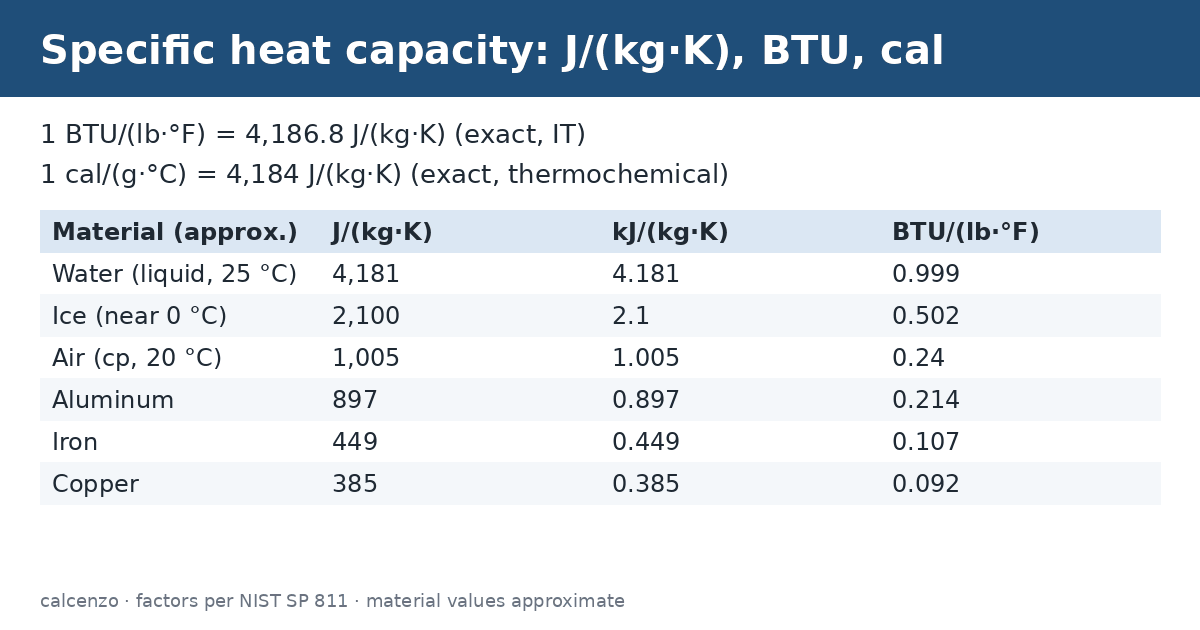
Specific heat of water and common materials
Approximate values near room temperature at constant pressure:
| Material (approximate) | J/(kg·K) | kJ/(kg·K) | BTU/(lb·°F) |
|---|---|---|---|
| Water (liquid, 25 °C) | 4,181 | 4.181 | 0.999 |
| Ice (near 0 °C) | 2,100 | 2.1 | 0.502 |
| Air (cp, 20 °C) | 1,005 | 1.005 | 0.24 |
| Aluminum | 897 | 0.897 | 0.214 |
| Iron | 449 | 0.449 | 0.107 |
| Copper | 385 | 0.385 | 0.092 |
The specific heat of water is unusually high, about 4.18 kJ/(kg·K), which is why water is used for heat storage and cooling.
Heat needed: Q = m × c × ΔT
Multiply mass, specific heat and temperature change. Heating 2 kg of water from 20 °C to 100 °C takes about 2 × 4,181 × 80 = 668,960 J, or roughly 0.186 kWh. Use a temperature change, not a reading, for ΔT; the temperature difference converter handles °F intervals. The energy unit converter turns joules into kWh or BTU.
Calories, BTU and volumetric heat capacity
There are two calories in use. The thermochemical calorie is exactly 4.184 J; the International Table calorie is 4.1868 J. That gives water a specific heat of 1 cal/(g·°C) in either system, but 4,184 or 4,186.8 J/(kg·K) depending on which one the source used. The difference is under 0.1%, so it rarely matters, but it explains why two tables disagree in the fourth digit.
One BTU/(lb·°F) equals 4,186.8 J/(kg·K) exactly, so water is close to 1 in both cal and BTU units. A specific heat capacity converter makes that easy to check.
For storage tanks and building materials, volumetric heat capacity is often handier: multiply specific heat by density. Water is about 4.18 MJ/(m³·K); concrete, at about 880 J/(kg·K) and 2,300 kg/m³, is about 2.0 MJ/(m³·K).
Related converters and calculators
Related thermal tools:
- Temperature difference converter: ΔC and ΔF
- Energy unit converter: J, kWh, BTU
- Thermal conductivity converter: W/(m·K)
- Heat density converter: MJ/m³ and BTU/ft³
- Thermal resistance converter: K/W and R-value
Sources
NIST Special Publication 811, Appendix B; NIST Chemistry WebBook: Thermophysical properties of fluid systems.
Questions about this calculator
What is the SI unit of specific heat capacity?
Joule per kilogram kelvin, J/(kg·K).
How do I convert J/kg·K to BTU/lb·°F?
Divide by 4,186.8. For example, 900 J/(kg·K) = 0.215 BTU/(lb·°F).
How do I convert cal/g°C to J/kg·K?
Multiply by 4,184. For example, 0.5 cal/(g·°C) = 2,092 J/(kg·K).
What is the specific heat of water?
About 4,181 J/(kg·K) at 25 °C, or roughly 1 cal/(g·°C) and 1 BTU/(lb·°F).
Is J/(kg·K) the same as J/(kg·°C)?
Yes. Specific heat uses a temperature difference, and 1 K equals 1 °C as an interval.
Check the assumptions and units before relying on a result. Financial, tax and health estimates do not replace advice for your individual circumstances.
Report a calculation issue