
A balance transfer calculator compares paying off a card at its current APR with moving the debt to a card that has a low promo rate and a transfer fee. Formula: Interest saved = interest at current APR − (transfer fee + interest at promo APR, then later APR), both paid with the same monthly payment. Moving $6,000 from 22% APR to a 0% card for 15 months with a 3% fee, then 19%, and paying $250 a month saves $1,749.06 and finishes 6 months sooner.
On this page
How to use the balance transfer calculator
- Enter the balance you want to move and its current APR.
- Enter the transfer fee as a percent, the promo APR and how many months it lasts.
- Enter the APR that applies after the promo ends.
- Enter the monthly payment you can make. The same payment is used for both paths.
The balance transfer calculator shows interest and months if you stay, interest and months after the transfer (with the fee counted as a cost), and the difference.
What formula does the balance transfer calculator use?
Both paths are simulated month by month. If you stay, interest is charged at the current APR divided by 12 and your payment is applied until the balance is zero. If you transfer, the fee is added to the new balance, then interest is charged at the promo rate for the promo months and at the later APR after that. Savings equal the first path’s interest minus the second path’s fee and interest.
Balance transfer calculator worked example
Results from the balance transfer calculator:
| Scenario | Stay: interest, months | Transfer: fee and interest, months | Saved |
|---|---|---|---|
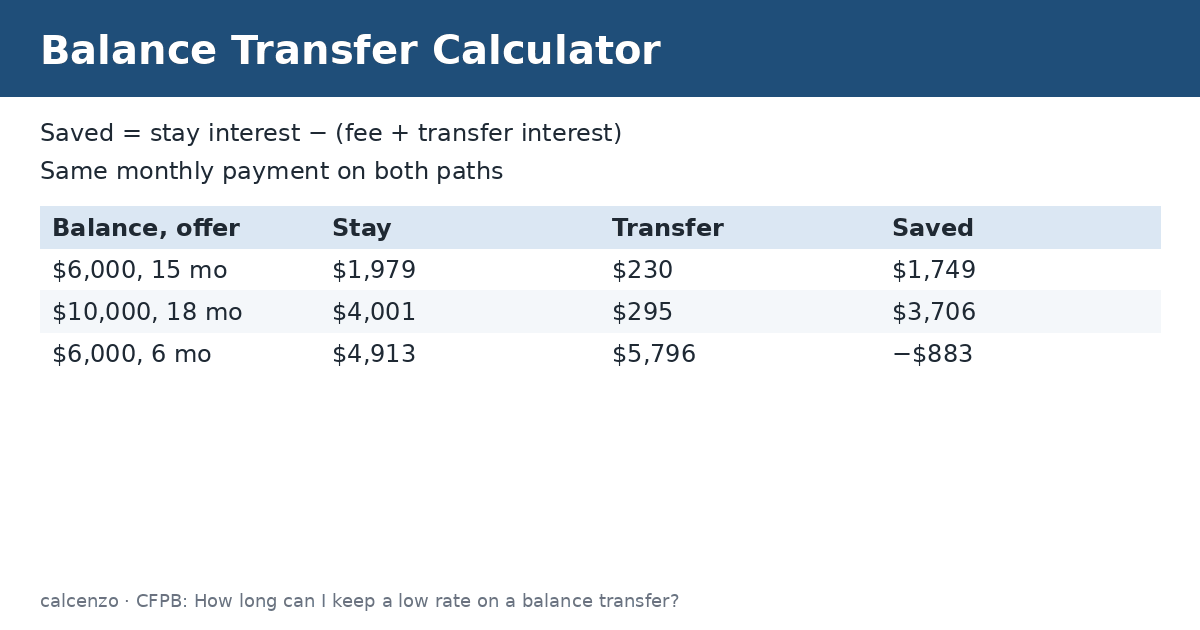
| $6,000 at 22%, 3% fee, 0% for 15 months then 19%, $250 a month | $1,979.05, 32 | $229.99, 26 | $1,749.06 |
| $10,000 at 24%, 5% fee, 0% for 18 months then 21%, $400 a month | $4,001.13, 36 | $295.09, 27 | $3,706.03 |
| $6,000 at 22%, 5% fee, 0% for 6 months then 27%, $150 a month | $4,913.45, 73 | $5,796.02, 81 | −$882.57 |
The last row shows how a transfer can backfire. With a short promo, a high later APR and a small payment, most of the balance is still there when the rate jumps, and you end up paying more than if you had stayed.
Rules to know
The CFPB says an introductory rate has to last at least six months unless you are more than 60 days late, and the issuer must tell you how long it lasts and what rate applies after. Issuers are allowed to charge a balance transfer fee even on a 0% offer.
Watch new purchases. The CFPB explains that if you carry a balance, new purchases on most cards accrue interest from the transaction date, even while the transferred balance sits at 0%. Using the new card only for the transfer keeps the plan simple and matches what the balance transfer calculator assumes.
How to make a transfer pay off
Divide the transferred balance plus the fee by the promo months to find the payment that clears it before the rate rises. For the first example that is $6,180 ÷ 15, or $412 a month. Paying that amount, the transfer costs only the fee. If you cannot pay that much, a longer promo or lower later APR matters more than a small fee difference. Our credit card payoff calculator helps you set the payment.
Common mistakes to avoid
A common mistake is missing a payment. The CFPB notes the six-month protection for an intro rate does not apply if you are more than 60 days late. Another is assuming the full balance will be approved; the new card’s limit may be lower than your debt, leaving part of it on the old card. A third is running up the old card again after it is cleared, which leaves you with two balances instead of one.
Before you apply, read the offer for the fee, the promo length, the later APR and whether the promo only applies to transfers made within a set number of days. Then enter those exact terms in the balance transfer calculator.
Estimates for education only, not tax, legal or financial advice. Check current rules with the tax authority or a qualified adviser.
Related converters and calculators
Related calculators:
- Credit card payoff calculator: payoff time
- Credit card interest calculator: monthly interest
- Debt consolidation calculator: loan vs cards
Sources
CFPB: How long can I keep a low rate on a balance transfer?; CFPB: What is a balance transfer fee?; CFPB: Do I pay interest on new purchases after a balance transfer?.
Questions about this calculator
Is a balance transfer worth it?
Often, if the fee is lower than the interest you avoid and you can pay down most of the balance during the promo period.
How long does a promo rate last?
At least six months under CFPB-described rules, unless you are more than 60 days late. Many offers run longer.
Can I be charged a fee on a 0% transfer?
Yes. Card issuers are permitted to charge a balance transfer fee on a zero percent offer.
Do new purchases get 0% too?
Usually not. If you carry a balance, new purchases on most cards accrue interest right away.
What payment pays it off during the promo?
Divide the balance plus the fee by the promo months.
Check the assumptions and units before relying on a result. Financial, tax and health estimates do not replace advice for your individual circumstances.
Report a calculation issue