
This capacitance converter changes capacitance between farads, millifarads, microfarads, nanofarads, picofarads, abfarads and statfarads. Each metric step is a factor of 1,000: 1 µF = 1,000 nF and 1 nF = 1,000 pF. One statfarad is about 1.11265 pF, and one abfarad is 10⁹ F.
On this page
How to use the capacitance converter
- Enter the capacitance, for example 0.1 µF.
- In the capacitance converter, choose its unit and the target unit, such as µF to nF.
- Read the capacitance converter result: 0.1 µF = 100 nF = 100,000 pF.
For µF to nF, multiply by 1,000; for nF to pF, multiply by 1,000. For pF to µF, divide by 1,000,000.
What is capacitance?
Capacitance is a component’s ability to store electric charge per volt. The SI unit is the farad (F). Practical capacitors are usually rated in microfarads (µF), nanofarads (nF) or picofarads (pF).
Conversion formula
The capacitance converter stores every unit as a multiple of the base unit, the farad (F). To convert:
value in target unit = value × (factor of source unit ÷ factor of target unit)
where each factor is the size of the unit in farads.
Common capacitance conversions
| From | To | 1 unit equals |
|---|---|---|
| microfarad (µF) | nanofarad (nF) | 1,000 nF |
| farad (F) | microfarad (µF) | 1,000,000 µF |
| nanofarad (nF) | picofarad (pF) | 1,000 pF |
| millifarad (mF) | microfarad (µF) | 1,000 µF |
Capacitance converter worked example
Convert 25 microfarads to nanofarads:
- Factor of µF = 1 × 10⁻⁶ F
- Factor of nF = 1 × 10⁻⁹ F
- 25 × 1 × 10−6 ÷ 1 × 10−9 = 25,000 nF
Capacitance unit reference
| Unit | Symbol | Group | Equals (F) |
|---|---|---|---|
| Farad | F | SI | 1 |
| Millifarad | mF | SI | 0.001 |
| Microfarad | µF | SI | 1 × 10⁻⁶ |
| Nanofarad | nF | SI | 1 × 10⁻⁹ |
| Picofarad | pF | SI | 1 × 10⁻¹² |
| Abfarad | abF | CGS-EMU | 1,000,000,000 |
| Statfarad | statF | CGS-ESU | 1.11265 × 10⁻¹² |
Reverse factors for each capacitance unit
The capacitance converter reference table gives each unit in farads. To go the other way, divide by that factor; the list below does the division for you.
- Millifarad (mF), SI: 1 mF = 0.001 F, so 1 F = 1,000 mF.
- Microfarad (µF), SI: 1 µF = 1 × 10⁻⁶ F, so 1 F = 1,000,000 µF.
- Nanofarad (nF), SI: 1 nF = 1 × 10⁻⁹ F, so 1 F = 1 × 10⁹ nF.
- Picofarad (pF), SI: 1 pF = 1 × 10⁻¹² F, so 1 F = 1 × 10¹² pF.
- Abfarad (abF), CGS-EMU: 1 abF = 1 × 10⁹ F, so 1 F = 1 × 10⁻⁹ abF.
- Statfarad (statF), CGS-ESU: 1 statF = 1.11265 × 10⁻¹² F, so 1 F = 8.98755 × 10¹¹ statF.
Three-digit capacitor codes
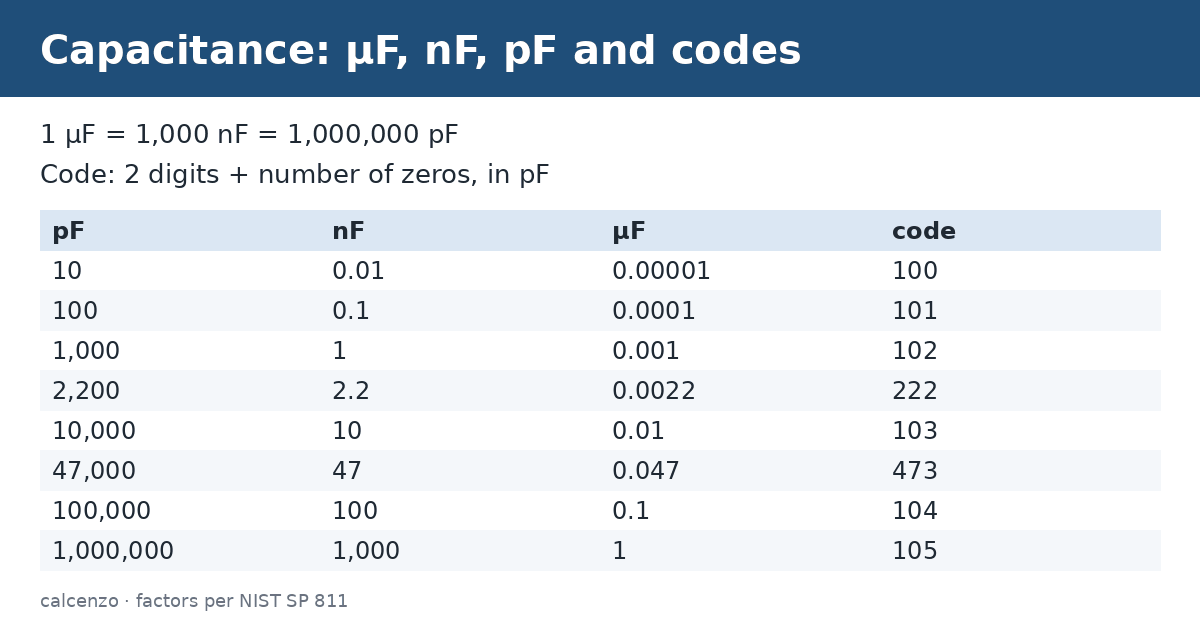
Small ceramic capacitors carry a three-digit code in picofarads: two significant digits followed by the number of zeros. Decoded:
| Code | pF | nF | µF |
|---|---|---|---|
| 101 | 100 | 0.1 | 0.0001 |
| 102 | 1,000 | 1 | 0.001 |
| 222 | 2,200 | 2.2 | 0.0022 |
| 103 | 10,000 | 10 | 0.01 |
| 473 | 47,000 | 47 | 0.047 |
| 104 | 100,000 | 100 | 0.1 |
| 105 | 1,000,000 | 1,000 | 1 |
A letter after the code, such as K or J, gives the tolerance, not the unit.
Series, parallel and stored energy
Capacitors in parallel add: C = C₁ + C₂. In series, the reciprocals add, so two 10 µF capacitors in series give 5 µF. The energy stored is E = ½CV²: 1,000 µF at 12 V stores 0.072 J. With a resistor, the time constant is τ = RC; 10 kΩ and 100 µF give 1 s. Use the electric charge converter for Q = CV and the voltage converter.
RC time constants
Capacitance sets timing. The time constant of a resistor and capacitor is τ = R × C. With 10 kΩ and 100 µF, τ = 10,000 × 0.0001 = 1 s, and the capacitor reaches about 63% of the supply in that time. With 10 kΩ and 47 nF, τ is 0.47 ms. The capacitance converter turns µF and nF into farads first, which is where slip-ups happen.
After five time constants a charging capacitor is above 99% of the supply, which engineers treat as fully charged. That gives a quick way to size a delay: if you need about 5 seconds with a 100 kΩ resistor, τ should be about 1 second, so C ≈ 10 µF. Electrolytic capacitors can be 20% off their marked value, so expect the real delay to vary.
Related converters and calculators
Related electrical tools:
- Inductance converter: H, mH, µH
- Electric charge converter: C and mAh
- Voltage converter: V and mV
- Electrical resistance converter: Ω, kΩ, MΩ
- Surface charge density converter: C/m²
Sources
BIPM: SI Brochure; NIST Special Publication 811, Appendix B.
Questions about this calculator
How many nF are in a µF?
1,000 nF = 1 µF exactly.
How do I convert µF to nF?
Multiply by 1,000. For example, 0.47 µF = 470 nF.
How do I convert nF to pF?
Multiply by 1,000. For example, 2.2 nF = 2,200 pF.
How do I convert pF to µF?
Divide by 1,000,000. For example, 100,000 pF = 0.1 µF.
What does capacitor code 104 mean?
10 followed by 4 zeros in pF: 100,000 pF = 100 nF = 0.1 µF.
Check the assumptions and units before relying on a result. Financial, tax and health estimates do not replace advice for your individual circumstances.
Report a calculation issue