
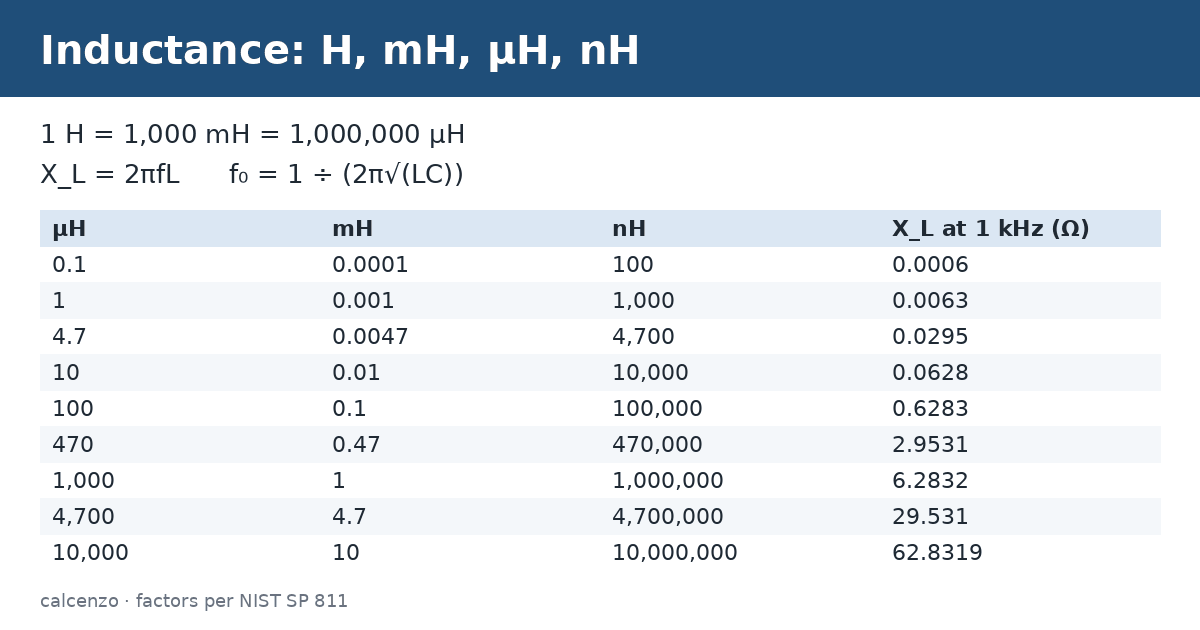
This inductance converter changes inductance between henries, millihenries, microhenries, nanohenries, abhenries and stathenries. Each metric step is a factor of 1,000: 1 H = 1,000 mH and 1 mH = 1,000 µH. One abhenry equals 1 nH, while one stathenry is about 8.98755 × 10¹¹ H.
On this page
How to use the inductance converter
- Enter the inductance, for example 2.2 mH.
- In the inductance converter, choose its unit and the target unit, such as mH to µH.
- Read the inductance converter result: 2.2 mH = 2,200 µH.
For mH to µH, multiply by 1,000; for µH to H, divide by 1,000,000. For nH to µH, divide by 1,000.
What is inductance?
Inductance is a conductor’s tendency to oppose changes in current by storing energy in a magnetic field. The SI unit is the henry (H); inductors in electronics are typically rated in millihenries (mH) or microhenries (µH).
Conversion formula
The inductance converter stores every unit as a multiple of the base unit, the henry (H). To convert:
value in target unit = value × (factor of source unit ÷ factor of target unit)
where each factor is the size of the unit in henries.
Common inductance conversions
| From | To | 1 unit equals |
|---|---|---|
| henry (H) | millihenry (mH) | 1,000 mH |
| millihenry (mH) | microhenry (µH) | 1,000 µH |
| microhenry (µH) | nanohenry (nH) | 1,000 nH |
Inductance converter worked example
Convert 25 millihenries to microhenries:
- Factor of mH = 0.001 H
- Factor of µH = 1 × 10⁻⁶ H
- 25 × 0.001 ÷ 1 × 10−6 = 25,000 µH
Inductance unit reference
| Unit | Symbol | Group | Equals (H) |
|---|---|---|---|
| Henry | H | SI | 1 |
| Millihenry | mH | SI | 0.001 |
| Microhenry | µH | SI | 1 × 10⁻⁶ |
| Nanohenry | nH | SI | 1 × 10⁻⁹ |
| Abhenry | abH | CGS-EMU | 1 × 10⁻⁹ |
| Stathenry | statH | CGS-ESU | 898,755,178,737 |
Reverse factors for each inductance unit
The reference table gives each unit in henrys. To go the other way, divide by that factor; the list below does the division for you.
- Millihenry (mH), SI: 1 mH = 0.001 H, so 1 H = 1,000 mH.
- Microhenry (µH), SI: 1 µH = 1 × 10⁻⁶ H, so 1 H = 1,000,000 µH.
- Nanohenry (nH), SI: 1 nH = 1 × 10⁻⁹ H, so 1 H = 1 × 10⁹ nH.
- Abhenry (abH), CGS-EMU: 1 abH = 1 × 10⁻⁹ H, so 1 H = 1 × 10⁹ abH.
- Stathenry (statH), CGS-ESU: 1 statH = 8.98755 × 10¹¹ H, so 1 H = 1.11265 × 10⁻¹² statH.
Inductive reactance and LC resonance
An inductor’s reactance rises with frequency: X_L = 2πfL. With a capacitor it resonates at f = 1 ÷ (2π√(LC)). Values must be in henries and farads:
| L | C | Resonant frequency | X_L at 1 kHz |
|---|---|---|---|
| 1 mH | 1 µF | 5,033 Hz | 6.283 Ω |
| 100 µH | 100 nF | 50.33 kHz | 0.6283 Ω |
| 10 µH | 100 pF | 5.033 MHz | 0.06283 Ω |
Convert the capacitor with the capacitance converter before using the formula.
Inductor codes and stored energy
Small inductors use a three-digit code in microhenries: two digits and a multiplier, so 101 is 100 µH and 472 is 4,700 µH (4.7 mH). Codes with an R mark the decimal point: 4R7 is 4.7 µH. The energy stored in an inductor is E = ½LI², so 10 mH carrying 2 A holds 0.02 J. For an air-core solenoid, L = μ₀N²A ÷ l, with μ₀ ≈ 1.25663706127 × 10⁻⁶ H/m. Use the electric current converter for the current.
L/R time constant
An inductor and resistor have a time constant τ = L ÷ R. A 10 mH coil with 100 Ω of resistance gives τ = 0.01 ÷ 100 = 0.1 ms, so the current reaches about 63% of its final value in that time. The inductance converter helps put mH, µH and nH into henries first.
At the small end, a straight PCB trace has a rule-of-thumb inductance of about 1 nH per millimeter. That is tiny, but at fast edges it matters, which is why decoupling capacitors sit close to chip pins.
Unit prefixes for inductors run from nH for RF chokes to H for mains filters and old audio chokes.
Related converters and calculators
Related electrical tools:
- Capacitance converter: F, µF, pF
- Electric current converter: A and mA
- Magnetic flux converter: Wb and Mx
- Magnetic flux density converter: tesla and gauss
- Frequency to wavelength converter: Hz to m
Sources
BIPM: SI Brochure; NIST CODATA: Vacuum magnetic permeability.
Questions about this calculator
How many µH are in a mH?
1,000 µH = 1 mH exactly.
How do I convert mH to µH?
Multiply by 1,000. For example, 0.33 mH = 330 µH.
How do I convert µH to H?
Divide by 1,000,000. For example, 470 µH = 0.00047 H.
How do I convert nH to µH?
Divide by 1,000. For example, 680 nH = 0.68 µH.
What does inductor code 101 mean?
10 followed by 1 zero in µH: 100 µH.
Check the assumptions and units before relying on a result. Financial, tax and health estimates do not replace advice for your individual circumstances.
Report a calculation issue