
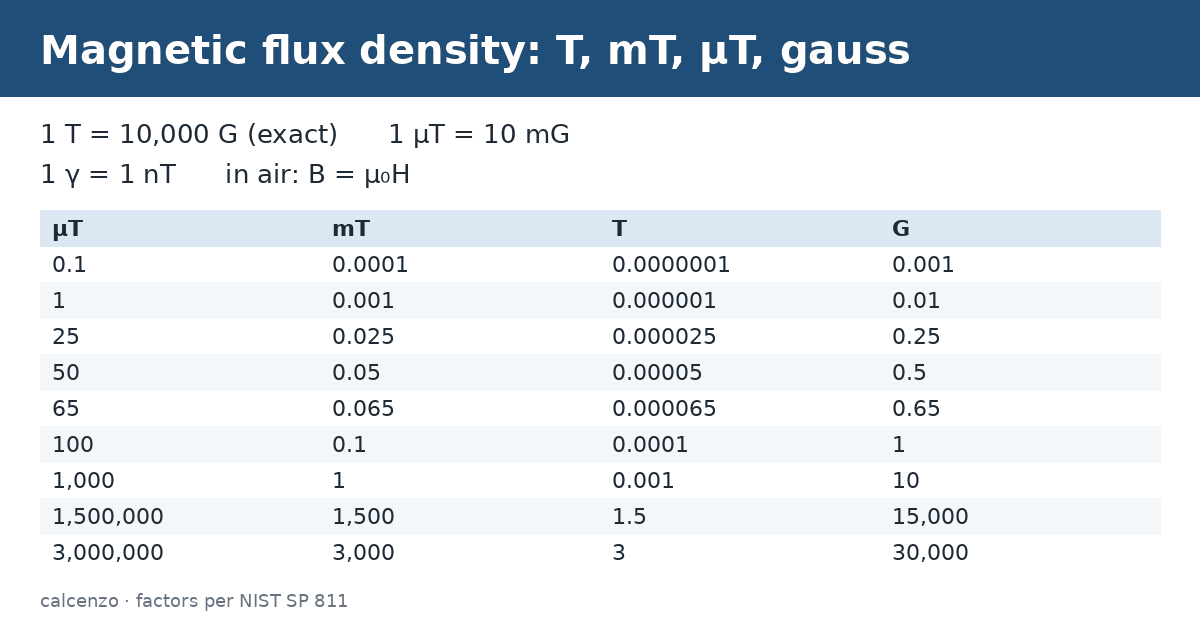
This magnetic flux density converter changes field strength B between tesla, millitesla, microtesla, nanotesla, gauss, kilogauss and gamma. The tesla is the SI unit. One gauss is exactly 10⁻⁴ T, so 1 T = 10,000 G and 1 µT = 10 mG; one gamma equals 1 nT.
On this page
How to use the magnetic flux density converter
- Enter the field, for example 3 T.
- In the magnetic flux density converter, choose its unit and the target unit, such as tesla to gauss.
- Read the magnetic flux density converter result: 3 T = 30,000 G (30 kG).
For tesla to gauss, multiply by 10,000; for gauss to tesla, divide by 10,000. For µT to mG, multiply by 10.
What is magnetic flux density?
Magnetic flux density (B) is the strength of a magnetic field, measured in tesla (T). The CGS unit gauss is still common: 1 T = 10,000 G. Earth’s field is roughly 25 to 65 microtesla depending on location.
Conversion formula
The magnetic flux density converter stores every unit as a multiple of the base unit, the tesla (T). To convert:
value in target unit = value × (factor of source unit ÷ factor of target unit)
where each factor is the size of the unit in teslas.
Common magnetic flux density conversions
| From | To | 1 unit equals |
|---|---|---|
| tesla (T) | gauss (G) | 10,000 G |
| gauss (G) | tesla (T) | 0.0001 T |
| millitesla (mT) | gauss (G) | 10 G |
| microtesla (µT) | millitesla (mT) | 0.001 mT |
Magnetic flux density converter worked example
Convert 25 milliteslas to gauss:
- Factor of mT = 0.001 T
- Factor of G = 0.0001 T
- 25 × 0.001 ÷ 0.0001 = 250 G
Magnetic flux density unit reference
| Unit | Symbol | Group | Equals (T) |
|---|---|---|---|
| Tesla | T | SI | 1 |
| Millitesla | mT | SI | 0.001 |
| Microtesla | µT | SI | 1 × 10⁻⁶ |
| Nanotesla | nT | SI | 1 × 10⁻⁹ |
| Gauss | G | CGS | 0.0001 |
| Kilogauss | kG | CGS | 0.1 |
| Gamma | γ | Geophysics | 1 × 10⁻⁹ |
Reverse factors for each magnetic flux density unit
The magnetic flux density converter reference table gives each unit in teslas. To go the other way, divide by that factor; the list below does the division for you.
- Millitesla (mT), SI: 1 mT = 0.001 T, so 1 T = 1,000 mT.
- Microtesla (µT), SI: 1 µT = 1 × 10⁻⁶ T, so 1 T = 1,000,000 µT.
- Nanotesla (nT), SI: 1 nT = 1 × 10⁻⁹ T, so 1 T = 1 × 10⁹ nT.
- Gauss (G), CGS: 1 G = 0.0001 T, so 1 T = 10,000 G.
- Kilogauss (kG), CGS: 1 kG = 0.1 T, so 1 T = 10 kG.
- Gamma (γ), Geophysics: 1 γ = 1 × 10⁻⁹ T, so 1 T = 1 × 10⁹ γ.
Typical magnetic fields in T, mT, µT and gauss
Fields range over many orders of magnitude:
| Field | T | µT | G |
|---|---|---|---|
| Earth’s surface field, low end | 0.000025 | 25 | 0.25 |
| Earth’s surface field, high end | 0.000065 | 65 | 0.65 |
| Clinical MRI scanner, common strength | 1.5 | 1,500,000 | 15,000 |
| Clinical MRI scanner, high field | 3 | 3,000,000 | 30,000 |
Earth’s field varies by location, weakest near the equator and strongest near the magnetic poles. MRI strengths of 1.5 T and 3 T are the common clinical systems.
Flux density and field strength
In air or vacuum, B = μ₀ H, with μ₀ ≈ 1.25663706127 × 10⁻⁶ N/A². So 1 A/m corresponds to about 1.2566 µT, and 1 Oe to 0.1 mT, or 1 G. Inside iron, μᵣ can be in the thousands until the core saturates. Flux is flux density times area, Φ = B × A. Use the magnetic field strength converter for H and the magnetic flux converter for webers.
Field around a wire
A long straight wire produces B = μ₀I ÷ (2πr). With 10 A at 1 cm, B is 0.0002 T, or 2 G in the magnetic flux density converter. At 1 m the field falls to 2 µT, or 0.02 G, which is well under Earth’s field of about 25 to 65 µT.
This is why power cables in walls barely affect a compass a short distance away. Paired supply and return conductors also cancel most of each other’s field, so the real value next to a cable is usually lower than the single-wire formula suggests. Gaussmeters often display mT and G side by side, where 1 mT equals 10 G.
Related converters and calculators
Related magnetic tools:
- Magnetic field strength converter: A/m and Oe
- Magnetic flux converter: Wb and Mx
- Magnetomotive force converter: At and Gb
- Inductance converter: H, mH, µH
- Linear current density converter: A/m
Sources
NIST Special Publication 811, Appendix B; NOAA NCEI: World Magnetic Model; NIST CODATA: Vacuum magnetic permeability.
Questions about this calculator
How many gauss are in a tesla?
10,000 G = 1 T exactly.
How do I convert tesla to gauss?
Multiply by 10,000. For example, 0.5 T = 5,000 G.
How do I convert gauss to tesla?
Divide by 10,000. For example, 500 G = 0.05 T.
How do I convert µT to mG?
Multiply by 10. For example, 0.4 µT = 4 mG.
How strong is Earth’s magnetic field?
Roughly 25 to 65 µT, or 0.25 to 0.65 G, at the surface.
Check the assumptions and units before relying on a result. Financial, tax and health estimates do not replace advice for your individual circumstances.
Report a calculation issue