
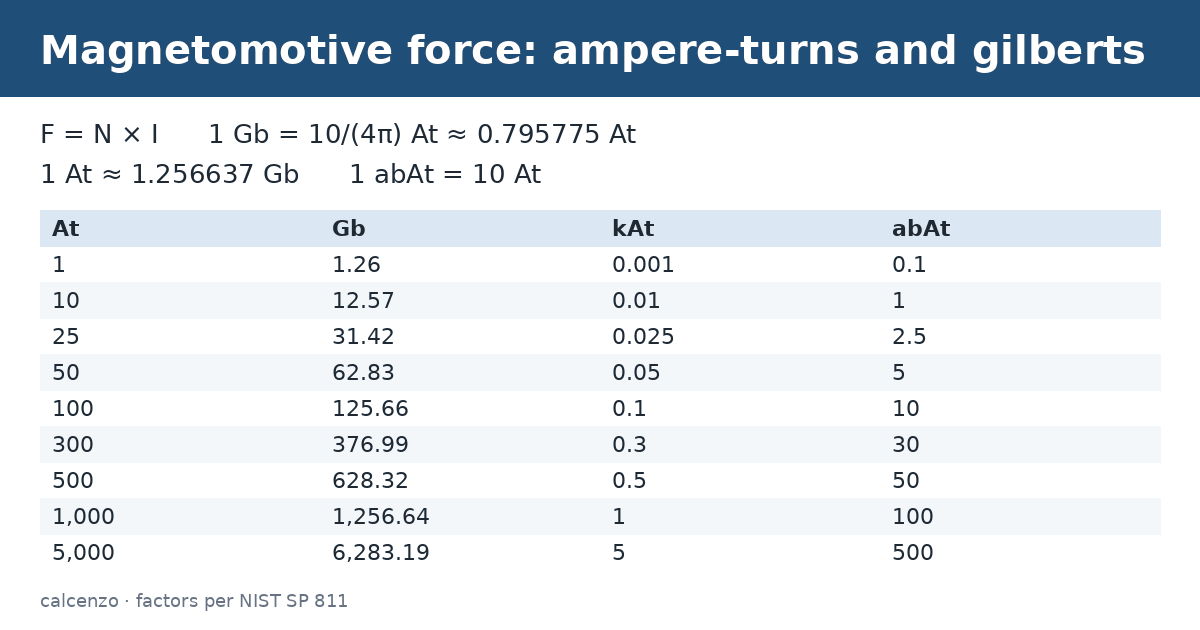
This magnetomotive force converter changes magnetomotive force (MMF) between ampere-turns, kiloampere-turns, milliampere-turns, gilberts and abampere-turns. Formula: 1 gilbert = 10/(4π) A-turn ≈ 0.795774715 A-turn. The SI unit is the ampere (often written ampere-turn, At). One gilbert is 10/(4π) At, about 0.795775 At, and one abampere-turn is exactly 10 At.
On this page
How to use the magnetomotive force converter
- Enter the MMF, for example 400 At from a coil design.
- In the magnetomotive force converter, choose its unit and the target unit, such as ampere-turn to gilbert.
- Read the magnetomotive force converter result: 400 At ≈ 502.65 Gb.
For ampere-turn to gilbert, multiply by 1.256637 (4π/10). For gilbert to ampere-turn, multiply by 0.795775.
What is magnetomotive force?
Magnetomotive force drives magnetic flux through a magnetic circuit, much as voltage drives current. It is measured in ampere-turns; the CGS unit is the gilbert.
Conversion formula
The magnetomotive force converter stores every unit as a multiple of the base unit, the ampere-turn (At). To convert:
value in target unit = value × (factor of source unit ÷ factor of target unit)
where each factor is the size of the unit in ampere-turns.
Common magnetomotive force conversions
| From | To | 1 unit equals |
|---|---|---|
| ampere-turn (At) | gilbert (Gb) | 1.256637 Gb |
| gilbert (Gb) | ampere-turn (At) | 0.7957747 At |
| kiloampere-turn (kAt) | ampere-turn (At) | 1,000 At |
Magnetomotive force converter worked example
Convert 25 ampere-turns to gilberts:
- Factor of At = 1 At
- Factor of Gb = 0.79577472 At
- 25 × 1 ÷ 0.79577472 = 31.41593 Gb
Magnetomotive force unit reference
| Unit | Symbol | Group | Equals (At) |
|---|---|---|---|
| Ampere-Turn | At | SI | 1 |
| Kiloampere-Turn | kAt | SI | 1,000 |
| Milliampere-Turn | mAt | SI | 0.001 |
| Gilbert | Gb | CGS | 0.7957747155 |
| Abampere-Turn | abAt | CGS-EMU | 10 |
Reverse factors for each magnetomotive force unit
The reference table gives each unit in ampere-turns. To go the other way, divide by that factor; the list below does the division for you.
- Kiloampere-Turn (kAt), SI: 1 kAt = 1,000 At, so 1 At = 0.001 kAt.
- Milliampere-Turn (mAt), SI: 1 mAt = 0.001 At, so 1 At = 1,000 mAt.
- Gilbert (Gb), CGS: 1 Gb = 0.7957747 At, so 1 At = 1.256637 Gb.
- Abampere-Turn (abAt), CGS-EMU: 1 abAt = 10 At, so 1 At = 0.1 abAt.
Magnetomotive force formula
The magnetomotive force formula for a coil is F = N × I: turns times current. A 200-turn coil carrying 1.5 A provides 300 At. Doubling either the turns or the current doubles the MMF:
| Turns N | Current I | F = NI (At) | F (Gb) |
|---|---|---|---|
| 50 | 0.5 A | 25 | 31.4 |
| 100 | 1 A | 100 | 125.7 |
| 200 | 1.5 A | 300 | 377 |
| 500 | 2 A | 1,000 | 1,256.6 |
| 1000 | 5 A | 5,000 | 6,283.2 |
MMF is to a magnetic circuit what voltage is to an electric circuit.
MMF, flux and reluctance
Hopkinson’s law relates MMF to flux: F = Φ × ℛ, where reluctance ℛ = l ÷ (μ₀ μᵣ A). A steel core with a 0.2 m path, 4 cm² cross-section and relative permeability 2,000 has ℛ ≈ 198,944 A/Wb. With 25 At, the flux is about 1.26 × 10⁻⁴ Wb and B = Φ ÷ A ≈ 0.314 T. Real cores saturate, so this holds only below saturation. Convert the result with the magnetic flux converter and the magnetic field strength converter, since H = F ÷ l.
Gilberts in older texts
Older CGS texts give magnetomotive force in gilberts. One gilbert is 10 ÷ 4π ampere-turns, about 0.796 At. Going the other way, one ampere-turn is about 1.257 Gb.
A worked case: a coil with 500 turns carrying 0.2 A has an MMF of 100 At. The magnetomotive force converter shows this as about 125.7 Gb. Doubling the turns or the current doubles the MMF, which is why designers trade turns against wire size.
Note that “ampere-turn” and “ampere” are the same SI unit; turns are dimensionless. Data sheets use At to make the coil count clear.
Magnetomotive force drives flux through a magnetic circuit the way voltage drives current through a resistor. The magnetic equivalent of resistance is reluctance, in ampere-turns per weber. With 100 At and a reluctance of 500,000 At/Wb, the flux is 0.0002 Wb. Air gaps add most of the reluctance in real cores.
Related converters and calculators
Related magnetic tools:
- Magnetic field strength converter: A/m and Oe
- Magnetic flux converter: Wb and Mx
- Magnetic flux density converter: T and G
- Inductance converter: H, mH, µH
- Electric current converter: A and mA
Sources
NIST CODATA: Vacuum magnetic permeability; NIST Special Publication 811, Appendix B.
Questions about this calculator
What is magnetomotive force?
The “push” that drives magnetic flux through a magnetic circuit, F = N × I, in ampere-turns.
How do I convert gilberts to ampere-turns?
Multiply by 0.795775. For example, 100 Gb ≈ 79.58 At.
How do I convert ampere-turns to gilberts?
Multiply by 1.256637. For example, 50 At ≈ 62.83 Gb.
What is the magnetomotive force formula?
F = N × I. 300 turns at 0.2 A give 60 At.
What is an abampere-turn?
The CGS-EMU unit, equal to exactly 10 ampere-turns.
Check the assumptions and units before relying on a result. Financial, tax and health estimates do not replace advice for your individual circumstances.
Report a calculation issue