
A case converter changes the capitalization and word separators of text without changing the words. Formula: Apply documented Unicode case mapping; title case requires a separately named editorial style. Paste text, choose a style, and copy the result. For example, “monthly loan payment” becomes “Monthly Loan Payment” (Title Case), “monthlyLoanPayment” (camelCase) or “monthly loan payment” (snake case).
On this page
How to use the case converter
- Paste or type your text into the input box.
- Choose the target style, such as Title Case or snake_case.
- Copy the output and paste it where you need it, then check acronyms and brand names.
Mixed input works: “Monthly-Loan payment” and “monthlyLoanPayment” both split into the same three words before the new style is applied.
Case styles and how each one is formed
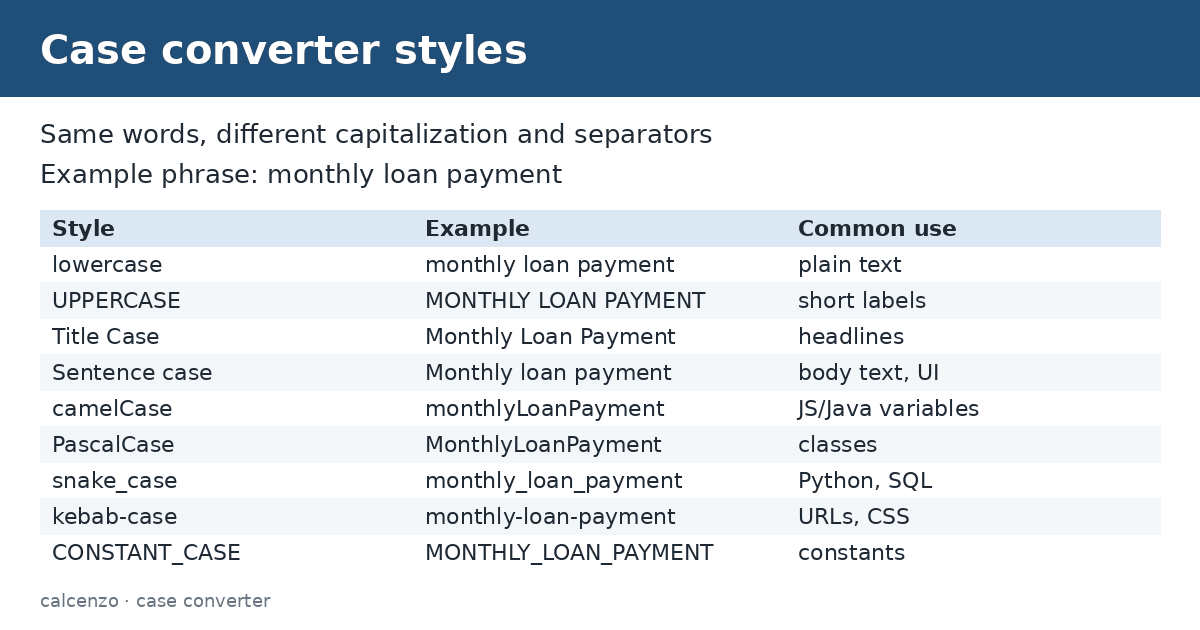
| Style | Rule | Example |
|---|---|---|
| lowercase | All letters small | monthly loan payment |
| UPPERCASE | All letters capital | MONTHLY LOAN PAYMENT |
| Title Case | First letter of each word capital | Monthly Loan Payment |
| Sentence case | First letter of the sentence capital | Monthly loan payment |
| camelCase | No spaces; first word lowercase, later words capitalized | monthlyLoanPayment |
| PascalCase | No spaces; every word capitalized | MonthlyLoanPayment |
| snake_case | Lowercase words joined by underscores | monthly_loan_payment |
| kebab-case | Lowercase words joined by hyphens | monthly-loan-payment |
| CONSTANT_CASE | Uppercase words joined by underscores | MONTHLY_LOAN_PAYMENT |
Conversion method
- Split the input into words at spaces, hyphens, underscores and lowercase-to-uppercase boundaries (so “monthlyLoan” splits into “monthly” and “Loan”).
- Change the letters of each word to the target pattern.
- Join the words with the target separator: a space, nothing, “_” or “-“.
When to use each style
- Title Case: headlines, page titles and book titles. Style guides such as AP and Chicago keep short words like “of” and “and” lowercase; a simple converter capitalizes every word, so check headlines by hand.
- Sentence case: body text, buttons and many UI labels.
- camelCase: variable and function names in JavaScript and Java.
- PascalCase: class and component names (for example, React components).
- snake_case: Python variables and database column names.
- kebab-case: URL slugs and CSS class names, such as /calculators/case-converter/.
- CONSTANT_CASE: constants and environment variables.
Case converter styles for programming
Style guides fix the case for each kind of name, so a consistent converter saves time when moving names between languages:
| Language or system | Variables and functions | Classes or types | Constants |
|---|---|---|---|
| Python (PEP 8) | snake_case | PascalCase (CapWords) | CONSTANT_CASE |
| JavaScript | camelCase | PascalCase | CONSTANT_CASE (by convention) |
| Java | camelCase | PascalCase | CONSTANT_CASE |
| CSS | kebab-case classes | — | — |
| SQL columns | snake_case (common) | — | — |
Title case rules and pitfalls
Style guides disagree about small words. AP style capitalizes words of four letters or more and lowercases short articles, conjunctions and prepositions; Chicago lowercases prepositions of any length. Both always capitalize the first and last word. Acronyms such as NASA and brand names such as iPhone should be fixed by hand after conversion, because a simple rule changes them. UPPERCASE text is also harder to read in long passages, so keep it for short labels.
A case converter is also handy for cleaning up pasted data: text copied from a PDF or spreadsheet often arrives in ALL CAPS, and converting uppercase to lowercase or Sentence case is quicker than retyping. Writers use a case converter to apply one headline style across a document, and developers rename database columns, API fields and file names in bulk.
Languages with special rules
Changing case is not always one letter for one letter. In German, the lowercase ß becomes “SS” in uppercase, so a word can get longer. Turkish has a dotted and a dotless i; the uppercase of i is İ, and the lowercase of I is ı. Programs that ignore the language setting get these wrong. Greek has a separate final sigma, ς, used only at the end of a word.
A case converter that works in the browser uses JavaScript’s built-in functions, which handle the German rule but use the default rules for Turkish unless a language is set. If you are working with Turkish text, check the result by eye.
Cleaning pasted text
A common job is fixing text that was typed in all caps, such as an old email or a spreadsheet export. Converting to sentence case gets most of the way, but proper nouns, acronyms and product names will be lowercased too. Read through and capitalize names like “Paris” or “NASA” by hand. For headings, title case is a better start, but small words such as “and”, “of” and “the” need checking against your style guide.
This is why a case converter is a starting point rather than a final step. For long documents, convert, then search for names and abbreviations you know appear in the text and fix them in one pass. Spreadsheet programs offer UPPER, LOWER and PROPER functions that behave like a case converter, but PROPER capitalizes every word, including small ones, so title case still needs a human check.
Related converters and calculators
Related tools:
- Password generator: random passwords
- Number base converter: binary, hex
- Base64 encoder and decoder: encode text
Sources
PEP 8: Style Guide for Python Code; Google Search Central: URL structure best practices; Google Java Style Guide.
Questions about this calculator
What is the difference between camelCase and PascalCase?
Both remove spaces and capitalize each new word. camelCase keeps the first word lowercase (loanAmount); PascalCase capitalizes it too (LoanAmount).
What is the difference between Title Case and Sentence case?
Title Case capitalizes the first letter of every word. Sentence case capitalizes only the first word and proper nouns.
Is snake_case or kebab-case better for URLs?
Google recommends hyphens rather than underscores to separate words in URLs, so kebab-case is the usual choice.
Does changing case alter my text?
Only the capitalization and separators change. The words and their order stay the same.
Which case does Python use?
PEP 8 uses snake_case for functions and variables, CapWords for classes and UPPER_CASE for constants.
Check the assumptions and units before relying on a result. Financial, tax and health estimates do not replace advice for your individual circumstances.
Report a calculation issue