
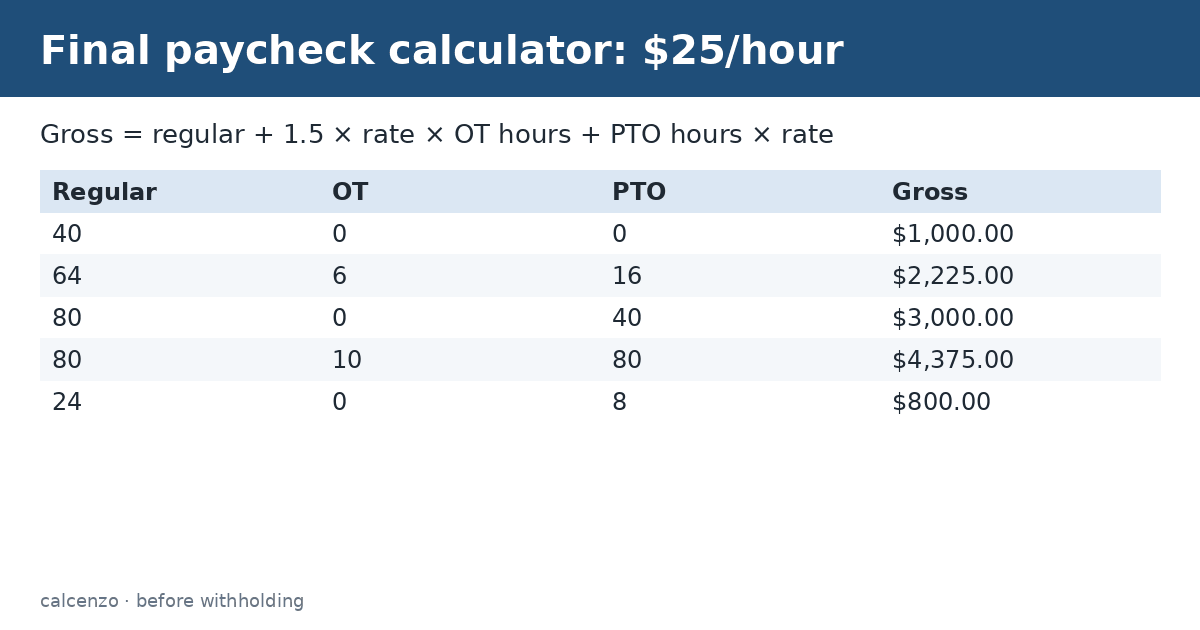
A final paycheck calculator adds up the wages you are owed when you leave a job: your last hours, overtime and any unused PTO. The final paycheck calculator uses this formula: Gross = rate×hours + 1.5×rate×OT + rate×PTO + other. Net = gross – deductions. At $25 an hour, 64 regular hours, 6 overtime hours and 16 hours of PTO make a gross final paycheck of $2,225.
On this page
How to use the final paycheck calculator
- Enter your hourly rate.
- Enter the regular and overtime hours not yet paid.
- Enter unused PTO hours if your state or employer pays them out.
- Enter any deductions and read the gross and estimated net pay.
What formula does the final paycheck calculator use?
- Regular pay = hourly rate × regular hours not yet paid
- Overtime pay = 1.5 × regular rate × overtime hours
- PTO payout = unused PTO hours × hourly rate, where owed
- Gross final pay = regular + overtime + PTO + other amounts owed − authorized deductions
Final paycheck calculator worked example
| Item | Hours | Amount |
|---|---|---|
| Regular pay at $25 | 64 | $1,600.00 |
| Overtime at $37.50 | 6 | $225.00 |
| PTO payout at $25 | 16 | $400.00 |
| Gross final paycheck | $2,225.00 |
Withholding then applies as usual: Social Security and Medicare are 7.65%, or $170.21 here, plus federal and state income tax. If your pay includes a shift differential or bonus, the overtime rate should use your blended regular rate, which the final paycheck calculator does not do automatically.
When is the final paycheck due?
The U.S. Department of Labor says federal law does not require employers to give former employees their final paycheck immediately, though some states do. Where state law is silent, the final pay is generally due by the next regular payday. State rules often differ between workers who quit and workers who are fired, and some require payment on the last day. Check your state labor department for the exact deadline and any penalty for late pay.
What is included
- All hours worked through the last day, including overtime, are wages you are owed.
- Unused vacation or PTO is included when state law or your employer’s policy requires it.
- Earned commissions and bonuses depend on the written plan.
- Deductions for uniforms or equipment cannot reduce pay below the federal minimum wage for non-exempt workers.
Salaried and tipped workers
If you are salaried, divide your salary by the number of pay periods to find each period’s pay, then prorate it for the days you worked in the last period. Exempt salaried employees are not owed overtime under the FLSA. Tipped workers should also receive tips earned on their final shifts, and credit card tips are usually paid through payroll. Commission earners should check the plan for how sales closed after the last day are treated.
If you are not paid
Contact your former employer in writing first and keep copies of time records and pay stubs. If wages remain unpaid, you can file a complaint with your state labor department or the DOL Wage and Hour Division, which enforces federal minimum wage and overtime rules.
Estimates for education only, not legal or tax advice. State law, your employer’s policy and any written agreement control the actual amount.
Deductions from a final paycheck
Employers sometimes try to recover costs from the last check, such as unreturned equipment, uniform charges or an advance. Federal law limits this for nonexempt workers: under the Fair Labor Standards Act, deductions for items that mainly benefit the employer cannot take pay below the minimum wage or cut into overtime owed. Many states go further and require written consent for any deduction, or ban some deductions altogether.
Take a worker owed $1,200 for 40 hours plus overtime. A $600 deduction for a laptop that was not returned could push pay for the period below the minimum wage once taxes are counted, which is not allowed. Use the final paycheck calculator to work out the gross amount owed first, then compare it with the stub. If deductions appear that you did not agree to in writing, ask for an explanation, and contact your state labor department if the final paycheck calculator figure and the actual payment do not match.
Related converters and calculators
Related calculators:
- PTO payout calculator: unused leave
- Severance pay calculator: severance
- COBRA cost calculator: health coverage
- Shift differential calculator: blended rate
Sources
U.S. DOL: Last paycheck; DOL Fact Sheet #23: Overtime pay; IRS Publication 15.
Questions about this calculator
When do I get my final paycheck?
Federal law does not require immediate payment; some states do. Otherwise it is generally due by the next regular payday.
Is unused PTO included?
Only if your state law or employer policy requires a payout.
Is overtime included in the final paycheck?
Yes. All overtime worked must be paid.
Can my employer hold my final paycheck until I return equipment?
Rules vary by state; deductions cannot cut a non-exempt worker below minimum wage.
What if I am not paid?
Contact the employer, then your state labor department or the DOL Wage and Hour Division.
Check the assumptions and units before relying on a result. Financial, tax and health estimates do not replace advice for your individual circumstances.
Report a calculation issue