
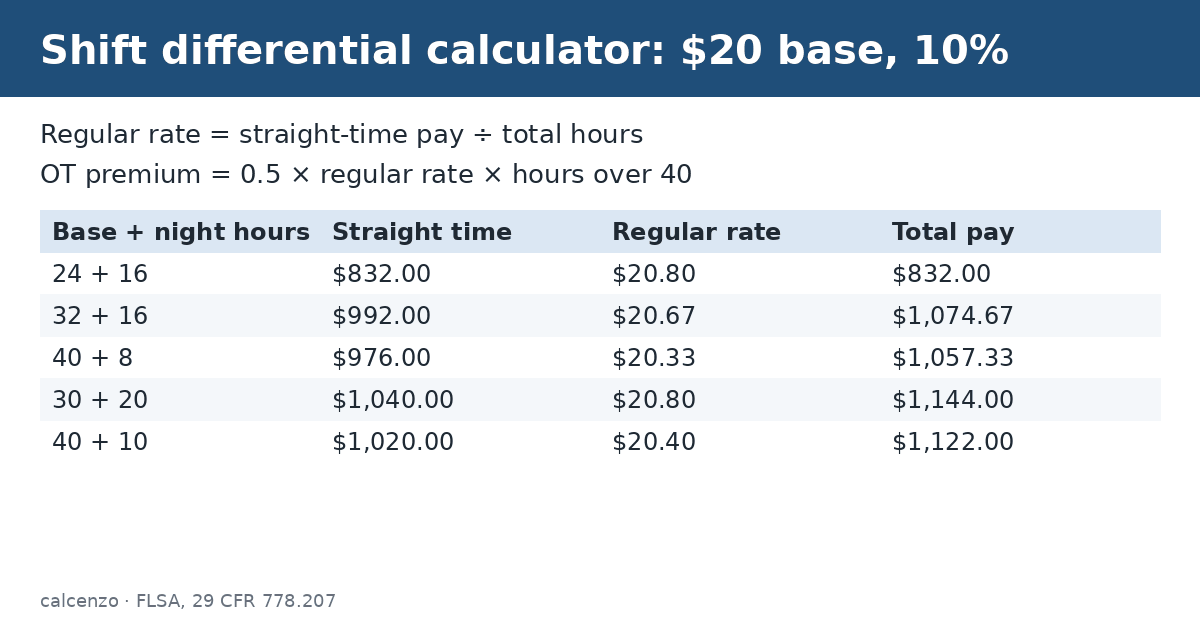
A shift differential calculator works out your pay when some hours earn a higher rate for nights, evenings or weekends, including overtime at the correct blended rate. Formula: Straight=base×base hrs+diff rate×diff hrs; OT premium=0.5×blended×max(0,total−40); weekly=straight+OT. With a $20 base and a 10% differential on 16 of 48 hours, weekly pay is $1,074.67, because federal law requires the differential to be included in the overtime rate.
On this page
How to use the shift differential calculator
- Enter your base hourly rate.
- Choose a percentage or flat differential and enter its value.
- Enter the hours worked at the differential and at the base rate in the week.
- Read the differential rate, blended regular rate, overtime premium and weekly, monthly and annual gross.
What formula does the shift differential calculator use?
- Differential rate = base rate × (1 + percent) or base rate + flat amount
- Straight-time pay = base rate × base hours + differential rate × differential hours
- Regular rate (blended) = straight-time pay ÷ total hours
- Overtime premium = 0.5 × regular rate × hours over 40
- Weekly pay = straight-time pay + overtime premium
Shift differential calculator worked example
A $20 base rate with a 10% night differential ($22 an hour):
| Week | Straight-time pay | Regular rate | Overtime premium | Total |
|---|---|---|---|---|
| 24 base + 16 night hours | $832.00 | $20.80 | $0 | $832.00 |
| 32 base + 16 night hours | $992.00 | $20.67 | 8 × 0.5 × $20.67 = $82.67 | $1,074.67 |
If the employer paid overtime at 1.5 × the $20 base rate only, the second week would total $1,072.00, $2.67 short. Over a year of similar weeks that gap adds up, and it is a common payroll error.
Why the differential counts in overtime
Under the Fair Labor Standards Act, overtime for non-exempt employees is at least 1.5 times the regular rate for hours over 40 in a workweek. Federal rules at 29 CFR 778.207 say shift differentials are part of the regular rate, so they must be included when overtime is calculated. When an employee works at two rates in one week, the regular rate is normally the weighted average of all straight-time pay divided by all hours worked.
Common types of shift differential
- Evening, night or weekend shifts, often paid as a percentage or a flat amount per hour.
- On-call or holiday premiums, which depend on how they are paid; some are excluded from the regular rate under the FLSA.
- Hazard or skill premiums tied to a type of work.
Federal law does not require employers to pay a shift differential; it is set by policy or agreement.
Checking your pay stub
Compare the overtime rate on your stub with the blended rate from the shift differential calculator. If overtime is at 1.5 × base only, ask payroll how the differential was included. State laws, such as daily overtime rules, can require more than the federal minimum; if you think you were underpaid, you can contact the Department of Labor’s Wage and Hour Division or your state labor agency.
Estimates for education only, not legal or tax advice. State law, your employer’s policy and any written agreement control the actual amount.
Flat versus percentage differentials
Employers pay shift premiums either as a flat amount per hour or as a percentage of base pay. The difference matters more as pay rises. A 10% night differential is worth $1.80 an hour on an $18 base and $3.00 on a $30 base, while a flat $2 premium is the same for everyone.
Over a year the totals add up. Two eight-hour night shifts a week for 50 weeks is 800 hours; a $2 differential adds $1,600 a year, and a 10% differential on $30 adds $2,400. When comparing job offers, put each premium into the shift differential calculator using your own base rate and expected schedule. Check whether the premium applies to every hour of a shift or only to hours after a set time, such as 11 p.m., because that changes the result of the shift differential calculator a great deal.
Related converters and calculators
Related calculators:
- Overtime tax calculator: overtime deduction
- Final paycheck calculator: last check
- Salary tax calculator: take-home pay
- PTO payout calculator: unused leave
Sources
29 CFR 778.207: Other types of contract premium pay; DOL Fact Sheet #23: Overtime pay requirements of the FLSA.
Questions about this calculator
Is shift differential included in overtime?
Yes. Under 29 CFR 778.207 it is part of the regular rate used for overtime.
How is the blended rate calculated?
Divide all straight-time pay for the week by all hours worked.
Is shift differential required by law?
No. Federal law does not require it; it comes from policy or agreement.
How much is a typical shift differential?
It varies by employer and industry; it may be a percentage or a flat amount per hour.
What if my overtime ignores the differential?
Ask payroll, then contact the Wage and Hour Division or your state labor agency if it is not corrected.
Check the assumptions and units before relying on a result. Financial, tax and health estimates do not replace advice for your individual circumstances.
Report a calculation issue