
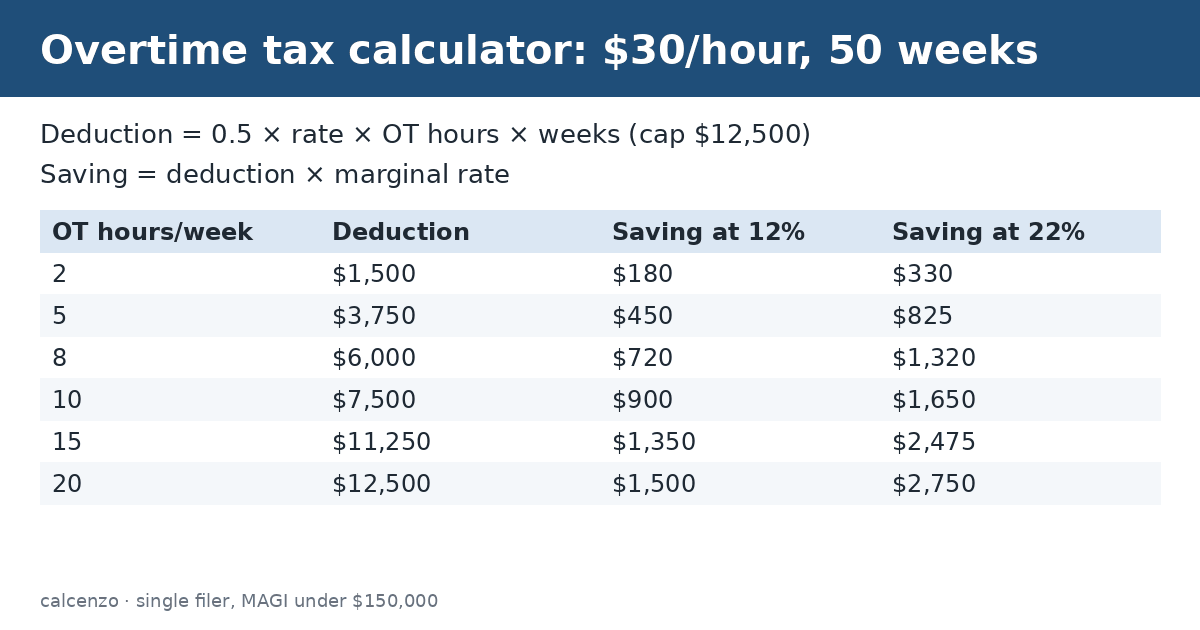
An overtime tax calculator estimates the federal “no tax on overtime” deduction and how much income tax it saves you. Formula: Premium=0.5×rate×OT_hours×weeks; deduction=max(0,min(premium,cap)−phaseout); savings=deduction×rate%. Only the premium part of time-and-a-half is deductible, up to $12,500 a year ($25,000 for joint filers). A worker paid $30 an hour with 8 overtime hours a week for 50 weeks can deduct $6,000, saving $1,320 in the 22% bracket.
On this page
How to use the overtime tax calculator
- Enter your regular hourly rate.
- Enter your average FLSA overtime hours per week and the weeks you expect to work them.
- Choose your filing status and enter your modified AGI.
- Enter your marginal federal tax rate and read the deduction and estimated saving.
What formula does the overtime tax calculator use?
- Total overtime pay = 1.5 × hourly rate × overtime hours per week × weeks
- Qualified overtime (the premium) = 0.5 × hourly rate × overtime hours × weeks
- Deduction = the premium, capped at $12,500 ($25,000 for joint filers), then reduced by $100 for each $1,000 of MAGI over $150,000 ($300,000 joint)
- Estimated tax saving = deduction × your marginal federal income tax rate
Overtime tax calculator worked example
A single filer earning $30 an hour works 8 overtime hours a week for 50 weeks:
| Item | Amount |
|---|---|
| Total overtime pay (1.5×) | $18,000 |
| Qualified overtime premium (0.5×) | $6,000 |
| Deduction (under the $12,500 cap) | $6,000 |
| Saving in the 22% bracket | $1,320 |
| Saving in the 12% bracket | $720 |
If the same worker’s MAGI were $160,000, the deduction would be cut by $1,000 to $5,000. Only the premium is deductible; the base pay for those hours ($12,000) stays taxable.
Who qualifies for the overtime deduction
The IRS says the deduction applies for tax years 2025 through 2028 to qualified overtime compensation: overtime required by section 7 of the Fair Labor Standards Act that exceeds your regular rate, generally the “half” of time-and-a-half. You need a valid Social Security number, married couples must file jointly, and you can claim it whether you itemize or take the standard deduction. It is claimed on Schedule 1-A of Form 1040.
What does not count
- Overtime paid only because of state law, a union contract or company policy (for example daily overtime or double time beyond what the FLSA requires).
- The straight-time portion of overtime hours.
- Extra pay received by exempt salaried employees, who are not entitled to FLSA overtime in the first place.
- Social Security, Medicare and most state income taxes, which still apply to all overtime pay.
Reporting and records
Employers report qualified overtime on Form W-2 or Form 1099. For 2025, the IRS gave transition relief, so the amount may not be listed separately; the Schedule 1-A instructions explain how to work it out from pay stubs. Keep stubs that show your regular rate and overtime hours. The overtime tax calculator assumes the same overtime every week; if your hours vary, enter the yearly average. With two jobs, add the qualified overtime from both; the annual cap applies to the total on your return.
Estimates for education only, not tax, legal or financial advice. Check current rules with the tax authority or a qualified adviser.
Worked example: an hourly worker
Take a worker paid $25 an hour who works 300 overtime hours in a year at time and a half. Overtime pay is 300 × $37.50 = $11,250. Under the deduction for qualified overtime for tax years 2025 through 2028, only the premium portion counts: the extra half-time, or 300 × $12.50 = $3,750. That is well under the $12,500 cap for a single filer.
In the 22% bracket, a $3,750 deduction lowers federal income tax by about $825. Social Security and Medicare are still due on all the overtime pay, and state income tax may still apply. The overtime tax calculator shows this split so you can see which part of the paycheck the deduction affects. If your income is above the phase-out range, the deduction shrinks, so enter your full income in the overtime tax calculator rather than overtime alone.
Related converters and calculators
Related calculators:
- Shift differential calculator: blended rate
- Income tax calculator: federal tax
- Salary tax calculator: take-home
- Final paycheck calculator: last check
Tips are handled separately: the no tax on tips calculator estimates that deduction.
Sources
IRS: What to know about the No Tax on Overtime deduction; IRS: How to take advantage of no tax on tips and overtime; IRS Publication 6133.
Questions about this calculator
Is overtime tax-free now?
Not completely. From 2025 to 2028 you can deduct the overtime premium (the half in time-and-a-half), up to $12,500 or $25,000 joint, from federal taxable income.
Do I still pay Social Security on overtime?
Yes. Payroll taxes and most state income taxes still apply.
Does the deduction phase out?
Yes, above MAGI of $150,000 ($300,000 joint).
Do I need to itemize?
No. It is available with the standard deduction.
Does state-law daily overtime count?
No. Only overtime required by the federal FLSA qualifies.
Check the assumptions and units before relying on a result. Financial, tax and health estimates do not replace advice for your individual circumstances.
Report a calculation issue