
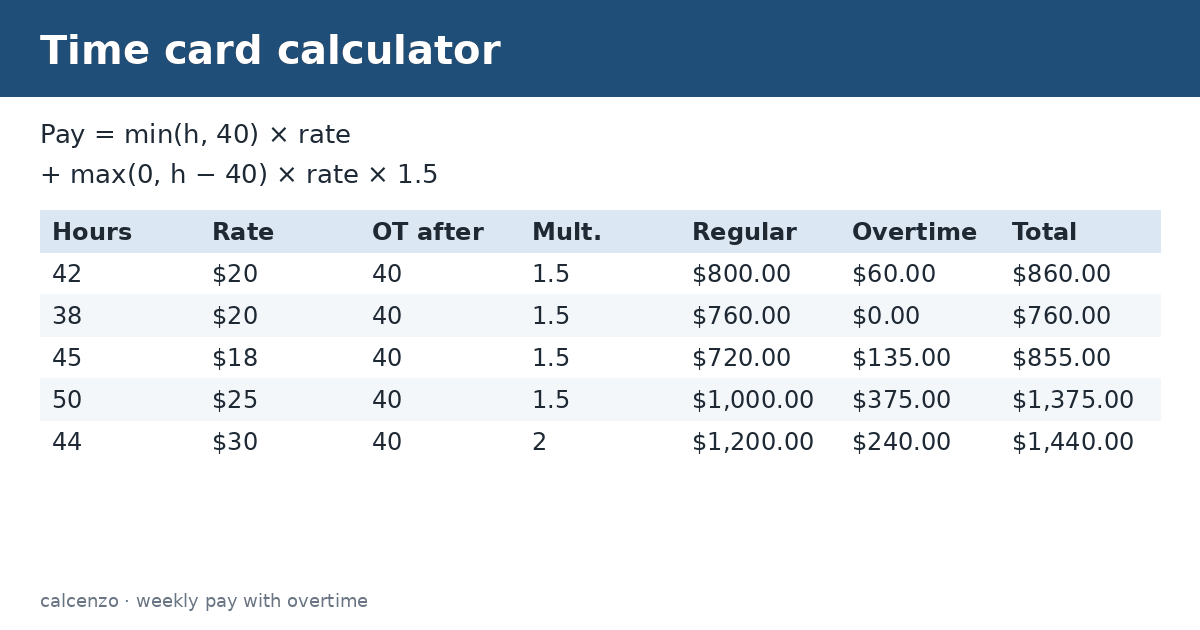
A time card calculator turns the hours on your timesheet into gross pay, including overtime. Formula: Regular hours = min(hours, ot after). OT hours = max(0, hours – ot after). Pay = regular x rate + OT x rate x ot mult. 42 hours at $20 an hour with time and a half after 40 hours is $860.
On this page
How to use the time card calculator
- Enter total hours worked in the week, in decimal hours.
- Enter your hourly rate.
- Check the overtime threshold and multiplier.
- Read regular, overtime and total pay.
How the time card calculator works
The time card calculator turns total hours worked in a week into gross pay. Regular hours are the smaller of hours worked and the overtime threshold. Overtime hours are anything above the threshold. Pay = regular hours × rate + overtime hours × rate × multiplier. The defaults are a 40-hour threshold and a 1.5 multiplier, which match the federal rule for non-exempt employees.
Time card calculator worked example
An employee works 42 hours at $20 an hour. The first 40 hours pay $800. The two extra hours pay $20 × 1.5 × 2 = $60. The time card calculator shows $860 gross. At 38 hours there is no overtime and pay is $760.
| Hours | Rate | OT after | Mult. | Regular | Overtime | Total |
|---|---|---|---|---|---|---|
| 42 | $20 | 40 | 1.5 | $800.00 | $60.00 | $860.00 |
| 38 | $20 | 40 | 1.5 | $760.00 | $0.00 | $760.00 |
| 45 | $18 | 40 | 1.5 | $720.00 | $135.00 | $855.00 |
| 50 | $25 | 40 | 1.5 | $1,000.00 | $375.00 | $1,375.00 |
| 44 | $30 | 40 | 2 | $1,200.00 | $240.00 | $1,440.00 |
Federal overtime rules
Under the Fair Labor Standards Act, covered non-exempt employees must get at least one and a half times their regular rate for hours over 40 in a workweek. The workweek is a fixed, recurring period of 168 hours; hours are not averaged across two weeks. The law does not require overtime for weekends or holidays as such, and some employees, such as many salaried professionals, are exempt.
Daily overtime and state rules
Some states set stricter rules, such as daily overtime after 8 hours or double time after 12 hours. This tool uses one weekly threshold and one multiplier. To estimate double time, run the time card calculator again with the extra hours and a multiplier of 2, or use your state’s rules to split the hours first. Union contracts can also set their own rates.
Adding up hours worked
Hours worked include time you are required to be on duty or at the workplace. Short breaks of about 5 to 20 minutes are generally counted as paid time under federal rules, while bona fide meal periods of 30 minutes or more when you are fully relieved usually are not. Convert minutes to decimal hours before entering them: 41 hours 30 minutes is 41.5 hours.
Gross pay, not take-home pay
The result is gross pay before taxes and deductions. Federal and state income tax, Social Security, Medicare and benefit deductions come out of it. Bonuses and shift differentials can also change the regular rate used for overtime.
The regular rate of pay
Overtime under federal law is based on the regular rate, which is not always the same as the posted hourly wage. Nondiscretionary bonuses, shift premiums and some commissions earned in the week must be added to straight-time pay and divided by total hours to find the regular rate. That rate then sets the overtime premium. For example, a $40 production bonus in a 40-hour week adds $1 an hour to the regular rate.
The time card calculator uses the hourly rate you enter as the regular rate. If you receive such extras, work out the regular rate first and enter that figure, or compare the result with your pay stub to see how your employer handled it.
Tips
- Keep your own record of start and end times.
- Enter decimal hours, such as 7.75 for 7 hours 45 minutes.
- The threshold must be 0 to 168 hours and the multiplier 1 to 3; other values are rejected.
- Compare the result with your pay stub each period.
Estimates for education only, not financial advice. Your lender’s figures are final.
Related converters and calculators
Related calculators:
- Hours calculator: clock hours
- Overtime tax calculator: tax on overtime
- Shift differential calculator: night pay
- Time calculator: add hours
Sources
U.S. Department of Labor: Overtime pay; DOL Fact Sheet #22: Hours worked under the FLSA.
Formula and method
Regular hours = min(hours, ot_after). OT hours = max(0, hours - ot_after). Pay = regular x rate + OT x rate x ot_mult.
Splits hours at the overtime threshold, pays regular rate on the first slice and rate times multiplier on the overtime slice.
Questions about this calculator
How is overtime calculated?
Hours over the threshold × rate × multiplier.
What is the federal overtime threshold?
40 hours in a workweek for non-exempt employees.
Are breaks paid?
Short breaks usually are; meal periods of 30 minutes or more usually are not.
Does it handle daily overtime?
No, only one weekly threshold.
Is the result take-home pay?
No, it is gross pay before deductions.
Check the assumptions and units before relying on a result. Financial, tax and health estimates do not replace advice for your individual circumstances.
Report a calculation issue