
A half life calculator finds how much of a substance remains after a period of time, given its starting amount and its half-life. Formula: remaining = initial x (1/2)^(time / half). 100 grams with a 5-year half-life leaves 12.5 grams after 15 years.
On this page
How to use the half life calculator
- Enter the starting amount.
- Enter the half-life.
- Enter the elapsed time in the same units.
- Read the amount remaining.
What is the half-life formula?
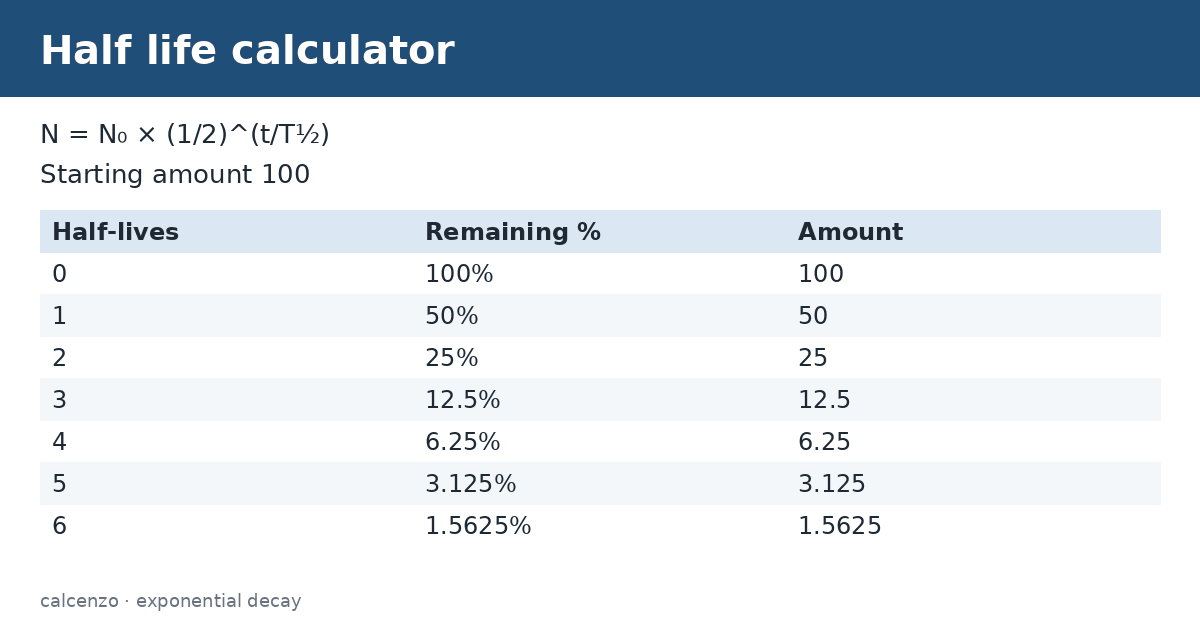
A half-life is the time it takes for half of a quantity to decay or be eliminated. After one half-life, 50% remains; after two, 25%; after three, 12.5%. The half life calculator uses the exponential decay formula:
- N(t) = N₀ × (1/2)t ÷ T½
- N₀ = starting amount, T½ = half-life, t = elapsed time
- The time units for t and T½ must match
Half life calculator worked example
Start with 100 grams of a substance whose half-life is 5 years. After 15 years, three half-lives have passed: 100 × (1/2)3 = 12.5 grams remain. After 7 years, which is 1.4 half-lives, 100 × 0.51.4 = 37.9 grams remain.
| Half-lives passed | Percent remaining | Amount left from 100 |
|---|---|---|
| 0 | 100% | 100 |
| 1 | 50% | 50 |
| 2 | 25% | 25 |
| 3 | 12.5% | 12.5 |
| 4 | 6.25% | 6.25 |
| 5 | 3.125% | 3.125 |
| 6 | 1.5625% | 1.5625 |
Solving for time or half-life
Rearranging the formula with logarithms lets you solve for other values:
- Time to reach N: t = T½ × log₂(N₀ ÷ N)
- Half-life from two measurements: T½ = t × ln 2 ÷ ln(N₀ ÷ N)
- Decay constant: λ = ln 2 ÷ T½, so N(t) = N₀e−λt
For example, falling from 100 to 10 takes log₂(10) = 3.32 half-lives.
Real half-lives
- Carbon-14: about 5,730 years, used in radiocarbon dating of once-living material.
- Iodine-131: about 8 days, used in thyroid treatment.
- Technetium-99m: about 6 hours, widely used in medical imaging.
- Uranium-238: about 4.5 billion years, roughly the age of Earth.
Radioactive decay is random for each atom, but with huge numbers of atoms the overall amount follows the formula very closely.
Half-life of medicines
Drugs also have elimination half-lives. A common rule of thumb is that it takes about 4 to 5 half-lives for most of a drug to leave the body, since after 5 half-lives about 3% remains. Real elimination varies with age, liver and kidney function and other medicines, so use the half life calculator only to understand the idea and follow your prescriber’s or pharmacist’s instructions for dosing.
Radiocarbon dating example
If a wooden artifact has 25% of the carbon-14 found in living wood, two half-lives have passed, so it is about 2 × 5,730 = 11,460 years old. Real labs calibrate results against tree rings and other records because atmospheric carbon-14 has varied over time.
Doubling time
The same math runs in reverse for growth. Something that doubles every T years grows as N₀ × 2t ÷ T. Enter a negative elapsed time in the half life calculator to see what the amount was before, which is the same as doubling.
Working through half-life problems
Most half-life questions follow the same steps. First, make sure the elapsed time and the half-life are in the same units; convert days to hours or years to days if needed. Second, divide the time by the half-life to find how many half-lives have passed. Third, raise one half to that power and multiply by the starting amount. For whole numbers of half-lives you can do this in your head by halving repeatedly: 80 → 40 → 20 → 10 after three half-lives.
For fractional half-lives, the half life calculator does the exponent for you. A useful check is that the answer must lie between the values for the whole numbers of half-lives on either side: after 1.4 half-lives, the remaining amount must be between 50% and 25% of the start, and the calculator’s 37.9% fits.
Does anything ever reach zero?
Mathematically, halving never reaches zero; the amount only gets smaller and smaller. In practice, after about 10 half-lives less than 0.1% remains, which is often treated as effectively gone. For radioactive material, that point depends on how much there was to begin with.
Related converters and calculators
Related calculators:
- Exponent calculator: powers
- Log calculator: logarithms
- Scientific calculator: math
- Compound interest calculator: growth
Sources
Questions about this calculator
What is a half-life?
The time for half of a quantity to decay.
How much is left after 3 half-lives?
12.5%.
What is the half-life formula?
N = N₀ × (1/2)^(t ÷ T½).
What is the half-life of carbon-14?
About 5,730 years.
Do units matter?
Time and half-life must use the same units.
Check the assumptions and units before relying on a result. Financial, tax and health estimates do not replace advice for your individual circumstances.
Report a calculation issue