
This heat transfer coefficient converter changes a heat transfer coefficient or U-value between watts per square meter kelvin and BTU per hour square foot degree Fahrenheit. Formula: 1 Btu(IT)/(h·ft²·°F) ≈ 5.678263341 W/(m²·K). The SI unit is W/(m²·K). 1 BTU/(h·ft²·°F) is about 5.67826 W/(m²·K), so 1 W/(m²·K) is about 0.176110 BTU/(h·ft²·°F).
On this page
How to use the heat transfer coefficient converter
- Enter the value, for example 0.30 from a US window label.
- In the heat transfer coefficient converter, choose its unit and the target unit.
- Read the heat transfer coefficient converter result: U-0.30 ≈ 1.70 W/(m²·K).
The same unit describes surface convection coefficients (h) and whole-assembly U-values; only the meaning differs.
What is heat transfer coefficient?
The heat transfer coefficient describes how much heat passes between a surface and a fluid per unit area per degree of temperature difference, in W/(m²·K) in SI. It is used for heat exchangers, radiators and insulation (U-values).
Conversion formula
The heat transfer coefficient converter stores every unit as a multiple of the base unit, the watt per square meter kelvin (W/(m²·K)). To convert:
value in target unit = value × (factor of source unit ÷ factor of target unit)
where each factor is the size of the unit in watts per square meter kelvin.
Common heat transfer coefficient conversions
| From | To | 1 unit equals |
|---|---|---|
| BTU per hour square foot Fahrenheit (BTU/(h·ft²·°F)) | watt per square meter kelvin (W/(m²·K)) | 5.678263 W/(m²·K) |
| watt per square meter kelvin (W/(m²·K)) | BTU per hour square foot Fahrenheit (BTU/(h·ft²·°F)) | 0.1761102 BTU/(h·ft²·°F) |
Heat transfer coefficient converter worked example
Convert 25 BTUs per hour square foot Fahrenheit to watts per square meter kelvin:
- Factor of BTU/(h·ft²·°F) = 5.678263 W/(m²·K)
- Factor of W/(m²·K) = 1 W/(m²·K)
- 25 × 5.678263 ÷ 1 = 141.9566 W/(m²·K)
Heat transfer coefficient unit reference
| Unit | Symbol | Group | Equals (W/(m²·K)) |
|---|---|---|---|
| Watt per Square Meter Kelvin | W/(m²·K) | SI | 1 |
| Watt per Square Meter Celsius | W/(m²·°C) | Common | 1 |
| Kilowatt per Square Meter Kelvin | kW/(m²·K) | SI | 1,000 |
| BTU per Hour Square Foot Fahrenheit | BTU/(h·ft²·°F) | US | 5.678263 |
| Calorie per Second Square Centimeter Celsius | cal/(s·cm²·°C) | CGS | 41,840 |
Reverse factors for each heat transfer coefficient unit
The reference table gives each unit in watt per square meter kelvins. To go the other way, divide by that factor; the list below does the division for you.
- Watt per Square Meter Kelvin (W/(m²·K)), SI: 1 W/(m²·K) = 1 W/(m²·K, so 1 W/(m²·K = 1 W/(m²·K).
- Watt per Square Meter Celsius (W/(m²·°C)), Common: 1 W/(m²·°C) = 1 W/(m²·K, so 1 W/(m²·K = 1 W/(m²·°C).
- Kilowatt per Square Meter Kelvin (kW/(m²·K)), SI: 1 kW/(m²·K) = 1,000 W/(m²·K, so 1 W/(m²·K = 0.001 kW/(m²·K).
- BTU per Hour Square Foot Fahrenheit (BTU/(h·ft²·°F)), US: 1 BTU/(h·ft²·°F) = 5.678263 W/(m²·K, so 1 W/(m²·K = 0.1761102 BTU/(h·ft²·°F).
- Calorie per Second Square Centimeter Celsius (cal/(s·cm²·°C)), CGS: 1 cal/(s·cm²·°C) = 41,840 W/(m²·K, so 1 W/(m²·K = 2.39006 × 10⁻⁵ cal/(s·cm²·°C).
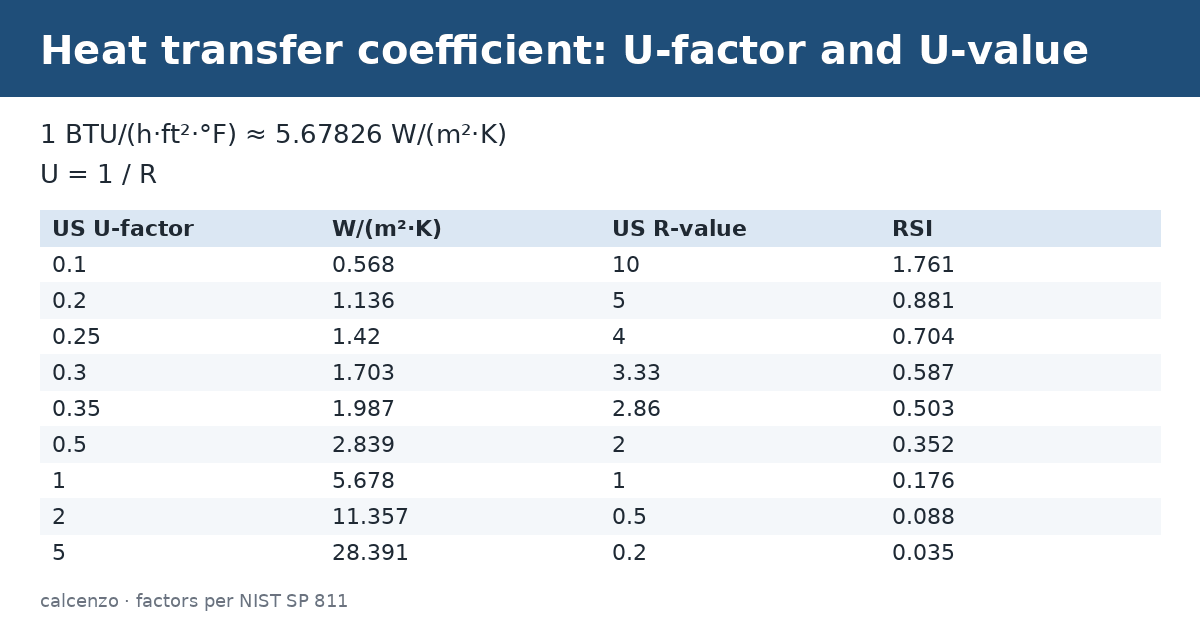
Window U-factor to U-value
US window labels give the U-factor in BTU/(h·ft²·°F), while Europe and Canada use W/(m²·K). For U-factor to U-value, multiply by 5.67826. The R-value of the assembly is the reciprocal of the U-factor:
| US U-factor (BTU/(h·ft²·°F)) | U-value (W/(m²·K)) | R-value |
|---|---|---|
| 0.2 | 1.14 | 5 |
| 0.25 | 1.42 | 4 |
| 0.27 | 1.53 | 3.7 |
| 0.3 | 1.7 | 3.33 |
| 0.35 | 1.99 | 2.86 |
| 0.5 | 2.84 | 2 |
| 1 | 5.68 | 1 |
Lower U means less heat loss. The ENERGY STAR and NFRC labels show the US U-factor.
U-value, R-value and heat loss
U = 1 / R for a whole assembly. Heat loss is U × area × ΔT: a 2 m² window at 1.70 W/(m²·K) with a 20 K difference loses about 68 W. Heat flux per square meter is U × ΔT; see the heat flux converter.
Typical coefficient ranges
Convection coefficients cover a wide range, and textbooks give rough bands rather than single values. Still air over a wall, by natural convection, is in the range of about 2 to 25 W/(m²·K). Forced air from a fan is about 25 to 250. Forced water flow runs from about 100 to 20,000, and boiling or condensing water can be higher still.
US references use BTU/(h·ft²·°F). One of those is about 5.678 W/(m²·K), so 10 W/(m²·K) is about 1.76 in US units. The heat transfer coefficient converter applies that factor both ways.
Because these values are so spread out, carry two significant figures at most unless you have measured data.
Related converters and calculators
Related heat transfer tools:
- Heat flux converter: W/m²
- Thermal resistance converter: K/W and R-value
- Thermal conductivity converter: W/(m·K)
- Temperature difference converter: ΔC and ΔF
- BTU calculator: room heating and cooling
Sources
NIST Special Publication 811, Appendix B; ENERGY STAR: Windows, doors and skylights criteria.
Questions about this calculator
What is the SI unit of heat transfer coefficient?
Watt per square meter kelvin, W/(m²·K).
How do I convert W/m²K to BTU/h·ft²·°F?
Multiply by 0.176110. For example, 1.4 W/(m²·K) = 0.247 BTU/(h·ft²·°F).
How do I convert a US U-factor to a metric U-value?
Multiply by 5.67826. U-0.27 is about 1.53 W/(m²·K).
What is the relationship between U-value and R-value?
U = 1/R. A U-factor of 0.25 corresponds to R-4 in US units.
Is a lower U-value better?
Yes. A lower U-value means less heat flows through the element for each degree of temperature difference.
Check the assumptions and units before relying on a result. Financial, tax and health estimates do not replace advice for your individual circumstances.
Report a calculation issue