
To convert inches to mm, multiply by 25.4: one inch is defined as exactly 25.4 millimeters. For example, 2 in = 50.8 mm, and 3/4 in = 19.05 mm.
On this page
How to use the inches to mm converter
- Enter the length in inches, for example 1.375.
- Read the inches to mm converter result: 1.375 × 25.4 = 34.925 mm.
- For a fraction, divide first: 5/16 in = 0.3125 in = 7.9375 mm.
What is the inches to MM formula?
millimeters = inches × 25.4
The reverse is inches = millimeters × 0.039370079 (approximately).
The inch, foot, yard and mile are defined exactly in meters (1 in = 2.54 cm, 1 ft = 0.3048 m, 1 yd = 0.9144 m, 1 mi = 1,609.344 m), so these factors are exact.
What are inches and millimeters?
Length measures distance. The SI base unit is the meter. Since 1959 the international inch has been defined as exactly 2.54 cm, so the foot is exactly 0.3048 m and the mile exactly 1,609.344 m.
- Inch (in): 1 in = 0.0254 m (US/Imperial unit).
- Millimeter (mm): 1 mm = 0.001 m (Metric unit).
Inches to mm worked examples
- A 1/2-inch bolt: 0.5 × 25.4 = 12.7 mm
- 3/4-inch plywood (nominal): 0.75 × 25.4 = 19.05 mm
- A 2-inch pipe size label: 2 × 25.4 = 50.8 mm
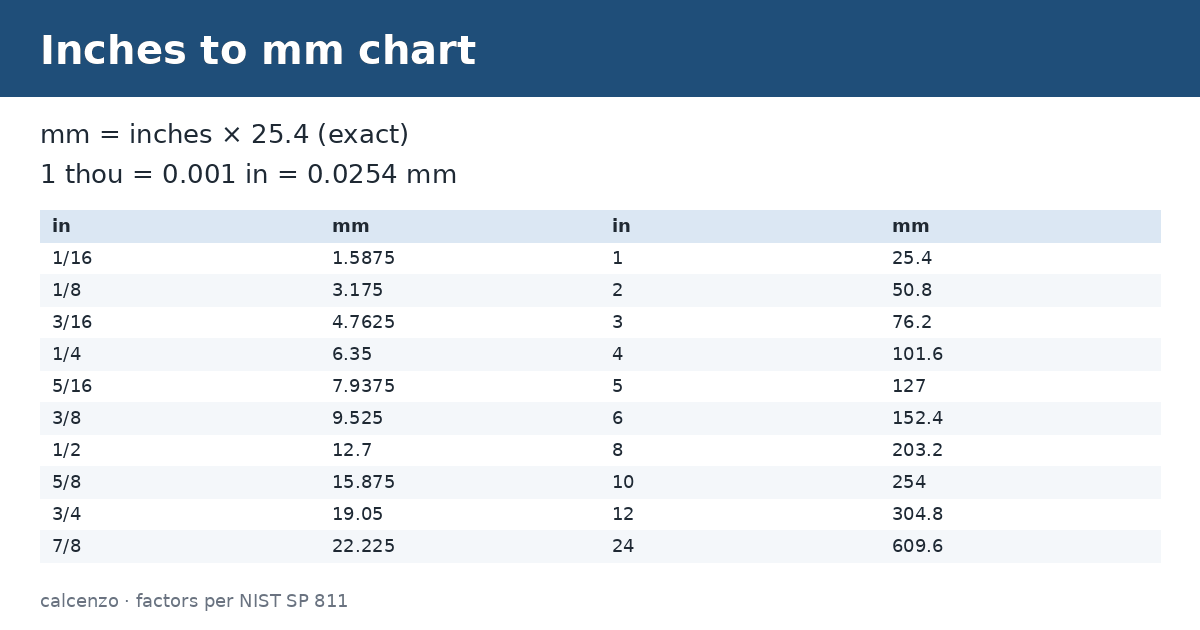
Conversion chart
| in | mm | in | mm |
|---|---|---|---|
| 0.0625 | 1.5875 | 1.5 | 38.1 |
| 0.125 | 3.175 | 2 | 50.8 |
| 0.25 | 6.35 | 3 | 76.2 |
| 0.375 | 9.525 | 4 | 101.6 |
| 0.5 | 12.7 | 6 | 152.4 |
| 0.625 | 15.875 | 8 | 203.2 |
| 0.75 | 19.05 | 10 | 254 |
| 1 | 25.4 | 12 | 304.8 |
Values are rounded to four decimal places, or two for results of 100 or more.
Quick mental conversion
Multiply by 25 for a quick estimate, then add 1.6%: 4 in ≈ 100 mm (exact 101.6 mm).
Nominal sizes are not always actual sizes
Lumber and pipe sizes are names, not measurements. A 2×4 board is about 1.5 × 3.5 in (38 × 89 mm), and plywood sold as 3/4 in is often slightly thinner. Measure the actual piece before converting.
Inches from millimeters: reverse chart
Going the other way, inches = millimeters × 0.039370079. Common values:
| millimeters | inches |
|---|---|
| 1 | 0.03937008 |
| 2 | 0.07874016 |
| 5 | 0.1968504 |
| 10 | 0.3937008 |
| 20 | 0.7874016 |
| 50 | 1.968504 |
| 100 | 3.937008 |
| 500 | 19.68504 |
| 1,000 | 39.37008 |
Fractional inch sizes in mm
Fractional drills, sockets and bolts in mm:
| Fraction | Decimal inch | mm |
|---|---|---|
| 1/64 | 0.015625 | 0.3969 |
| 1/32 | 0.03125 | 0.7937 |
| 1/16 | 0.0625 | 1.5875 |
| 1/8 | 0.125 | 3.175 |
| 3/16 | 0.1875 | 4.7625 |
| 1/4 | 0.25 | 6.35 |
| 5/16 | 0.3125 | 7.9375 |
| 3/8 | 0.375 | 9.525 |
| 1/2 | 0.5 | 12.7 |
| 5/8 | 0.625 | 15.875 |
Because 25.4 is exact, these values are exact too.
Thou to mm for tolerances
Machinists measure in thousandths of an inch, called thou or mils. 1 thou = 0.0254 mm = 25.4 µm, so a ±0.005 in tolerance is ±0.127 mm, and 0.1 mm is about 3.94 thou. Sheet and wire thickness are often quoted this way. Use the mm to inches converter for the reverse and the inches to cm converter for longer lengths.
Tolerances and small parts
Engineering drawings often state tolerances in thousandths of an inch. A tolerance of ±0.005 in is ±0.127 mm, so a part drawn at 1.000 ± 0.005 in must measure between 25.27 and 25.53 mm. When you convert, keep the tolerance in the same units as the size so the band does not shift through rounding.
Bike parts show how inch sizes live on in metric design. A 1-1/8 inch steerer tube is 28.6 mm, and headset makers list both values. Camera tripods use a 1/4-20 screw, which is 6.35 mm across, and larger heads use 3/8-16, which is 9.525 mm. An inches to mm conversion tells you why a metric M6 bolt will not quite fit a 1/4 inch thread.
Sheet metal and wire gauges are not inches at all, so look up the gauge table before converting. Once you have the thickness in inches, an inches to mm conversion gives the metric value, and from there you can match it to metric stock sizes. A 16 gauge steel sheet, for example, is about 0.0598 in, or 1.52 mm, which is usually replaced by 1.5 mm metric sheet. Keep the original inch value on the drawing for reference.
Related converters and calculators
Related conversions:
- mm to inches: mm to in
- Inches to cm: in to cm
- Inches to feet: in to ft
- Typography unit converter: pt and px
- Length converter: all length units
Sources
NIST Special Publication 811, Appendix B; NIST: SI units – length.
Questions about this calculator
How many mm are in an inch?
25.4 mm exactly.
How do I convert inches to mm?
Multiply by 25.4. For example, 0.5 in = 12.7 mm.
What is 1/4 inch in mm?
6.35 mm.
What is a thou in mm?
0.0254 mm (25.4 µm).
What is 3/8 inch in mm?
9.525 mm.
Check the assumptions and units before relying on a result. Financial, tax and health estimates do not replace advice for your individual circumstances.
Report a calculation issue